Loan Covenants: Track Your Headroom and Talk to the Bank Before a Breach
The types of loan covenants, how far your DSCR and debt-to-equity can move before a breach, what a breach does to your financial statements, and what to bring when you ask the bank for a waiver.
In this article
A business term loan usually comes with duties that last for the life of the loan, beyond paying principal and interest on time. Keep the debt ratio under a limit. Deliver financial statements by a deadline. Take on no new debt without consent. These conditions are called covenants. Many companies sign the agreement and never open it again, until the day the bank says they are in breach, even though every installment has been paid.
This article covers the types of covenants, the common formulas, how to calculate your headroom with a worked example, what a breach does to the loan and to your financial statements, and how to approach the bank before it is too late.
Types of covenants
The Corporate Finance Institute (CFI) defines debt covenants as restrictions that lenders put on lending agreements to limit the actions of the borrower. They fall into these broad groups.
| Type | What it means | Examples |
|---|---|---|
| Affirmative covenant | Things the borrower must do | Deliver audited financial statements every year, keep assets in good condition, keep financial ratios within limits |
| Negative covenant | Things the borrower may not do without consent | Pay dividends above a limit, borrow more, merge or buy another business |
| Financial covenant | Ratios the borrower must keep within limits | DSCR not below a floor, debt to equity not above a ceiling |
Negative covenants are easy to breach without noticing. A company leases a vehicle on hire purchase or opens a credit line at another bank without realizing the existing loan bars new debt, or pays a large dividend before checking the limit in the agreement.
Common financial covenants
CFI lists the ratios lenders use most, including debt to EBITDA, interest coverage, debt to equity, debt to assets and a minimum tangible net worth. For SMEs borrowing from banks, these come up most often:
- Debt service coverage ratio (DSCR). Operating cash flow compared with the principal and interest due. CFI says many small and middle market commercial lenders set a minimum DSCR covenant of not less than 1.25x. For the full calculation, see Preparing an SME Loan Application.
- Debt to equity (D/E). Some agreements use total liabilities, others only interest-bearing debt.
- Debt to EBITDA. Interest-bearing debt compared with earnings before interest, taxes, depreciation and amortization.
- Current ratio. See its meaning and pitfalls in Liquidity Ratios.
The key point: the formula that counts is the one written in your agreement, not the textbook one. The agreement may say which items can be added back to EBITDA, which debts count, whether figures are trailing 12 months or annual, and whether the test uses audited or management accounts. Copy the definitions from the agreement into your own spreadsheet.
Calculate your headroom
Passing today is not enough. You need to know how far the numbers can move before you breach.
Illustrative example: a manufacturer has a term loan that requires a DSCR of at least 1.25x and debt to equity of no more than 2.0x. Assume the agreement uses CFI's formula, DSCR = (EBITDA − cash taxes) ÷ (principal + interest). The latest 12 months look like this.
| Item | Current figure | Covenant | Room to move before a breach |
|---|---|---|---|
| EBITDA | 10.0 | — | — |
| Cash taxes | 0.6 | — | — |
| Principal + interest per year | 6.0 | — | — |
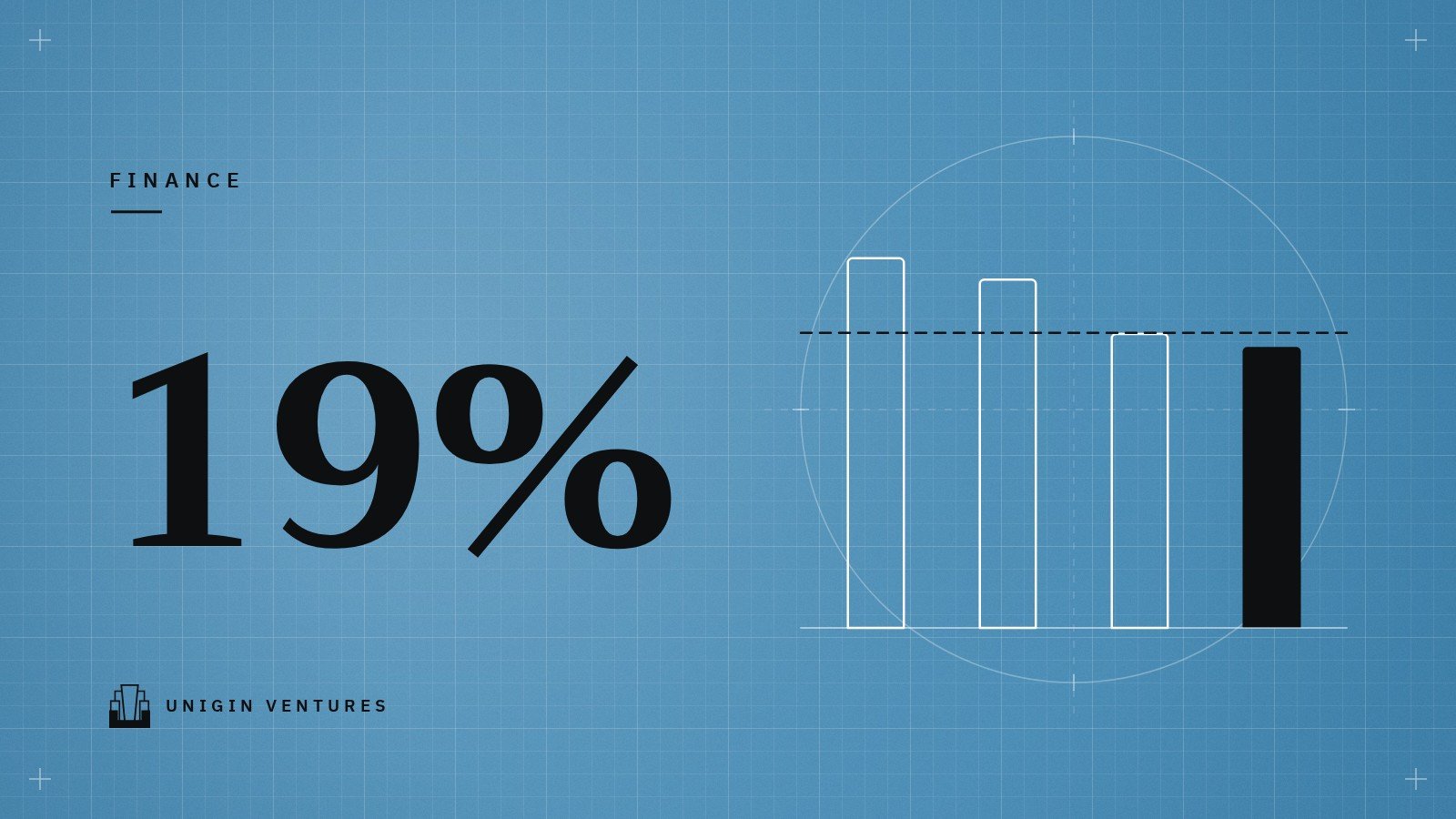
| DSCR | 1.57x | At least 1.25x | EBITDA can fall 1.9 million baht, or 19% |
| Debt ÷ equity | 24.0 ÷ 15.0 = 1.60x | No more than 2.0x | Equity can fall 3.0 million baht |
Lowest EBITDA that still passes = 1.25 × 6.0 + 0.6 = 8.1 million baht. Headroom = (10.0 − 8.1) ÷ 10.0 = 19%
Lowest equity that still passes = 24.0 ÷ 2.0 = 12.0 million baht. Headroom = 15.0 − 12.0 = 3.0 million baht
The company looks safe. But if it borrows another 6.0 million baht for a machine, adding 1.5 million baht a year in principal and interest, both covenants move right to the edge. Debt to equity becomes 30.0 ÷ 15.0 = 2.0x exactly, and DSCR drops to 9.4 ÷ 7.5 = 1.25x. One loss-making month or one weak quarter could trigger a breach. If the existing agreement bars new debt, the company also needs the current lender's consent before taking the new loan.
Run four cases to see it clearly. Assume cash taxes stay at 0.6 million baht, and the bad case is EBITDA falling 5%, from 10.0 to 9.5 million baht.
| Case | EBITDA − taxes | Principal + interest | DSCR |
|---|---|---|---|
| Today | 9.4 | 6.0 | 1.57x |
| No new loan, EBITDA down 5% | 8.9 | 6.0 | 1.48x |
| New loan, EBITDA unchanged | 9.4 | 7.5 | 1.25x |
| New loan and EBITDA down 5% | 8.9 | 7.5 | 1.19x |
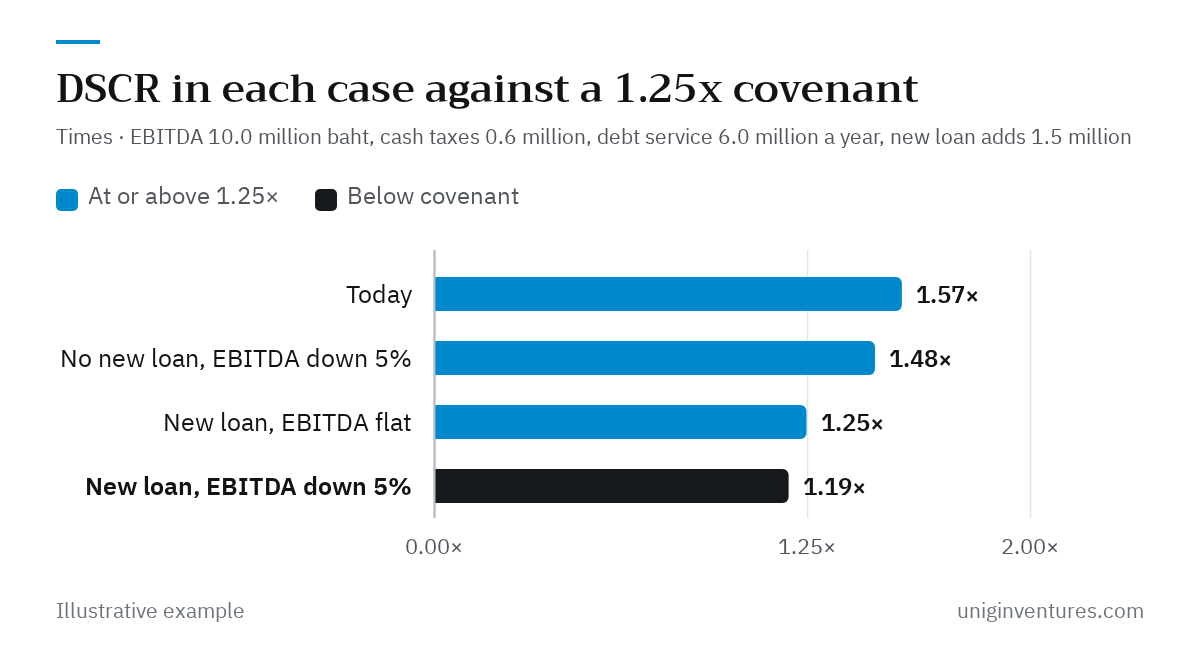
The same company can absorb a 19% fall in EBITDA without the new loan, but not even 5% with it. Seeing these numbers before signing gives you options: borrow less, stretch the repayment term to lower the annual installment, or negotiate the covenant as part of the new loan. This is the same method as scenario planning: build a base case and a bad case, then check which one breaks a covenant.
What happens when you breach
CFI notes that when a borrower violates a covenant, the lender may demand a penalty payment, raise the interest rate, require more collateral or demand full immediate repayment. What your bank can actually do depends on the wording of your agreement. If another agreement has a cross-default clause tied to this one, a breach here can spread to other loans too.
The effect on the financial statements matters just as much. Under IAS 1 in IFRS Standards, debt is non-current only if the company has the right to defer settlement for at least 12 months after the reporting date. EY explains the amendments effective for annual periods beginning on or after January 1, 2024:
- Covenants the company must comply with on or before the reporting date affect classification, even if compliance is assessed after that date.
- Covenants the company must comply with only after the reporting date do not affect classification at that date, but the company must disclose the nature of the covenants, when it must comply and the carrying amount of the related liabilities.
- If a breach happens before the reporting date, a waiver must be obtained by the reporting date. A waiver received afterward does not keep the debt non-current.
Most Thai SMEs use TFRS for NPAEs, which has a similar rule for breaches on or before the reporting date and a grace period of at least 12 months; see the example in Liquidity Ratios. The result is that a whole long-term loan can move into current liabilities, the current ratio collapses, and covenants in other agreements may break in turn.
Talk to the bank before a breach
The best time to talk is when your forecast says you will breach, not after. You can ask for one of two things:
- A waiver. The bank agrees not to use its rights for a particular breach or period. This suits temporary problems, such as one weak quarter.
- An amendment. The covenant level, formula or repayment schedule changes. This suits a business whose structure has changed, such as a capacity expansion that will take years to pay back.
Bring four things: actual figures and a forecast showing when and by how much you expect to breach, a cause you can explain, a plan with numbers, such as a 13-week cash flow forecast, and a clear request, such as a waiver for a named quarter or a change of the limit from one figure to another. The bank may ask for something in return, such as a fee or a higher rate. Get every agreement in writing, and if it affects the year-end accounts, get it before the reporting date.
A monthly covenant tracker
Keep one table covering every agreement and update it each time you close the monthly books.
| Agreement / covenant | Formula per agreement | Test and reporting dates | Covenant level | Internal warning level | Latest |
|---|---|---|---|---|---|
| Term loan, Bank A / DSCR | Copied from the agreement | As the agreement specifies | ≥ 1.25x | ≥ 1.40x | 1.57x |
| Term loan, Bank A / D/E | Copied from the agreement | As the agreement specifies | ≤ 2.0x | ≤ 1.8x | 1.60x |
| Term loan, Bank A / no new debt | — | Before every new loan or hire purchase | Consent required | — | Not yet requested |
Set internal warning levels inside the covenant levels so you have time to act before a real breach. The levels in the table are examples; set yours according to how volatile your business is.
Where to start
- Open every loan, hire purchase and credit line agreement, and list every covenant: affirmative, negative and financial.
- Copy each formula from the agreement into a spreadsheet, then calculate the latest figures and the headroom.
- Forecast each covenant at least four quarters ahead, in a base case and a bad case.
- Before new borrowing, a large asset purchase or a dividend, check the negative covenants and calculate the effect on each ratio.
- If the forecast shows a breach, meet the bank with numbers and a plan, and get the agreement in writing before the reporting date.
The company and figures in this article are illustrative examples to explain the reasoning. Real terms depend on each company's agreements. Involve your auditor and legal counsel when a breach looks possible.
Sources
- Debt Covenants — Corporate Finance Institute
- Debt Service Coverage Ratio (DSCR) — Corporate Finance Institute
- What companies need to consider for classification of liabilities (IAS 1 amendments) — EY
- IASB amends accounting standard to improve information about long-term debt with covenants — IFRS Foundation