Valuing a Profitable SME: Normalize EBITDA, Then Pick a Defensible Multiple
Restate EBITDA to a normal year, choose a multiple without copying listed companies, and bridge enterprise value to equity value, with a worked example of how owner pay and debt move the price.

In this article
Once a business is profitable, the owner starts hearing the same question from buyers, investors and would-be partners: what is the company worth? The answer that comes up most often at the table is EBITDA times a multiple. Neither number comes straight from the financial statements, though. EBITDA has to be restated to a normal year first, the multiple needs a reason behind it, and the product of the two is still not what the shareholders will receive.
This article explains the difference between enterprise value and equity value, walks through normalization with a worked example, shows where multiples come from and why you should not copy a listed-company multiple, and lists what to prepare before you discuss price with anyone.
EBITDA and Enterprise Value
EBITDA is operating income (EBIT) with depreciation and amortization added back. It sits before interest and tax, so it lets you compare businesses with different debt levels and tax positions.
Because EBITDA is earned before lenders are paid, multiplying it gives you the value of the whole business, the enterprise value (EV), which belongs to lenders and shareholders together. It is not the value of the shares alone. Aswath Damodaran of NYU Stern defines the terms in his multiples dataset as follows.
Enterprise value = market value of equity + value of debt − cash
EV/EBITDA = enterprise value ÷ EBITDA
Rearranged, equity value equals EV minus interest-bearing debt plus cash. Two companies with the same EBITDA and the same multiple can have very different equity values if one of them carries a large bank loan.
Normalization: Find the Earnings of a Normal Year
A buyer is not paying for last year's profit. The buyer is paying for what the business normally earns under a new owner. The accounts of an owner-run company usually contain items that distort that figure. Mercer Capital, a US business valuation firm, sorts the adjustments into two groups.
- Non-recurring and non-operating items, such as one-time gains or losses, unusual expenses and the costs of assets the business does not use.
- Owner compensation and discretionary expenses that a professionally run company would not have, or would pay at market rates.
When the owner also runs the company, personal and business spending tend to mix, and it is hard to tell which part of the money the owner takes out is a manager's pay and which part is a shareholder's return. These are the items that come up most often in Thai SMEs.
- Owner salary. If you pay yourself less than it would cost to hire a manager to replace you, deduct the gap from EBITDA. If you pay yourself more than the role is worth, add the excess back.
- Rent from family. Land, buildings or warehouses rented from the owner or relatives at non-market rates should be restated to market rent.
- Personal expenses booked in the company. You can add them back for valuation, but stop booking them now: Section 65 ter (3) of the Thai Revenue Code already treats expenses of a personal nature as non-deductible.
- One-time items, such as disaster repairs, litigation costs or a gain on selling old equipment.
For businesses whose results swing with the economic cycle, Damodaran suggests averaging several years, or applying the average historical margin to current revenue, rather than relying on a single best or worst year.
Worked example
Illustrative example: a distribution company reports EBITDA of THB 6,000,000. Going through the accounts line by line turns up five items to adjust.
| Item | Issue | Adjustment (THB) |
|---|---|---|
| Reported EBITDA | 6,000,000 | |
| Owner salary 600,000; cost of a hired manager 1,800,000 | Below market | −1,200,000 |
| Warehouse rent paid to a relative 240,000; market rent 600,000 | Below market | −360,000 |
| Flood repairs | One-time | +500,000 |
| Owner's personal expenses | Not a business cost | +300,000 |
| Gain on sale of an old truck | One-time | −400,000 |
| Normalized EBITDA | 4,840,000 |
Normalized EBITDA is THB 1,160,000, or about 19%, below the reported figure. The largest cut comes from the owner's salary, the item owners most often forget. At a multiple of 5×, the gap is worth THB 5,800,000 of value. A seller who prices off reported EBITDA will see a buyer's due diligence cut that price for reasons that are hard to argue with.
Where Multiples Come From, and Why Not to Copy Listed Companies
A multiple reflects what a buyer expects from each baht of earnings. Businesses that grow faster, carry less risk and need less reinvestment earn higher multiples, so multiples vary widely by industry. Damodaran's January 2026 data on US listed companies puts EV/EBITDA at about 9.6× for food processing, about 31.8× for software and about 24× for the market as a whole.
You cannot use those numbers as a price for a Thai SME, for three reasons.
- Listed shares trade every day. Shares in a private limited company are much harder to sell. Damodaran notes that the common rule of thumb is an illiquidity discount of 20–30% of value, and that studies of restricted stock found average or median discounts of roughly 34–35%. He argues the discount should be smaller for firms that are larger, profitable and cash-rich, and larger for firms that are small, loss-making or hold hard-to-sell assets such as factories.
- Size and key-person risk. An SME whose customers and suppliers are tied to one owner is riskier than a large company with a management team.
- Market and timing. US multiples reflect that market's growth and cost of capital at the time the data was collected.
A better benchmark is the price actually paid for businesses of similar size in the same industry, but data on small deals in Thailand is hard to find. In practice, buyers combine several sources and then check whether a discounted cash flow valuation lands in the same range.
One more caution: EBITDA is not cash. A business that has to replace machinery often, or put more money into working capital every time sales grow, leaves less cash for its owners than EBITDA suggests, and it deserves a lower multiple than a business that does not need to reinvest.
From Enterprise Value to Equity Value
Continuing the example, assume buyer and seller agree on a 5× multiple (an illustrative figure, not a standard for any industry).
| Step | Calculation | THB million |
|---|---|---|
| Enterprise value | 4.84 × 5 | 24.20 |
| Less bank loans | −6.00 | |
| Less loans from directors | −2.00 | |
| Plus cash above operating needs | +1.50 | |
| Equity value | 17.70 |
Money the company borrowed from its directors has to be repaid, so a buyer treats it as debt, just like a bank loan. Using reported EBITDA instead, equity value would be 30.00 − 6.50 = THB 23.50 million, THB 5.80 million more than the normalized figure.
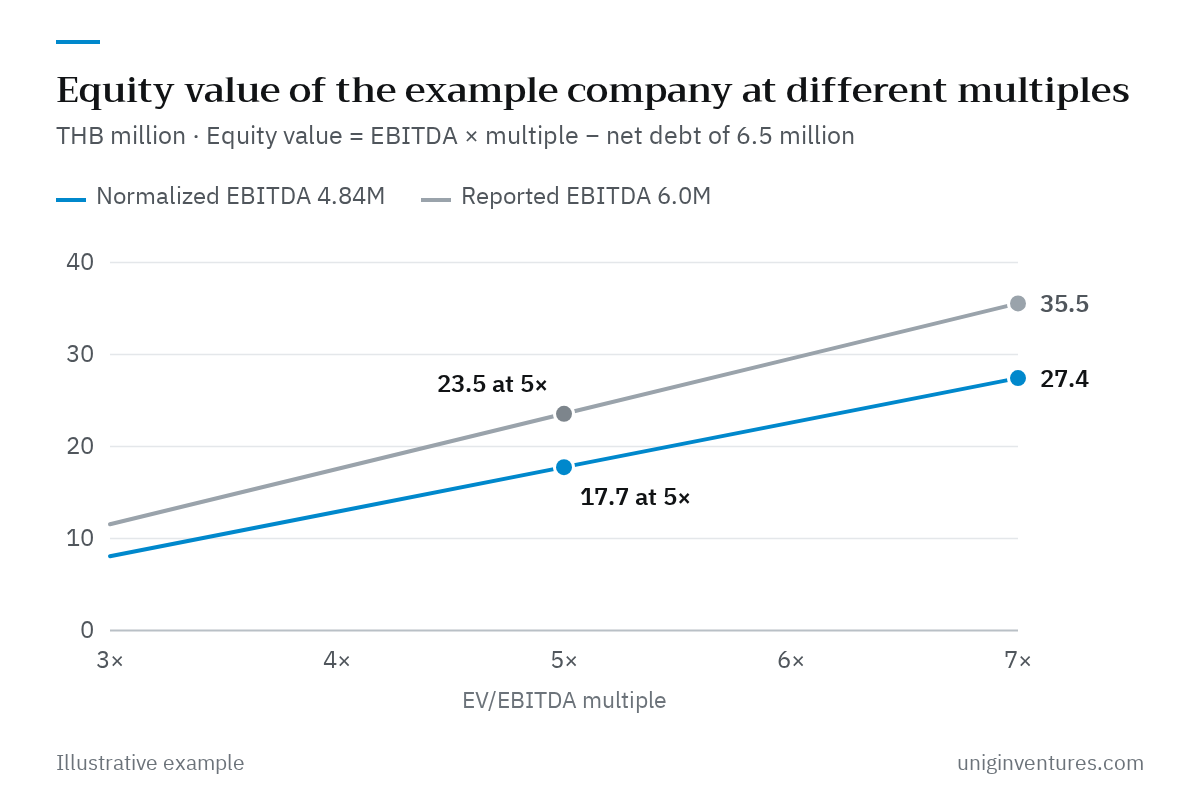
Because net debt is a fixed amount that is always subtracted, equity value moves more sharply than EV. If the multiple drops from 5× to 4×, EV falls 20%, but equity value falls from THB 17.70 million to THB 12.86 million, about 27%. The more debt a company carries, the more the multiple negotiation matters to its shareholders.
What to Prepare Before You Talk Price
- At least three years of audited financial statements and monthly accounts for the current year.
- A normalization schedule that shows every line, with evidence such as market rent quotes or salary ranges for the management role.
- A list of all interest-bearing debt, including director loans, and the amount of cash the business really needs to operate.
- Capital spending due in the next few years, so you can explain how much of EBITDA turns into cash.
- The risks a buyer will ask about, such as the share of sales from the largest customer and work that still depends on the owner alone.
Where to Start
- Calculate EBITDA for the last three years, then work through the adjustments as in the example above.
- Separate personal spending from the company now, so next year's numbers are clean without explanation.
- Gather several benchmarks and use a range of multiples, for example three levels, not a single figure.
- Build the full bridge from EV to equity value and see how sensitive the equity is to the multiple because of debt.
- If the numbers will be used in a real transaction, have an independent valuer and a tax adviser review them.
EBITDA times a multiple is the common language of the negotiation, not the final answer. An owner who normalizes the numbers first and can explain every line gets to negotiate the multiple instead of arguing over what the real profit is.
Sources
- Enterprise Value Multiples by Sector (US), January 2026 (Aswath Damodaran) — NYU Stern
- Variable definitions: Enterprise Value, EBITDA, EV/EBITDA (Aswath Damodaran) — NYU Stern
- More on normalizing earnings (Aswath Damodaran) — NYU Stern
- Estimating Illiquidity Discounts (Aswath Damodaran) — NYU Stern
- Normalizing Adjustments to the Income Statement — Mercer Capital
- Private Company Valuation (2026 Level II refresher reading) — CFA Institute
- Conditions for computing net profit under Section 65 ter (non-deductible expenses) — The Revenue Department (Thai)