Should You Buy the Machine? Capex Decisions With Payback, NPV and IRR
Build the after-tax cash flows of one machine, see what payback, NPV and IRR each tell you, why the project that pays back faster can destroy value, and how to stress-test the numbers before you sign.
In this article
- Start With Incremental Cash Flow, Not Accounting Profit
- Example: After-Tax Cash Flow of Machine A
- Payback: How Many Years to Get the Money Back
- NPV: How Much Richer the Investment Makes You
- IRR: The Annual Return the Project Delivers
- Faster Payback Does Not Mean Better
- Stress-Test the Numbers Before You Sign
- Where to Start
A 2-million-baht machine that the vendor says "pays for itself in three years" might be a good buy, or it might quietly lose money. The answer depends on which numbers went into that payback figure, whether tax was counted, and whether a baht you get back in year four is worth the same as a baht you spend today. Capital expenditure (capex) decisions are hard to reverse: the cash leaves at once, and the return trickles back over years.
This article works through one machine from start to finish. We build its after-tax cash flows, calculate the payback period, net present value (NPV) and internal rate of return (IRR), then compare it with a second machine that pays back faster but should not be bought. We finish with a quick stress test to run before you sign the purchase order.
Start With Incremental Cash Flow, Not Accounting Profit
All three methods use the same input: the cash that changes because of this investment. If those numbers are wrong, no formula will save the decision. Before you open a spreadsheet, answer three questions.
- How much goes out, and when? Count the purchase price, freight, installation, staff training and any extra working capital, such as additional raw material you need to stock once output speeds up.
- How much comes in or is saved each year? Always compare against the "don't buy" case. If the new machine cuts overtime and scrap, count only the reduction, not the full labor cost of the line.
- How long will it last, and what is left at the end? Realistic useful life, major overhauls along the way and resale value when you retire it.
Leave out sunk costs, money already spent that you cannot recover, such as a feasibility study you have already paid for. Leave out overhead you pay whether or not you buy. And do not deduct interest on a loan used to buy the machine: the cost of money already enters through the discount rate in the NPV calculation, so deducting interest would count it twice.
Example: After-Tax Cash Flow of Machine A
Illustrative example: a small factory is considering Machine A, which costs 2,000,000 baht installed. It is expected to cut overtime and scrap by 650,000 baht a year for five years, with no resale value at the end of year five. Assume it is bought on the first day of the accounting year.
Tax means the company keeps less than 650,000 baht, but depreciation wins some of it back. Thailand's Royal Decree No. 145 on depreciation sets a maximum annual rate of 20% of cost for depreciable assets other than buildings, land and inventory. This example deducts 20%, or 400,000 baht, a year (an asset bought mid-year must be prorated for the time held in the first year). It also assumes the extra profit is taxed at 20% corporate income tax, the rate the Revenue Department lists for an SME's net profit above 3 million baht. If your profit falls in the 15% or exempt bracket, the numbers change.
| Item | Baht |
|---|---|
| Pre-tax savings | 650,000 |
| Less tax depreciation (20% of 2,000,000) | −400,000 |
| Extra profit before tax | 250,000 |
| Corporate income tax at 20% | −50,000 |
| After-tax cash flow (650,000 − 50,000) | 600,000 |
Depreciation is not a cash payment, so it does not reduce cash flow; it only reduces tax. Machine A therefore generates 600,000 baht of after-tax cash a year. That figure feeds all three methods below.
Payback: How Many Years to Get the Money Back
Payback period = investment ÷ annual cash flow (when cash flows are equal)
Machine A = 2,000,000 ÷ 600,000 = 3.33 years
Payback is easy to explain and answers a question owners genuinely worry about: how long will the cash be tied up? Cash-tight companies often set a rule such as "must pay back within four years." But OpenStax's Principles of Finance is clear about the limitation: payback ignores the time value of money. A baht in year three counts the same as a baht today, and nothing after the payback point counts at all. A machine that earns for ten more years and one that breaks the day after payback score the same.
Discounted payback partly fixes this by converting each year's cash to present value first. At a 10% discount rate, Machine A's discounted payback is about 4.26 years, almost a year longer than simple payback. It still ignores everything after the break-even point.
NPV: How Much Richer the Investment Makes You
NPV is the present value of cash coming in minus the present value of cash going out. A positive NPV means the project returns more than the company's cost of capital and adds that much value. A negative NPV means the company is better off not investing.
NPV = Σ [ cash flow in year t ÷ (1 + r) to the power t ] − investment today
r = discount rate, the company's cost of capital
This example uses a 10% discount rate as an assumption. In practice, use your own cost of capital, which combines the after-tax interest rate on debt and the return shareholders require.
| Year | Cash flow | Discount factor | Present value |
|---|---|---|---|
| 0 | −2,000,000 | 1.0000 | −2,000,000 |
| 1 | 600,000 | 0.9091 | 545,455 |
| 2 | 600,000 | 0.8264 | 495,868 |
| 3 | 600,000 | 0.7513 | 450,789 |
| 4 | 600,000 | 0.6830 | 409,808 |
| 5 | 600,000 | 0.6209 | 372,553 |
| NPV | 274,472 |
(Yearly values are rounded to the baht, so they may sum to one baht more than the NPV.)
Machine A's NPV is 274,472 baht: after earning the required 10% a year, it adds roughly 270,000 baht of value in today's money. OpenStax's rule is to accept projects with a positive NPV and reject those with a negative one. When you can pick only one of several options, the general rule is to pick the higher NPV. When the capital budget is limited and projects differ in size, OpenStax suggests also looking at the profitability index.
IRR: The Annual Return the Project Delivers
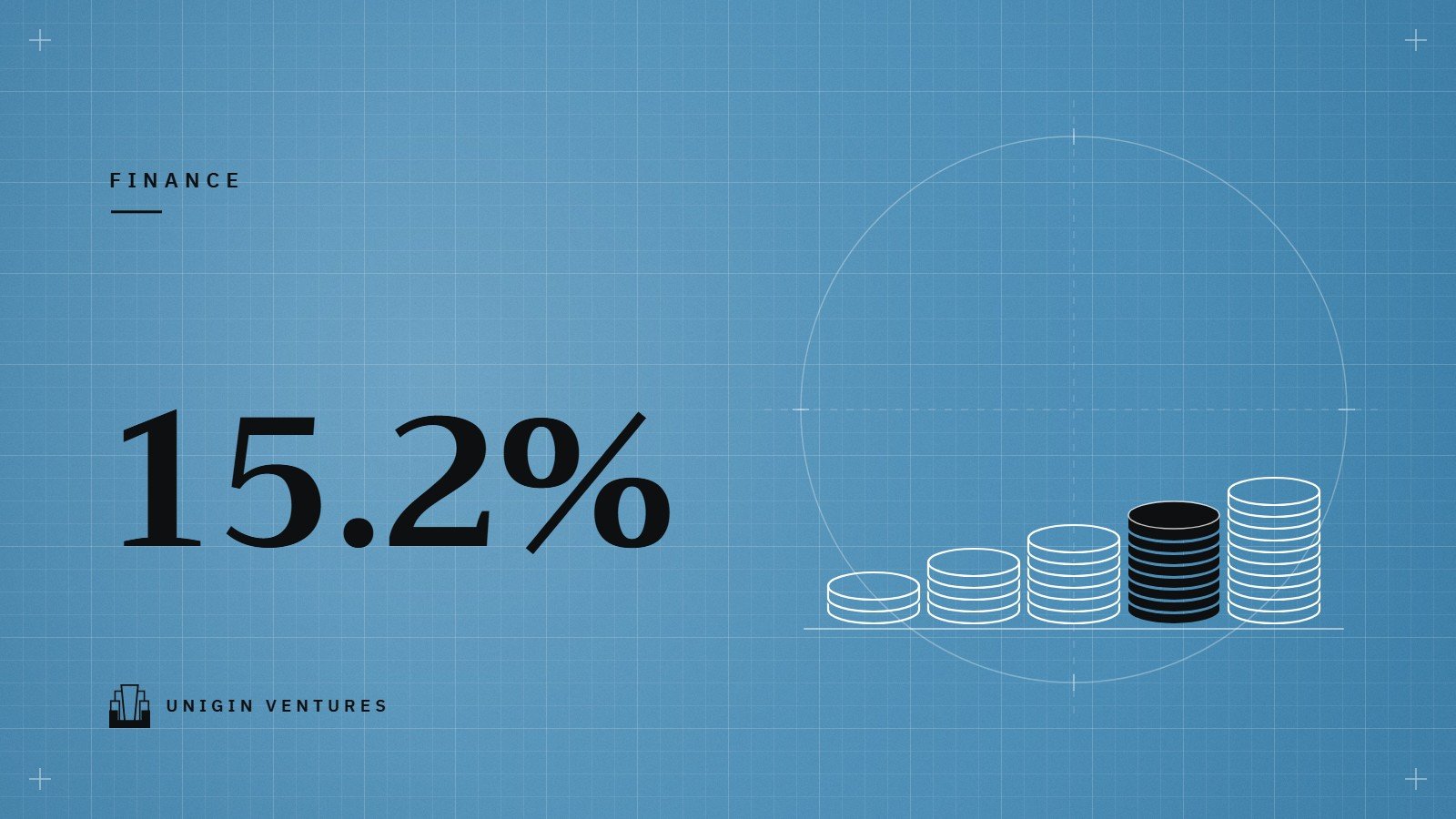
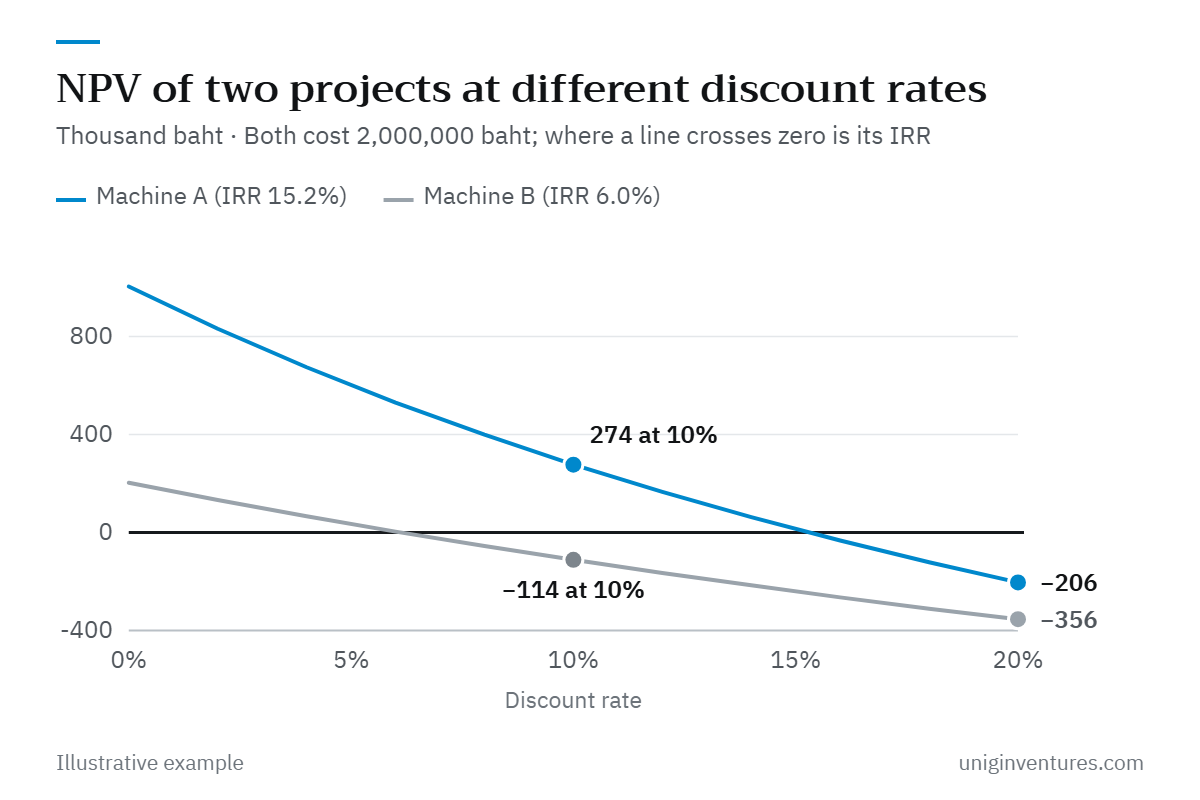
IRR is the discount rate at which NPV equals exactly zero; put differently, the annual return the investment generates. Machine A's IRR is about 15.2%, above the 10% cost of capital, so it passes. In practice, use your spreadsheet's IRR function with the investment as a negative number in year 0 followed by each year's cash flow.
IRR is easier to explain to non-finance colleagues than NPV, but it has three traps.
- It ignores scale. A small project with a 40% IRR may create less value than a large one at 18%. When you must choose one, decide on NPV.
- Cash flows that change sign more than once can produce more than one IRR, for example a project with a major overhaul or decommissioning cost partway through.
- It assumes interim cash can be reinvested at the same IRR, which may be unrealistic when the IRR is very high. OpenStax describes the modified IRR (MIRR), which compounds cash flows at the cost of capital instead, gives a single answer and addresses the reinvestment assumption.
Faster Payback Does Not Mean Better
Now suppose Machine B also costs 2,000,000 baht. It produces 1,000,000 baht of after-tax cash in years 1 and 2, then 200,000 baht in year 3, after which it is retired. Machine B pays back in exactly 2 years, faster than Machine A. Under a "fastest payback wins" rule, B would be chosen.
| Measure | Machine A | Machine B |
|---|---|---|
| Total cash flow over 5 years (baht) | 3,000,000 | 2,200,000 |
| Payback | 3.33 years | 2.00 years |
| NPV (baht) | 274,472 | −114,200 |
| IRR | 15.2% | 6.0% |
Once the time value of money is counted, Machine B has an NPV of −114,200 baht and an IRR of just 6.0%, below the cost of capital. Getting money back early does not make up for the machine stopping early. Machine A keeps earning for almost two years after payback, and payback ignores all of it.
Payback still has a role as a secondary check. If the company has only two years of cash reserves, a project that takes longer to pay back carries a real liquidity risk. It just should not be the only test.
Stress-Test the Numbers Before You Sign
Every number in the example is an estimate, and the one most likely to be wrong is the savings figure, which often comes from the vendor. Cut it by 20%, from 650,000 to 520,000 baht a year. Extra profit before tax falls to 120,000 baht, tax to 24,000 baht, and after-tax cash flow to 496,000 baht a year.
- NPV at 10% turns negative: −119,770 baht.
- IRR drops to about 7.6%, below the cost of capital.
Machine A only passes if the savings come close to the estimate. Before deciding, find the break-even value of each key assumption, such as the lowest annual saving that keeps NPV at zero or above, and ask honestly what evidence supports it: twelve months of overtime and scrap records, or results from another plant running the same model.
Where to Start
- List incremental cash flows by year against the no-investment case, including installation, extra working capital and major overhauls. Exclude sunk costs and interest.
- Work out tax using the depreciation rate tax law allows and the rate your company actually pays at that profit level.
- Set the discount rate from your cost of capital, and use the same rate for projects of similar risk.
- Use NPV as the main test, IRR to communicate, and payback to check whether your cash position can wait.
- Cut each key assumption by 10–20%, one at a time. If NPV turns negative easily, gather more evidence or negotiate the price first.
- After buying, compare actual results with the estimate every quarter so your next estimate is better.
Sources
- Principles of Finance, Chapter 16: How Companies Think about Investing (summary: payback, NPV, IRR) — OpenStax
- Principles of Finance, Chapter 16 key terms (discounted payback, MIRR) — OpenStax
- Royal Decree No. 145 (1984) on depreciation of assets — Revenue Department (Thai)
- Corporate income tax rates and calculation — Revenue Department (Thai)