Dividend Policy for Small Companies: How Much You Can Pay From Profit and Cash
A dividend must clear three layers: the legal ceiling, the 5% legal reserve and the cash left after 12 months of commitments. A worked example from 2 million baht of profit, plus the payout steps.
In this article
- Layer one: the law allows dividends only from profit
- Calculate the legally distributable profit
- Layer two: the cash you can actually pay
- Worked example: from 2 million baht of profit to a declared dividend
- Layer three: write the dividend policy down
- Steps from closing the books to payment
- Where to start
The books are closed, the year was profitable, and shareholders start asking what the dividend will be. Many owners of small companies answer by looking at the net profit line and picking a number that feels right. But profit on the income statement does not tell you how much the law lets you pay, and it does not tell you whether the company has the cash to pay without borrowing to do it.
This article splits the decision into three layers: the legal ceiling, the cash ceiling, and the policy the company chooses for itself. It includes a line-by-line worked example and the steps from closing the books to putting money in shareholders' hands.
Layer one: the law allows dividends only from profit
For Thai limited companies, the rules sit in Sections 1200–1205 of the Civil and Commercial Code, which the Department of Business Development and the Federation of Accounting Professions summarize in their published guidance. These are the points you need for the calculation:
- Pay only from profit. A company may not pay dividends out of any other funds, and if it has incurred losses, it may not pay until those losses are made good (Section 1201).
- A shareholders' meeting must approve. The exception is an interim dividend, which directors may pay from time to time when it appears to them that the company has sufficient profit.
- Pay within one month of the date the shareholders' meeting or the directors pass the resolution.
- Set aside the legal reserve. Each time it pays a dividend, the company must allocate at least one-twentieth (5%) of its profit to a reserve until the reserve reaches one-tenth (10%) of the company's capital, or more if the articles of association require it (Section 1202).
In practice, "losses" means looking at the whole balance sheet, not just this year. A company that made a profit this year but still carries losses from earlier years should have its auditor confirm whether the profit left after absorbing those losses is enough to pay anything.
Calculate the legally distributable profit
Start from the closed balance sheet. Shareholders' equity shows the legal reserve separately from unappropriated retained earnings. Use these two lines:
Reserve required this time = the lower of 5% of net profit, or (10% of capital − existing legal reserve)
Legal ceiling = unappropriated retained earnings at the start of the year + net profit this year − reserve required this time
If opening retained earnings are negative (an accumulated deficit), enter them as a negative number. If the articles of association require a larger reserve than the law, use the rate in the articles.
Watch for profit that is not cash, such as gains from revaluing assets. In a published ruling on dividends paid out of such gains, the Revenue Department said that whether the payment is allowed is a question for the Civil and Commercial Code, and that a parent company receiving that dividend does not get the exemption under Section 65 bis (10) of the Revenue Code. If your profit includes items like this, talk to your auditor before proposing a number.
Layer two: the cash you can actually pay
Profit and cash are not the same. A year's profit may be tied up in receivables and inventory, or already spent on equipment (see Accrual vs. Cash Basis). Paying out the full legal ceiling can leave the company drawing on its overdraft to meet next month's payroll. Test the cash with this formula:
Cash available for dividends = cash and deposits − minimum cash buffer − loan principal due within 12 months − planned capital spending paid in cash − taxes and other liabilities due
Set the minimum buffer from your fixed costs, for example two to three months of salaries, rent and loan installments. Seasonal businesses should keep more. This is the company's own decision; no law sets it.
Before settling on a number, read your loan agreements. Some set minimum financial ratios or restrict dividends outright, and a dividend that pushes a ratio below its threshold is a breach (see Loan Covenants). For startups that have taken investor money, the shareholders' agreement may make dividends a matter that requires investor consent (see reserved matters).
Worked example: from 2 million baht of profit to a declared dividend
Illustrative example: a limited company has 5,000,000 baht of fully paid registered capital, split into 50,000 shares of 100 baht. Net profit after tax this year is 2,000,000 baht. Its articles do not require a reserve above the legal minimum.
| Item | Baht |
|---|---|
| Unappropriated retained earnings, start of year | 600,000 |
| Add: net profit this year | 2,000,000 |
| Less: required reserve (5% of profit = 100,000, below the 200,000 still needed) | −100,000 |
| Legal ceiling | 2,500,000 |
The reserve stood at 300,000 baht at the start of the year, against a target of 10% of capital, or 500,000 baht. The company is 200,000 baht short, so this time it sets aside 100,000 baht at the 5% rate.
| Item | Baht |
|---|---|
| Cash and deposits at year-end | 3,200,000 |
| Less: minimum buffer, two months of fixed costs (600,000 × 2) | −1,200,000 |
| Less: loan principal due within 12 months | −480,000 |
| Less: new equipment to be bought with cash | −500,000 |
| Less: corporate income tax payable | −150,000 |
| Cash available for dividends | 870,000 |
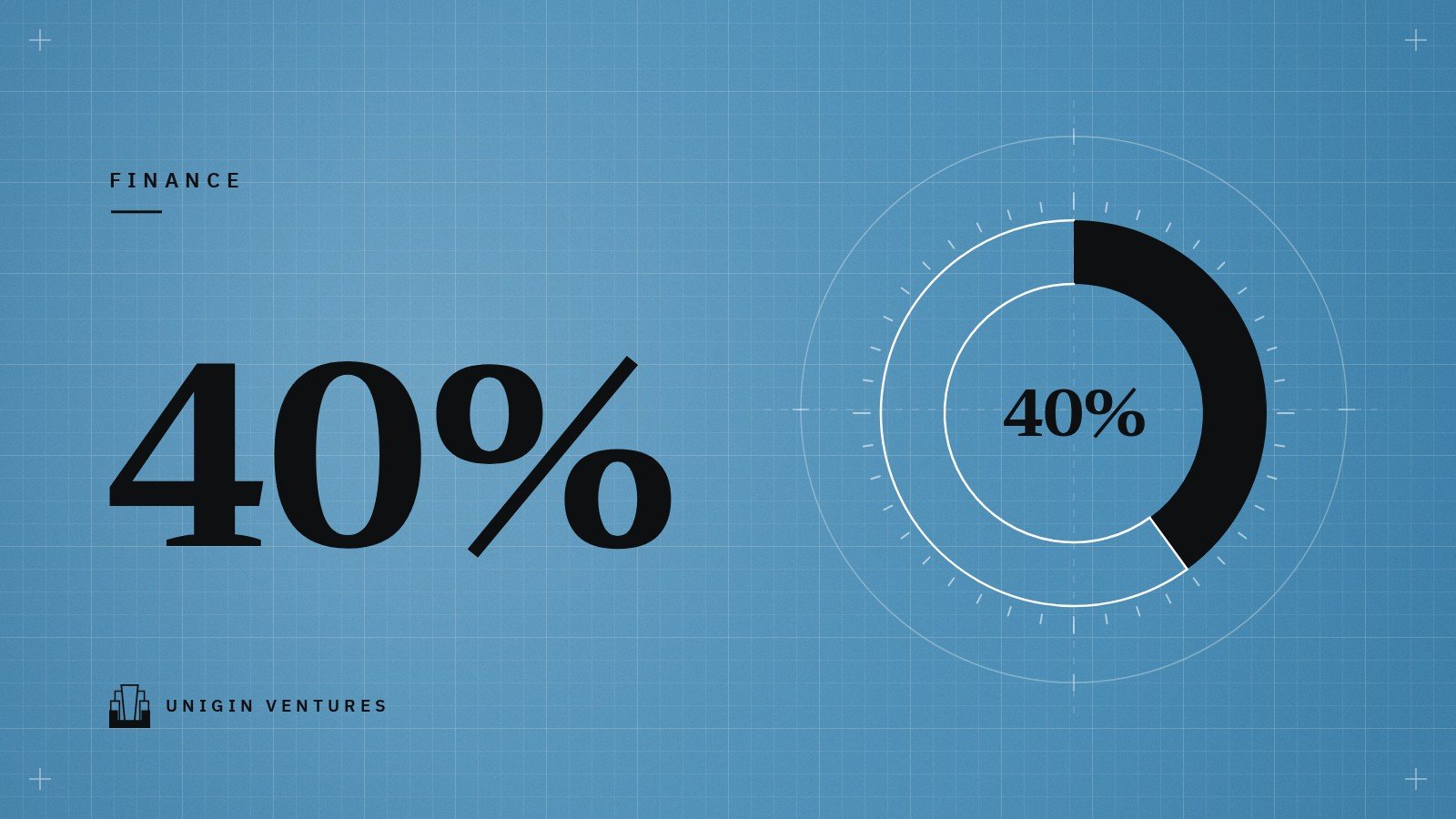
The binding limit is the lower of the two. Here it is cash at 870,000 baht, not profit at 2,500,000 baht. The directors propose 800,000 baht, or 40% of this year's net profit. That is 16 baht per share and leaves a further 70,000 baht of headroom.
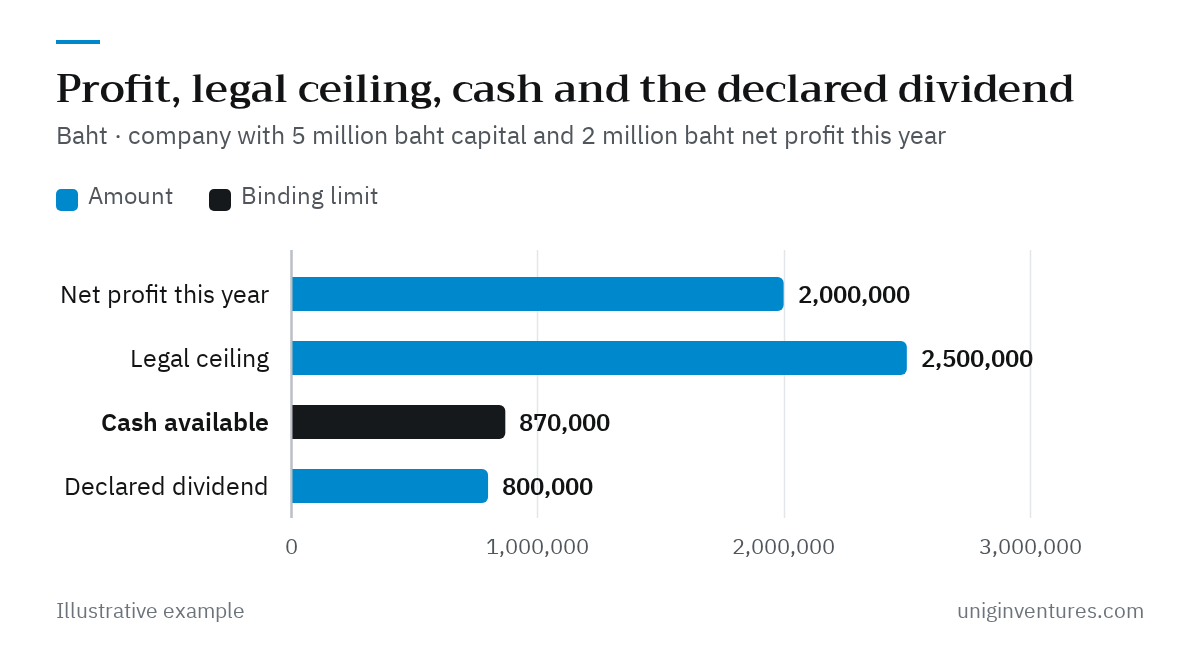
After the payment, unappropriated retained earnings fall to 1,700,000 baht and the legal reserve rises to 400,000 baht. The profit left behind does not disappear. It still belongs to shareholders and can be paid in a later year once the cash is there.
Layer three: write the dividend policy down
A written policy tells shareholders what to expect and spares the directors from renegotiating the number every year. Three common approaches:
- Fixed payout ratio. For example, pay no more than 40% of net profit. Simple to explain, but the dividend rises and falls with profit.
- Residual. Fund the investment plan and the minimum cash buffer first, then pay what is left. Suits companies that are expanding.
- Stable dividend per share. Pay the same amount each year and raise it only when profit grows steadily. Suits shareholders who want predictable income.
Whichever you choose, write in three minimum conditions: stay within the legal ceiling, pass the cash test, and breach nothing in the loan or shareholders' agreements. Pay interim dividends only from profit for a period whose books are already closed. If the second half of the year turns to losses, money paid early may exceed the profit for the full year.
Steps from closing the books to payment
- Close the books and have the auditor review them. Check accumulated losses, the legal reserve and any non-cash profit.
- Calculate the legal ceiling and the cash available. Use the latest cash balance at the meeting date, not the year-end balance, because months may pass in between. Look ahead with a 13-week cash flow forecast.
- The directors propose the dividend and the reserve allocation to the shareholders' meeting.
- The shareholders' meeting resolves. Record the amount per share, the payment date and the reserve set aside in the minutes.
- Notify shareholders and complete payment within one month of the resolution.
- For individual shareholders, withhold 10% tax, issue a withholding tax certificate and remit it with form P.N.D.2 within 7 days after the end of the month of payment, or within 15 days if filed online under the Finance Ministry extension that covers returns due through January 31, 2027.
In the example, if every shareholder is an individual, the company withholds 80,000 baht and shareholders receive 720,000 baht net. Recipients may treat the 10% as their final tax, or include the dividend in their annual return and claim the dividend tax credit. See the comparison in Salary or Dividends.
Where to start
- Open your latest balance sheet, find unappropriated retained earnings, the legal reserve and registered capital, and calculate the legal ceiling with the formula above.
- Set your minimum cash buffer as a number of months of fixed costs and build the cash test table.
- Read your loan and shareholders' agreements for any limits on dividends.
- Write a one-page dividend policy and share it with directors and shareholders before the annual meeting season.
The company and figures in this article are an illustrative example. This article is general information, not legal, accounting or tax advice for any particular business. Before declaring a dividend, have your auditor or legal adviser check the numbers and the process.
Sources
- Business returns known as profit or dividends (Thai) — Department of Business Development
- Financial reporting Q&A: dividend payment (Thai) — Federation of Accounting Professions
- Ruling 0702/1683 on dividends paid from asset revaluation gains, citing Civil and Commercial Code Sections 1200–1205 (Thai) — Revenue Department
- Ruling 0706/1926 on personal income tax on dividends, Sections 40 (4) (b), 47 bis, 48 (3) and 50 (2) (e) (Thai) — Revenue Department
- Revenue Code Sections 38–64 (Thai) — Revenue Department
- Finance Ministry notification extending deadlines for online filing (Thai) — Revenue Department