Accrual vs. Cash Basis: Why Profit and Your Bank Balance Differ
Thai companies must use accrual accounting, so profit is not cash. One month with two answers, a simple monthly bridge from profit to cash, and why fast growth makes cash tighter.
In this article
A common month in a growing company: the accountant reports a healthy profit, yet the bank balance has gone down and payroll next week looks tight. Nothing is wrong with the accounts. Profit and cash measure different things, and the gap between them comes from one choice: whether you record a transaction when it is earned or incurred, or when the money moves.
This article explains the difference between accrual accounting and cash accounting, why Thai companies must use the accrual basis, and how to walk from profit to cash with a simple bridge you can rebuild every month.
Two Ways to Record the Same Month
Cash basis records revenue when a customer pays and an expense when you pay it. It is how most people run a household budget and how many owners instinctively read their business: money in, money out.
Accrual basis records revenue when it is earned, such as when goods are delivered or a service is performed, and records expenses in the period they relate to, whether or not cash has changed hands. An invoice sent today on 60-day terms is revenue this month. An electricity bill for this month that arrives next month is an expense this month.
The accrual basis gives a truer picture of performance, because it matches each period's revenue with the costs of earning it. Cash accounting can make a quiet month look strong because a big customer happened to pay, or make a strong month look weak because you prepaid a year of insurance.
Thai Companies Must Use the Accrual Basis
For a Thai company, this is not a matter of preference. Two sets of rules point the same way.
- Tax. Section 65 of the Revenue Code requires companies to compute revenue and expenses for corporate income tax on an accrual basis: revenue that arises in an accounting period counts in that period even if it has not been received, and expenses of the period count even if they have not been paid. A company can change basis only with the Director-General's approval, and Revenue Department Order Tor.Por. 1/2528 sets specific timing rules for a few types of business, such as hire purchase and construction. Section 65 ter (9) also disallows expenses that should have been paid in another accounting period.
- Accounting standards. The Department of Business Development requires companies to prepare financial statements under the financial reporting standards set by the Federation of Accounting Professions. Most non-listed SMEs use TFRS for Non-Publicly Accountable Entities (TFRS for NPAEs), which names the accrual basis as an underlying assumption: a transaction is recognized in the period it occurs, which may differ from the period cash is received or paid.
Many owners still manage day to day by watching the bank account, and that habit is useful. The mistake is to treat the bank balance as the profit, or the profit as the cash you can spend.
One Month, Two Answers
Consider an illustrative example. A 10-person consulting company has the following transactions in March:
- Completes a project and invoices the client 1,000,000 baht on 60-day terms. The client will pay in May.
- Receives 600,000 baht from a January invoice.
- Pays March salaries of 500,000 baht.
- Pays a full year of insurance, 120,000 baht, covering March to February.
- Buys laptops and equipment for 360,000 baht, to be depreciated over three years (10,000 baht a month).
- Uses 20,000 baht of electricity in March. The bill arrives and is paid in April.
| Item | Cash basis | Accrual basis |
|---|---|---|
| Project invoiced in March | 0 | 1,000,000 |
| Payment of January invoice | 600,000 | 0 |
| Salaries | −500,000 | −500,000 |
| Insurance | −120,000 | −10,000 |
| Laptops and equipment | −360,000 | −10,000 |
| Electricity | 0 | −20,000 |
| Result for March | −380,000 | 460,000 |
The same company in the same month shows a cash outflow of 380,000 baht and an accrual profit of 460,000 baht, a gap of 840,000 baht. Both numbers are correct. They answer different questions: the accrual profit says whether March's work made money, and the cash figure says whether the bank account can carry the business until customers pay.
Bridge Profit to Cash Every Month
TFRS for NPAEs does not require a cash flow statement, so many SMEs only ever see accrual figures. You do not need to keep two sets of books. Start from the accrual profit and adjust for the items where cash moved at a different time. This is the logic of the indirect method in a cash flow statement.
Change in cash = net profit + depreciation − increase in receivables − increase in prepaid expenses and inventory + increase in payables and accrued expenses − purchases of equipment − loan repayments + new borrowing
For March in the example:
| Step | Amount |
|---|---|
| Accrual profit | 460,000 |
| Add back depreciation (no cash paid this month) | 10,000 |
| Less increase in receivables (1,000,000 invoiced − 600,000 collected) | −400,000 |
| Less increase in prepaid insurance (120,000 paid − 10,000 expensed) | −110,000 |
| Add accrued electricity (expensed, not yet paid) | 20,000 |
| Less purchase of equipment | −360,000 |
| Change in cash | −380,000 |
The bridge shows where the cash went. Here the largest item is receivables: the company is effectively lending its clients 60 days of revenue. That points to the actions that matter, such as shorter terms, a deposit at the start of each project, or invoicing by milestone instead of at the end.
Why Growth Makes the Gap Wider
The gap is not a one-month quirk. When a business sells on credit and pays its own costs sooner, every increase in sales ties up more cash in receivables. Growth makes the profit line rise while the bank balance falls.
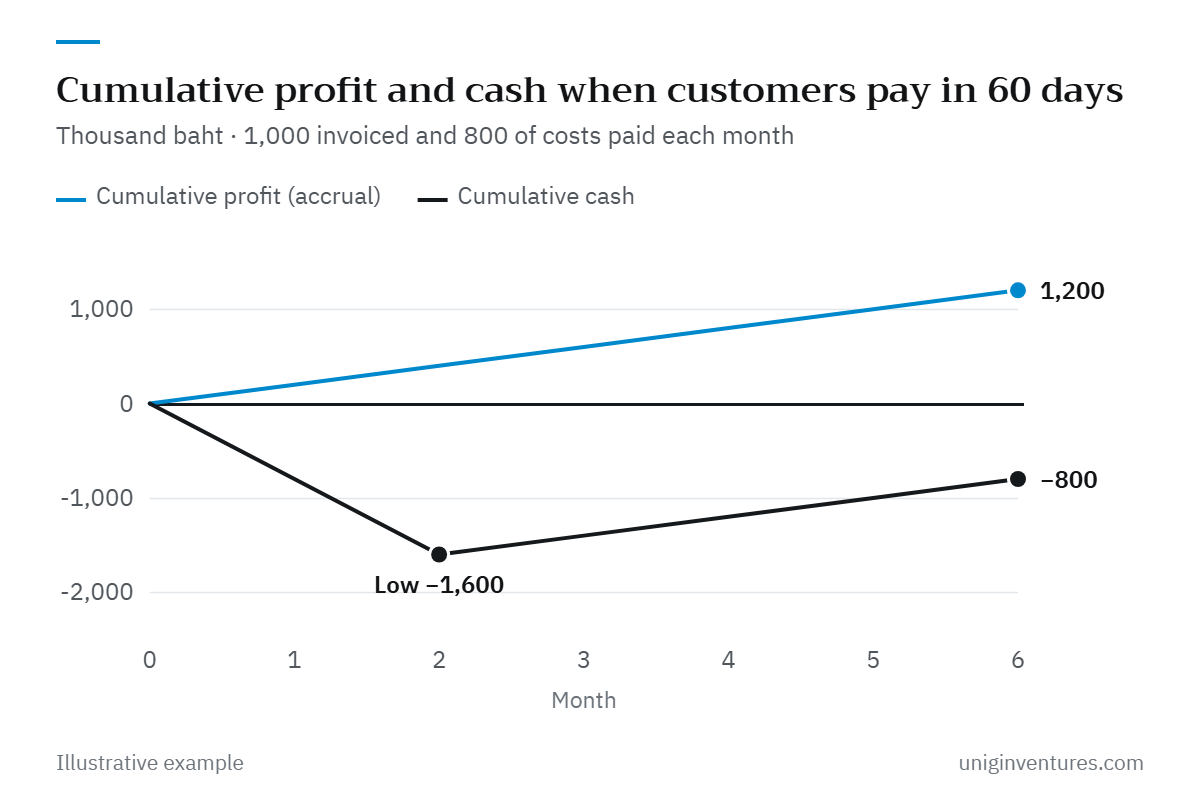
In this second illustrative example, a new company bills 1,000,000 baht every month, pays 800,000 baht of costs in the same month, and is paid 60 days after each invoice. It earns 200,000 baht of accrual profit every month from the start. But in months 1 and 2 nothing is collected, so the owners must fund 1,600,000 baht before the first payment arrives. Even after six months of profit, the business has 800,000 baht less cash than it started with. The money has not disappeared: it sits in receivables, and it comes back only if customers pay and growth slows.
This is why lenders and investors ask for both the income statement and the cash flow statement, and why a profitable company can still run out of cash. A rolling cash forecast helps you see the low point before you reach it (see the 13-week cash flow forecast).
Common Mistakes
- Booking revenue when the money arrives. Recording sales only when paid misstates monthly profit and can put revenue in the wrong tax year. Record the invoice when the work is delivered and track collection separately.
- Expensing big prepayments at once. Annual insurance, software subscriptions and rent paid in advance belong to the months they cover.
- Expensing equipment when bought. Assets that last more than a year are recorded as fixed assets and depreciated (see depreciation, book and tax).
- Forgetting accruals at month end. Bills that arrive late, such as utilities, commissions and bonuses, belong to the month the cost was incurred. Without them, profit looks better than it is.
- Assuming tax timing equals accrual timing. Value added tax has its own tax point rules. For goods, VAT is generally due on delivery. For services, it is generally due when payment is received, unless a tax invoice is issued or the service is used first. A service invoice booked as revenue in March may therefore fall into VAT for May. Check the rule for each type of sale with your accountant.
Where to Start
- Ask your accountant for monthly accrual statements within 10 working days of month end, including accruals for unpaid bills and prepayments (see a monthly close in 10 working days).
- Build the profit-to-cash bridge on one page each month, using the steps in the table above.
- Watch the largest bridge item. If receivables grow faster than sales, look at payment terms, deposits and collection.
- Plan cash for growth. Before a big new contract or a sales push, estimate how much cash will be tied up before customers pay, and arrange funding first.
This article is general information, not accounting or tax advice for a specific business. Rules are as checked in October 2026. The companies and figures above are illustrative examples.
Sources
- Revenue Code, Sections 65–76, including Section 65 (accrual basis) and Section 65 ter — Revenue Department
- Revenue Department Order Tor.Por. 1/2528 on the accrual basis — Revenue Department
- Revenue Code, Sections 77–79, VAT tax point (Sections 78 and 78/1) — Revenue Department
- TFRS for NPAEs (revised 2022), paragraphs 3.2–3.3 on the accrual basis — Federation of Accounting Professions
- Explanatory note on the 2023 notification on line items in financial statements — Department of Business Development