Choosing an Accounting Firm and Auditor: Credentials, Fees and Scope
How bookkeepers, certified public accountants and tax auditors differ in Thailand, how to check them before hiring, what the engagement letter must cover, and how to compare quotes on a full-year basis.

In this article
Most Thai SMEs do not keep their own books. They hire an outside accounting firm and an auditor. Many choose based on the lowest monthly price or a friend's recommendation, and only discover the problems in May: financial statements that are not ready, a tax return filed late, or a bookkeeper who never registered with the authorities. The penalties fall on the company, not the firm.
This article explains the three roles you need to tell apart, the deadlines your firm must help you meet, how to check credentials before hiring, what the engagement letter should cover, how to compare quotes on a full-year basis, and how to choose an auditor.
Three roles you need to tell apart
| Role | What they do | Who can use them |
|---|---|---|
| Bookkeeper (phu tham banchi) | Records transactions and prepares the financial statements. Must be registered with the Department of Business Development (DBD) and be a member of the Federation of Accounting Professions | Every juristic person must have one |
| Certified public accountant (CPA) | Audits and certifies the financial statements. Licensed through the Federation of Accounting Professions | Can audit companies and partnerships |
| Tax auditor (TA) | Audits and certifies accounts. Registered and licensed by the Revenue Department | Only small registered partnerships with capital up to 5 million baht and total assets and total revenue each up to 30 million baht. Cannot audit companies |
A limited company therefore needs a bookkeeper and a CPA. One accounting firm may offer both services through its network, but they are different people with different legal duties. The auditor's job is to check the bookkeeper's work.
The deadlines your firm must help you meet
For a company whose fiscal year ends on December 31, the key annual deadlines are:
| Task | Deadline | Rule |
|---|---|---|
| Audited balance sheet approved at the shareholders' meeting | Within 4 months of the balance sheet date (by April 30) | Civil and Commercial Code Section 1197 |
| Copy of the balance sheet sent to shareholders | At least 3 days before the meeting | Civil and Commercial Code Section 1197 |
| Corporate income tax return (P.N.D.50) and payment | Within 150 days of the end of the fiscal year | Revenue Department |
| Financial statements filed with the DBD through e-Filing | For most companies, by May 31 | Department of Business Development |
Work backward from these dates. The auditor needs complete draft financial statements several weeks before the shareholders' meeting. So your firm must finish the year-end close by around February or early March. Ask any firm you are considering when they will deliver the draft statements to the auditor. A vague answer is a warning sign.
Monthly work also has deadlines, such as VAT returns (P.P.30) and withholding tax returns (P.N.D.1, 3 and 53). Late filing brings fines and surcharges. Your engagement letter should say who pays them if the firm causes the delay.
Check before you hire, and after
The bookkeeper
The DBD recommends that companies check their bookkeeper in its e-Accountant system:
- Check the bookkeeper's status. At www.dbd.go.th, go to online services, the bookkeeper system (e-Accountant), and check the bookkeeper's status. Only the status "active" (khong yu) allows them to keep books. Statuses such as lapsed membership, suspended or revoked registration mean you must act right away.
- Check that the bookkeeper has registered your company. In the same system, search for your company's bookkeeper with your juristic person number. It shows the bookkeeper and the fiscal years they have confirmed. If they have not confirmed, the e-Filing system will warn you when you file.
This matters to you, not just to the firm. The DBD warns that a company that files financial statements prepared by a bookkeeper who is not active may face penalties under the Accounting Act B.E. 2543 (2000).
The auditor
- Confirm the auditor is a licensed CPA with the Federation of Accounting Professions, not a tax auditor, if your business is a company.
- Under Section 1208 of the Civil and Commercial Code, an auditor may hold shares, but anyone with another interest in the company's business, or who is a director, agent or employee of the company, cannot be chosen.
- Sign an engagement letter directly with the auditor or audit firm. Avoid arrangements where a middleman "takes care of the audit" and you never meet the auditor.
What the engagement letter should cover
Most disputes with accounting firms come from unclear scope. Before signing, make sure the contract answers these questions.
- Volume: How many documents or transactions per month does the fee cover? What is the charge for extra ones?
- Monthly tax filings: Which returns does the firm prepare and file? Who submits them, and from whose account is payment made?
- Payroll and social security: Included or charged separately?
- Monthly reports: Will you get a monthly profit and loss statement and balance sheet? By what day of the following month?
- Year-end: Does the fee include the year-end close, financial statements, P.N.D.50, coordination with the auditor and the DBD filing?
- Deadlines: The date your company must hand over documents, and the date the firm must deliver each item.
- Late filing: Who pays fines and surcharges if the firm misses a deadline that your documents did not cause?
- Exit: If you change firms, how and when will they return documents, ledgers and data files in a usable format?
Compare quotes on a full-year basis
Monthly prices are not comparable when what they include differs. Convert every quote to a total for the year, based on your actual volume.
Illustrative example: a VAT-registered company with 5 employees and about 60 documents a month receives three quotes for bookkeeping. The audit fee is quoted separately and is the same in all three cases.
| Firm | Quote | Annual cost |
|---|---|---|
| A | 4,000 baht a month, up to 80 documents, includes payroll, monthly filings, year-end statements and P.N.D.50. Reports only at year-end | 48,000 |
| B | 2,500 baht a month for up to 30 documents, 50 baht for each extra document, payroll 500 baht a month, year-end close 6,000 baht | 60,000 |
| C | 6,000 baht a month, everything in A plus a monthly management report by the 10th | 72,000 |
Firm B = (2,500 × 12) + (30 extra documents × 50 × 12) + (500 × 12) + 6,000
= 30,000 + 18,000 + 6,000 + 6,000 = 60,000 baht a year
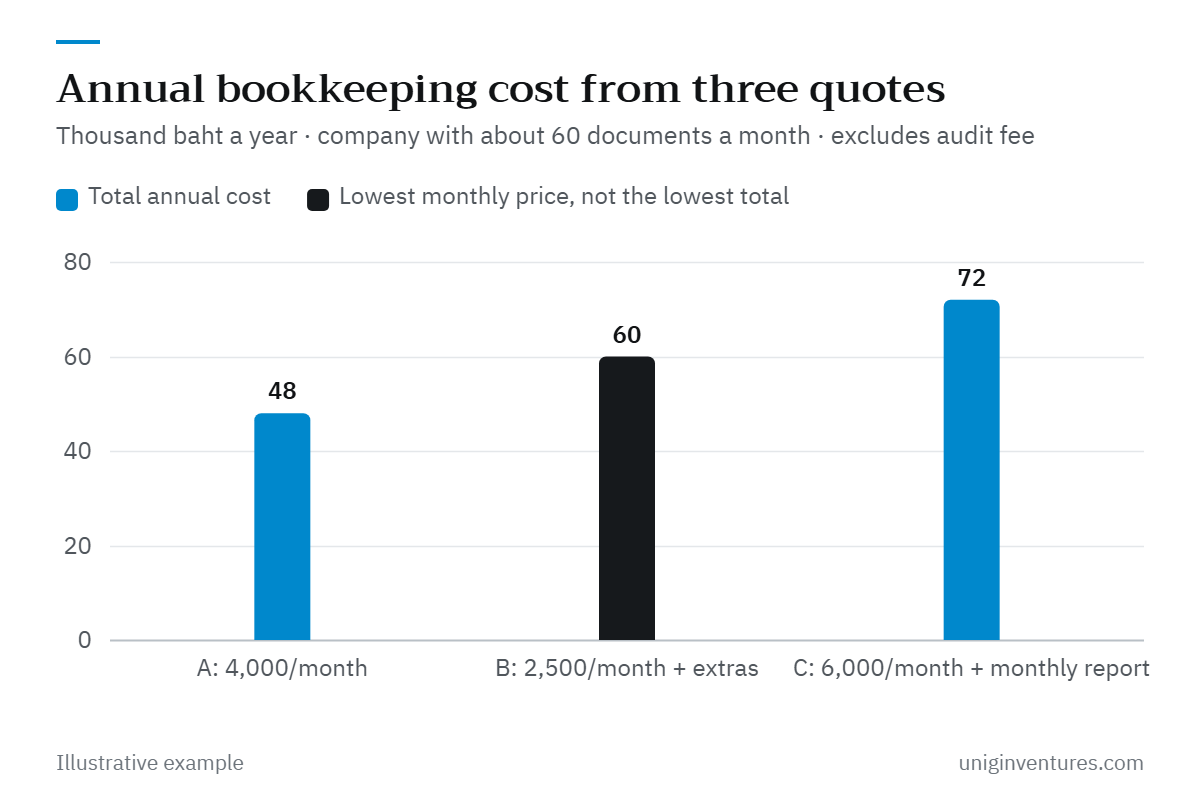
Firm C costs 24,000 baht a year more than firm A. What you get for that is monthly numbers within 10 days instead of once a year. If you plan to borrow from a bank, raise money from investors or need to control cash closely, timely monthly numbers are often worth more than the price difference. If your business is simple and stable, firm A may be enough.
Choosing an auditor
Under Sections 1209 and 1210 of the Civil and Commercial Code, the ordinary shareholders' meeting elects the auditor every year, and the general meeting sets the auditor's fee. The outgoing auditor may be re-elected. That means you can change auditors at any annual meeting, but it is better to choose well from the start.
- Keep the auditor separate from the bookkeeper. An auditor who reviews work prepared by a closely connected team has less reason to challenge it.
- Ask about timing. When do they need the draft statements? How many weeks does fieldwork take? When will the signed report be ready?
- Ask about the fee basis. Is it fixed, or does it rise if your records are incomplete?
- Think about the next three years. If you plan to raise money from investors or borrow from a bank, ask whether they have audited companies at that stage. Investors in a due diligence review will read several years of audited statements.
Where to start
- Today, check your current bookkeeper's status and your company's record in the DBD e-Accountant system.
- Pull out your current engagement letter and compare it with the list above. Note what is missing.
- Write down your actual monthly volume: documents, employees and returns filed.
- If you are switching firms, ask for at least two quotes and convert each one to a full-year cost.
- Agree with your firm and auditor on a year-end timeline that works back from the April 30 shareholders' meeting, and put it in your calendar.
Sources
- DBD advises companies to check that their bookkeeper is "active" before filing financial statements (February 2026) — Ministry of Commerce (Thai)
- Differences between a TA and a CPA — Revenue Department (Thai)
- Frequently asked questions about P.N.D.50 — Revenue Department (Thai)
- Civil and Commercial Code Section 1197 — Thai Law Online (Thai)
- Civil and Commercial Code Section 1208 — Thai Law Online (Thai)
- Civil and Commercial Code Section 1209 — Thai Law Online (Thai)
- Civil and Commercial Code Section 1210 — Thai Law Online (Thai)