Depreciation for Thai SMEs: Book vs. Tax Rules and the One-Million-Baht Car Cap
What to capitalize, how depreciation works under TFRS for NPAEs, the maximum tax rates in Royal Decree 145, and why a 1.5 million baht passenger car is never fully deductible.
In this article
When a company buys a machine, a car or a set of computers, the cash leaves the bank account at once. In the income statement, though, the cost turns into an expense slowly, year by year, as depreciation. Many owners are puzzled that profit still looks healthy in a year of heavy purchases while cash has dropped, and that the depreciation in the accounts does not match the figure used for tax.
This article explains what belongs on the balance sheet as a fixed asset and what is expensed immediately, how the accounting standard most Thai SMEs use treats depreciation, what limits Thai tax law sets, and why a 1.5 million baht passenger car cannot be fully deducted.
Fixed Asset or Expense?
Most Thai limited companies that are not listed on the stock exchange report under the Thai Financial Reporting Standard for Non-Publicly Accountable Entities (TFRS for NPAEs), revised 2022. Chapter 10 covers property, plant and equipment.
- Definition. Tangible assets held for use in production, supply of goods or services, rental or administration, and expected to be used for more than one reporting period (paragraph 10.1).
- Cost is more than the purchase price. It includes import duties and non-refundable input tax, less trade discounts, plus direct costs of bringing the asset to the location and condition needed to operate, such as delivery and installation (paragraph 10.5).
- Routine repairs and maintenance are expensed as incurred and are not added to the asset's carrying amount (paragraph 10.9). Replacing a significant part that meets the recognition criteria is capitalized, and the replaced part is removed (paragraph 10.10).
Tax law draws the same line. Section 65 ter (5) of the Revenue Code bars deducting capital expenditure, or spending that improves an asset, as a lump-sum expense. It must be recovered through depreciation. Expense a 100,000 baht machine in one year, and taxable profit that year is understated and likely to be adjusted in an audit.
The standard sets no minimum price for capitalization. Many companies agree an internal policy with their accountant, for example capitalizing items that last more than a year and cost above a set amount. Write the threshold down and apply it the same way every year.
How Book Depreciation Works
Annual depreciation (straight-line) = (Cost − Residual value) ÷ Useful life
- Residual value is what the company expects to receive today for the asset if it were already at the age and condition expected at the end of its useful life, less disposal costs (paragraphs 10.27–10.28).
- Useful life reflects expected output, physical wear, technical or commercial obsolescence, and legal limits such as lease terms (paragraph 10.31). It does not come from the tax rate table.
- Depreciation starts when the asset is available for use, meaning it is in the location and condition management intends, not on the payment date or the date it first runs (paragraph 10.30).
- Land is not depreciated. When land and a building are bought together, their costs must be separated (paragraphs 10.25 and 10.32).
- Methods include straight-line, diminishing balance and units of production. Pick the one that reflects how the asset's benefits are used up (paragraphs 10.34–10.36).
The standard calls for regular review of residual values and useful lives. If estimates change materially, recalculate from that period forward without restating prior years (paragraph 10.29). Significant components with different lives are depreciated separately (paragraph 10.24).
Maximum Rates for Tax
Section 65 bis (2) of the Revenue Code allows depreciation under a royal decree, which is Royal Decree No. 145 of 1984 as amended. Its Section 4 sets maximum annual rates as a percentage of cost.
| Asset type | Maximum rate per year |
|---|---|
| Permanent buildings | 5% |
| Temporary buildings | 100% |
| Cost of acquiring depletable natural resources | 5% |
| Leasehold rights, renewable indefinitely or without a written lease | 10% |
| Leasehold rights with a fixed term | 100% ÷ years of lease plus renewals |
| Patents, copyrights, trademarks, goodwill and other rights, unlimited life | 10% |
| The same rights, limited life | 100% ÷ years of use |
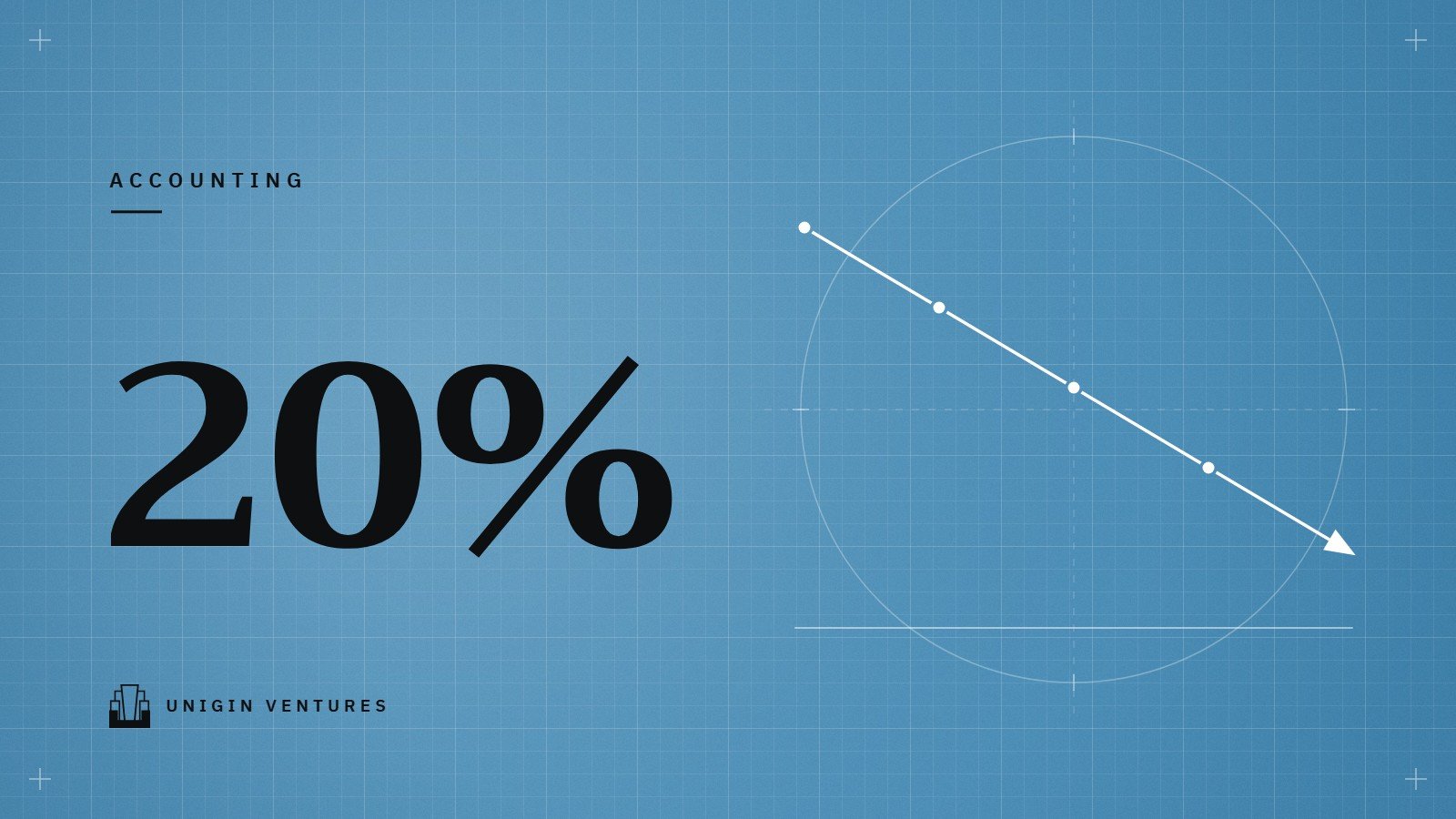
| Other depreciable assets (excluding land and inventory), such as machinery, vehicles and tools | 20% |
Other rules in the same decree worth knowing:
- Passenger cars and passenger vehicles with no more than 10 seats may be depreciated only on the part of cost up to 1,000,000 baht. Exceptions cover cars used solely in a car rental business and qualifying prototype cars used for research (Section 5).
- Computers, peripherals and software may be written off within three accounting periods from acquisition (Section 4 quater).
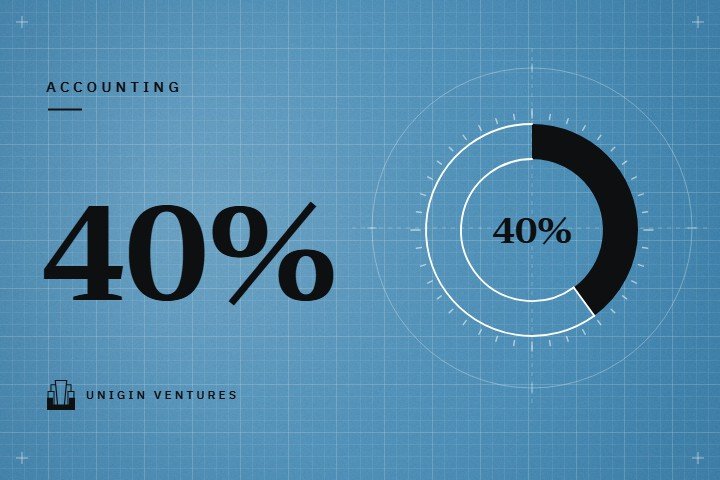
- Initial allowance for SMEs. Companies and juristic partnerships with fixed assets, excluding land, of no more than 200 million baht and no more than 200 employees may deduct an initial 40% of cost on the acquisition date for computers and for machinery and machine equipment, and 25% for factory buildings. The rest follows the normal rules (Sections 4 quater (2), 4 quinquies and 4 sexies).
- Hire purchase or installment purchases use the full price payable as cost, but depreciation in each period cannot exceed the installments due in that period (Section 7).
- An asset can never be depreciated down to zero (Section 8), so a small tax value must remain.
- Partial years are prorated by the time the asset was held in that accounting period (Section 4).
- Once a method and rate are chosen, they must be used consistently unless the Director-General of the Revenue Department approves a change (Section 3).
A common mistake is treating the table rates as an entitlement. They are ceilings. Revenue Department Order Por. 3/2527 holds that if the company's accounting method deducts less than the table rate, the tax deduction is limited to the accounting rate. If the books depreciate a machine over eight years (12.5% a year), the tax deduction is also 12.5%, not 20%. In the other direction, if the books use three years (about 33% a year), tax allows no more than 20%, and the excess is added back on the corporate income tax return (P.N.D. 50).
Worked Example: A 1.5 Million Baht Passenger Car
Illustrative example: a company with a calendar-year accounting period buys a passenger car for an executive to use on company business. Cost is 1,500,000 baht, the car is delivered and ready for use on January 1, and its useful life is estimated at five years. To keep the numbers simple, assume the residual value is immaterial.
Book depreciation = 1,500,000 ÷ 5 = 300,000 baht a year
Tax depreciation = 1,000,000 × 20% = 200,000 baht a year
Add-back = 300,000 − 200,000 = 100,000 baht a year
| Year | Book depreciation (baht) | Tax-deductible (baht) | Add-back (baht) |
|---|---|---|---|
| 1 | 300,000 | 200,000 | 100,000 |
| 2 | 300,000 | 200,000 | 100,000 |
| 3 | 300,000 | 200,000 | 100,000 |
| 4 | 300,000 | 200,000 | 100,000 |
| 5 | 300,000 | 200,000 | 100,000 |
| Total | 1,500,000 | 1,000,000 | 500,000 |
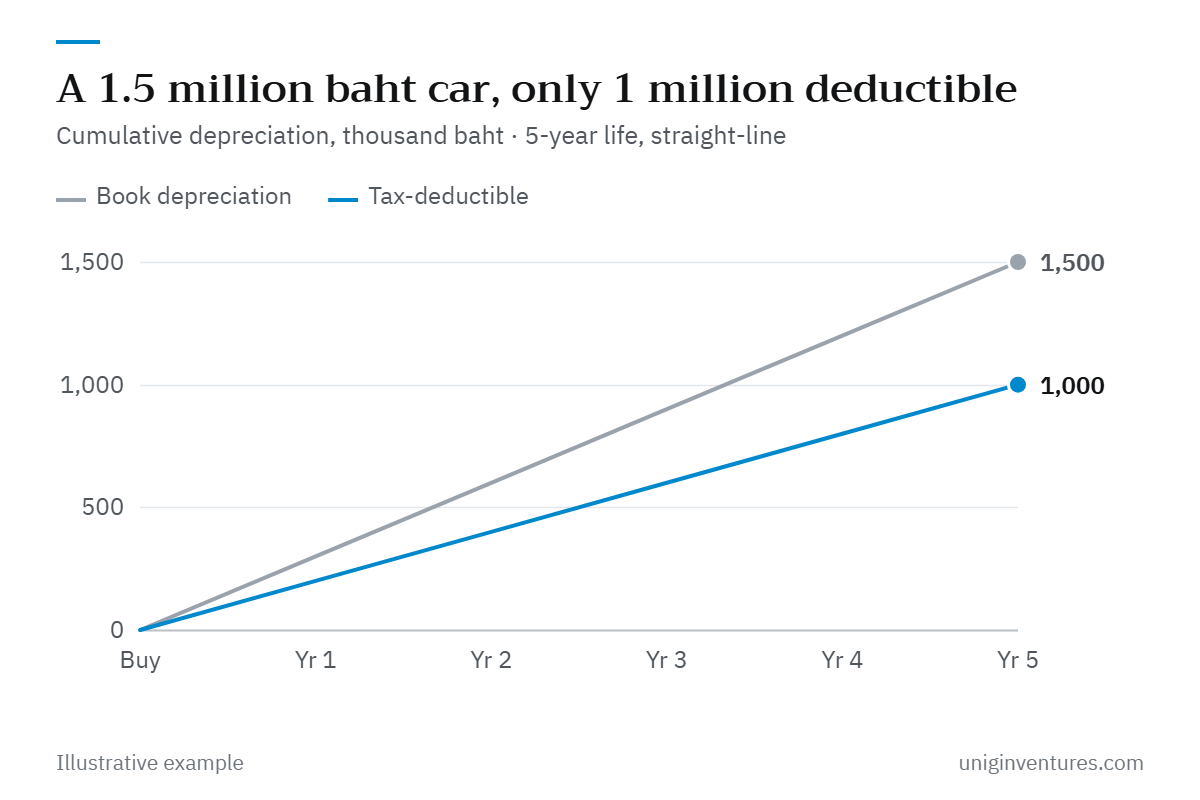
The 500,000 baht difference is permanent. If the company pays corporate income tax at 20% throughout, it pays 500,000 × 20% = 100,000 baht more tax over five years than it would on a car costing no more than one million baht. That figure belongs in the purchase decision. In practice, the final tax year must leave a small value under Section 8, so year 5's tax figure is slightly under 200,000 baht.
If the car were ready for use on July 1 instead, the company would hold it for half of year one. Book depreciation that year would be 150,000 baht and the tax deduction 100,000 baht, with the remainder finishing in year six.
The Fixed Asset Register and Disposals
Depreciation is only as accurate as the list of assets behind it. A fixed asset register should hold at least:
- Asset code, name, description, and location or custodian
- Purchase date, ready-for-use date and purchase document number
- Cost broken into components (price, delivery, installation)
- Method, useful life, residual value, and tax rate if it differs from the books
- Accumulated depreciation and carrying amount at period end
When an asset is sold, scrapped or lost, remove it from the register. The difference between proceeds and carrying amount is a gain or loss on disposal. Common problems are computers thrown away years ago that still sit in the register, and equipment in daily use that was never recorded. A yearly physical check against the register catches both.
If there are signs that an asset is obsolete, damaged or used differently in a way that permanently reduces its value, the standard requires considering an impairment (paragraph 10.37) instead of waiting for depreciation to wear it down.
Where to Start
- Get the asset register from your accountant and walk the premises to check it. Remove what no longer exists and add what was missed.
- Write a capitalization policy with a minimum price and minimum useful life, and share it with everyone who buys equipment.
- Review useful lives against real use rather than copying the tax table. Lives shorter than the tax ceiling mean add-backs every year. Lives longer than it mean smaller tax deductions under Order Por. 3/2527.
- Before buying a passenger car over one million baht, calculate the extra tax on the non-deductible part and ask whether it needs to be a passenger car at all.
- Ask your accountant whether the company qualifies as an SME for the initial allowance, and whether it has been claimed on machinery, computers and factory buildings bought this year.
With a register that matches reality and a clear depreciation policy, monthly profit stops jumping with the timing of purchases, and investors or lenders reading the accounts can tell operating profit from bookkeeping effects.
This article is general information, not accounting or tax advice for a specific case. Laws and standards are as of October 2026.
Sources
- TFRS for NPAEs (revised 2022), Chapter 10 Property, Plant and Equipment — Federation of Accounting Professions (Thai)
- Royal Decree No. 145 (1984) on depreciation of assets — Revenue Department (Thai)
- Revenue Department Order Por. 3/2527 on depreciation of assets — Revenue Department (Thai)
- Revenue Code Sections 65–76, including Sections 65 bis (2) and 65 ter (5) — Revenue Department (Thai)