Inventory Accounting for SMEs: FIFO, Weighted Average, Write-Downs and Counts
How FIFO and weighted average change your profit, when TFRS for NPAEs requires a stock write-down, and why missing stock can trigger VAT in Thailand, with a worked example.
In this article
For shops, wholesalers and small manufacturers, inventory is often the largest asset after cash. Yet many businesses only learn their true stock position once a year, at the annual close, when they find the system does not match what is on the shelves. A year's worth of reported profit then changes on the last day.
This article explains what the accounting standard most Thai SMEs use says about inventory, how much the first-in, first-out (FIFO) and weighted average methods change your profit, when you have to write stock down, and how a stock count connects to tax. It includes a worked example you can check with your accountant.
What inventory means in your financial statements
Most Thai limited companies that are not listed on the stock exchange report under the Thai Financial Reporting Standard for Non-Publicly Accountable Entities (TFRS for NPAEs), revised 2022. Inventory is covered in Chapter 8, and three points matter most:
- Measure inventory at the lower of cost and net realizable value (paragraph 8.4).
- Cost includes everything needed to make goods ready for sale: purchase price, import duties and non-recoverable taxes, freight and handling, less trade discounts. For goods you make, it also includes direct labor and production overheads (paragraphs 8.5–8.7).
- Three cost formulas are allowed: specific identification, first-in first-out, or weighted average (paragraph 8.9). Last-in first-out (LIFO) is not on the list.
Corporate income tax follows a similar principle. Section 65 bis (6) of the Revenue Code values closing inventory at the lower of cost or market price, and once a company picks a basis for calculating cost, it must keep using it unless the Director-General of the Revenue Department approves a change. That makes your first-year choice more important than many owners realize.
FIFO versus weighted average: an example where profit differs
In an illustrative example, an electrical supplies shop buys one model of light bulb three times during the year, each time at a higher cost. It then sells 250 bulbs at 90 baht each, for revenue of 22,500 baht.
| Lot | Units | Cost per unit (baht) | Total (baht) |
|---|---|---|---|
| Lot 1 | 100 | 50 | 5,000 |
| Lot 2 | 200 | 55 | 11,000 |
| Lot 3 | 100 | 60 | 6,000 |
| Total | 400 | 22,000 |
First-in, first-out (FIFO)
FIFO assumes the oldest goods are sold first, so the 250 bulbs sold come from all 100 in lot 1 and 150 from lot 2.
Cost of goods sold = (100 × 50) + (150 × 55) = 5,000 + 8,250 = 13,250 baht
Closing inventory of 150 bulbs = (50 × 55) + (100 × 60) = 2,750 + 6,000 = 8,750 baht
Weighted average
Weighted average pools the cost of everything available in the period and applies one unit cost to both the goods sold and the goods left.
Average cost = 22,000 ÷ 400 = 55 baht per bulb
Cost of goods sold = 250 × 55 = 13,750 baht
Closing inventory of 150 bulbs = 150 × 55 = 8,250 baht
| Item (baht) | FIFO | Weighted average |
|---|---|---|
| Revenue | 22,500 | 22,500 |
| Cost of goods sold | 13,250 | 13,750 |
| Gross profit | 9,250 | 8,750 |
| Closing inventory | 8,750 | 8,250 |
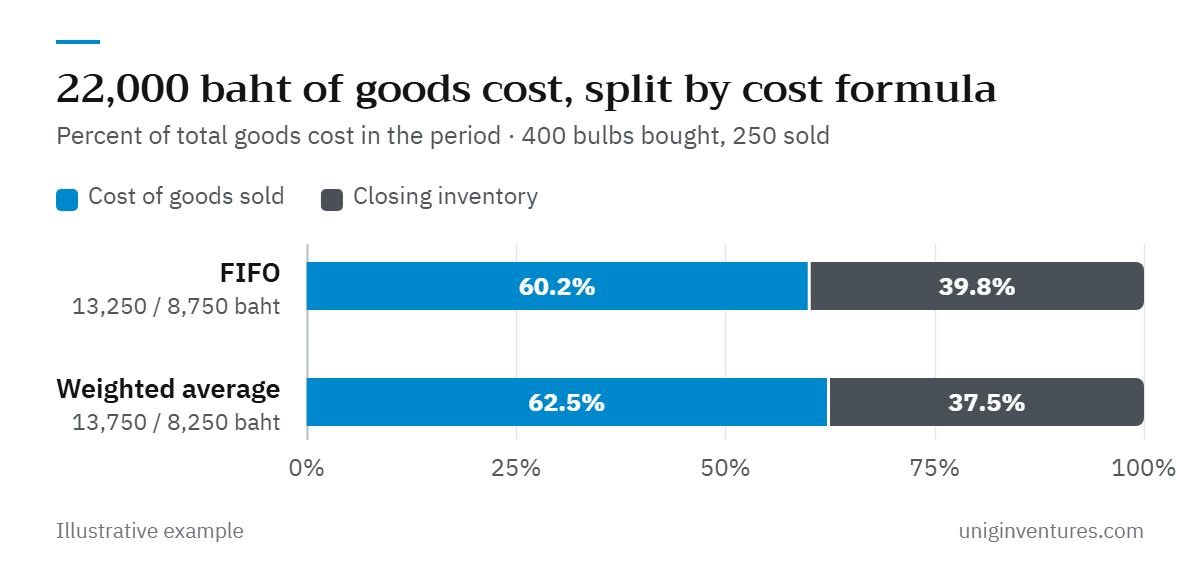
When purchase prices are rising, FIFO gives a lower cost of goods sold and a higher profit, while weighted average smooths the unit cost. Both are correct under the standard. They differ only in timing: in this example, the 500-baht difference flows into cost of goods sold next period, when the remaining bulbs are sold.
Which method to choose
- Specific identification suits large, distinguishable items such as vehicles, machinery or goods with serial numbers.
- FIFO matches how goods physically move when they expire or go out of date, and keeps closing stock close to the latest purchase prices.
- Weighted average suits large volumes of identical goods mixed together in a warehouse, because the unit cost does not jump with each lot. Many accounting programs use a moving average that recalculates every time stock arrives.
Whichever you choose, set up your accounting software to match the policy disclosed in your financial statement notes, and use the same method every year.
When you must write stock down
Net realizable value is the expected selling price in the ordinary course of business, less the costs needed to make the sale (paragraph 8.11). If goods are damaged, obsolete or selling below cost, you must write them down, and you assess this item by item (paragraph 8.12).
Continuing the illustrative example with weighted average: at year-end, 40 bulbs have dented boxes. The shop expects to sell them at 45 baht each and pay 3 baht each to ship them to the buyer.
Net realizable value = 45 − 3 = 42 baht per bulb
Write-down = 40 × (55 − 42) = 520 baht
Under the standard, the 520 baht is recorded as part of cost of goods sold in the period of the write-down (paragraph 8.16). For tax, "market price" under Section 65 bis (6) and net realizable value under the accounting standard are not defined the same way, and a general estimated allowance may count as a reserve, which Section 65 ter (1) bars from deduction. Keep evidence of actual selling prices or buyer quotes, and ask your accountant whether the amount must be added back on your tax return.
Stock counts and the tax cost of missing goods
Your system tells you what should be there. A count tells you what is actually there. Any unexplained gap is something you want to find before your auditor or a Revenue Department officer does.
Missing stock in your accounts
Suppose the system shows 150 bulbs but the count finds 144, so 6 are missing. At an average cost of 55 baht, the loss is 6 × 55 = 330 baht. Under the standard, this goes to administrative expenses, not cost of goods sold (paragraph 8.16).
Missing stock and VAT
- VAT-registered businesses that sell goods must keep a goods and raw materials report under Section 87 (3), with entries made within three business days of receiving or disposing of the goods, and must keep reports and supporting documents for at least five years under Section 87/3.
- Section 77/1 (8) (e) treats goods missing from the goods and raw materials report as sold, and Section 79 (3) uses the goods' market price on the date the liability arises as the tax base.
In the example, the 6 missing bulbs normally sell for 90 baht each, so the shop may owe VAT on a base of 6 × 90 = 540 baht even though no customer paid anything. If goods were destroyed by a cause you can prove, such as a natural disaster, keep the evidence and talk to your accountant before writing them off, because the tax result depends on the facts.
A year-end count procedure
- Stop goods moving during the count, or set a clear cut-off time, and make sure all receiving and delivery notes before that time are in the system.
- Separate goods that are not yours, such as consignment stock from suppliers or goods customers have paid for but not collected, and include your goods held elsewhere, such as stock on consignment at another shop.
- Count in pairs: one person counts and another records, on numbered count sheets, without seeing the system quantities first.
- Set aside damaged and slow-moving items for the write-down review described above.
- Investigate differences before adjusting. Large gaps often come from receiving goods in the wrong unit or sales that were never deducted from stock, not from real losses.
- Keep signed count sheets and a variance report. Your auditor may ask to observe the count and will want to see these documents.
Where to start
- Confirm your cost formula with your accountant, and check that your software settings match the policy disclosed in last year's notes. If you want to change methods, discuss Revenue Department approval first.
- Check that cost includes inbound freight. Many businesses expense freight immediately, which understates unit cost.
- Count part of your stock every month, such as your 20 highest-value items, so you find differences long before year-end.
- Run an inventory aging report. Items that have not moved for a long time should prompt a decision: discount, return or write down.
- If you are VAT-registered, check that your goods and raw materials report is updated on time and matches what is physically there.
Inventory that is valued the right way and counted to match the system makes monthly profit reliable, and leaves fewer questions to answer when auditors, banks or investors review your financial statements.
This article is general information, not accounting or tax advice for a specific case. Laws and standards are as of October 2026.
Sources
- TFRS for NPAEs (revised 2022), Chapter 8 Inventories, Federation of Accounting Professions (in Thai)
- Revenue Code, Sections 65–76 (Sections 65 bis (6) and 65 ter (1)), Revenue Department (in Thai)
- Revenue Code, Sections 77–79 (Sections 77/1 (8) (e) and 79 (3)), Revenue Department (in Thai)
- Revenue Code, Sections 87–90 (goods and raw materials report, record retention), Revenue Department (in Thai)