TFRS for NPAEs: The Accounting Standard Most Thai SMEs Use
Who can use TFRS for NPAEs, five areas where it is simpler than the full standards, the options added in the 2022 revision, and a lease example that nearly doubles debt-to-equity.
In this article
Most Thai SME owners sign off on their financial statements every year without knowing which accounting standard produced them. For almost every private limited company, the answer is TFRS for NPAEs, the Thai Financial Reporting Standard for Non-Publicly Accountable Entities. It decides the profit, liabilities and assets your statements show, including the figures your bank uses for credit decisions and the figures investors use to value the business.
This article explains which businesses can use the standard, where it differs from the full standards, which options the 2022 revision added, and when a company raising capital should start planning a switch to the full set.
Thailand Has Two Tiers of Accounting Standards
The Federation of Accounting Professions (TFAC) splits Thai financial reporting standards into two tiers (paragraph 1.1):
- TFRS for PAEs apply to publicly accountable entities. They follow IFRS and run to dozens of separate standards, such as TFRS 9 on financial instruments, TFRS 15 on revenue and TFRS 16 on leases.
- TFRS for NPAEs apply to non-publicly accountable entities. Thailand wrote this standard itself to cut the cost and effort of reporting for small and medium businesses. It fits in a single volume of 28 chapters.
The current version is TFRS for NPAEs (revised 2022), issued under TFAC Notification No. 48/2565 dated November 14, 2022. It applies to financial statements for periods beginning on or after January 1, 2023 (paragraph 28.1), replacing the original version in use since 2011.
Can Your Company Use TFRS for NPAEs?
The test is not revenue or registered capital. It is whether the entity is publicly accountable. Paragraph 2.2 lists four groups that cannot use the standard:
- Entities whose shares or debt trade publicly, on a domestic or foreign exchange or over the counter, and entities in the process of filing financial statements with the SEC or another regulator to offer securities to the public.
- Entities whose main business is holding assets for a broad group of outsiders, such as financial institutions, life and non-life insurers, securities companies and mutual funds.
- Public limited companies under the Public Limited Companies Act.
- Other entities that may be specified later.
Registered partnerships and private limited companies outside these four groups can all use TFRS for NPAEs, however large their sales. Travel agents, real estate brokers and pawnshops set up as private limited companies still count as non-publicly accountable (paragraph 2.3).
Paragraph 2.4 matters here. An entity that does not want to use this standard must apply all of TFRS for PAEs, consistently. It cannot mix individual full standards into the simplified one, except where TFRS for NPAEs itself offers an option, covered below.
Five Areas Where NPAEs Is Simpler
For a typical SME, five differences have the biggest effect on the numbers.
| Area | TFRS for NPAEs | TFRS for PAEs |
|---|---|---|
| Cash flow statement | Not required; optional if useful (paragraph 4.2) | Required |
| Income tax | Record only the tax payable for the year (paragraph 15.1) | Deferred tax required under TAS 12 |
| Leases (lessee) | Operating lease payments expensed on a straight-line basis, nothing on the balance sheet (paragraph 14.38) | Right-of-use asset and lease liability for almost every lease under TFRS 16 |
| Employee benefits | Best estimate of the amount payable at the reporting date (paragraph 16.14) | Actuarial method under TAS 19 |
| Investments in subsidiaries and associates | Cost less impairment, no consolidated statements (paragraph 9.12) | Consolidated statements under TFRS 10 |
Revenue also differs. TFRS for NPAEs recognizes revenue from goods when the significant risks and rewards of ownership pass to the buyer (paragraph 18.6), and revenue from services by stage of completion (paragraph 18.14). TFRS for PAEs use TFRS 15, which looks at each performance obligation in a contract. For straightforward sales the results are close. For bundled contracts, such as equipment sold with several years of service, the timing of revenue can differ.
For goodwill from an acquisition, when its useful life cannot be determined reliably, the revised standard requires straight-line amortization over 20 years (paragraphs 25.8.1 and 25.8.2).
Options Added in the 2022 Revision
The revision keeps the simple methods but lets entities opt into full-standard treatment in some areas (paragraph 1.3). Any option chosen must follow every requirement of the relevant full standard and be applied the same way every year.
- Deferred tax using the balance sheet liability method, applying all of TAS 12 (paragraph 15.2).
- Employee benefits under TAS 19, under the same condition (paragraph 16.14).
- Revaluation of property, plant and equipment to fair value. If chosen, every item in the same class must be revalued together (paragraphs 10.18–10.19), and increases go to a revaluation surplus in equity, not to profit (paragraph 10.20).
- Consolidated statements or the equity method. If chosen, the entity must follow TAS 27, TAS 28, TFRS 10, TFRS 11 and TFRS 12.
- A statement of comprehensive income, and a functional currency other than the baht.
The revision also added chapters for transactions the original version did not cover, including agriculture, derivatives, business combinations, government grants and service concession arrangements (paragraph 1.3.1). Entities that once had to use the full standards because of these transactions can now stay on the simplified one.
Revaluing land can raise equity and improve the debt-to-equity ratio, but it comes with obligations. Revaluations must be kept current; the standard treats every three to five years as enough when fair value has not moved much. And the method applies to every plot in the class, not just the ones that have gone up.
Example: How Much One Office Lease Changes the Statements
Illustrative example: a company has total liabilities of 5,000,000 baht and equity of 4,000,000 baht. It signs a three-year office lease at 100,000 baht a month, paid at month-end. Assume a 6% annual discount rate.
Under TFRS for NPAEs
An office lease that does not transfer the risks and rewards of ownership is an operating lease. The company expenses 1,200,000 baht of rent a year and adds nothing to the balance sheet. It only discloses future minimum lease payments in the notes (paragraph 14.39).
Under TFRS for PAEs (TFRS 16)
The company recognizes a lease liability equal to the present value of the 36 payments, and a right-of-use asset of the same amount.
Present value = payment × [1 − (1 + monthly rate) to the power of −number of payments] ÷ monthly rate
= 100,000 × [1 − 1.005 to the power of −36] ÷ 0.005 ≈ 3,287,000 baht
| Item | NPAEs | PAEs (TFRS 16) |
|---|---|---|
| Total liabilities at lease start | 5,000,000 | 8,287,000 |
| Debt-to-equity | 1.25× | 2.07× |
| Year-one expense | Rent 1,200,000 | Depreciation 1,095,700 + interest 169,200 = 1,264,900 |
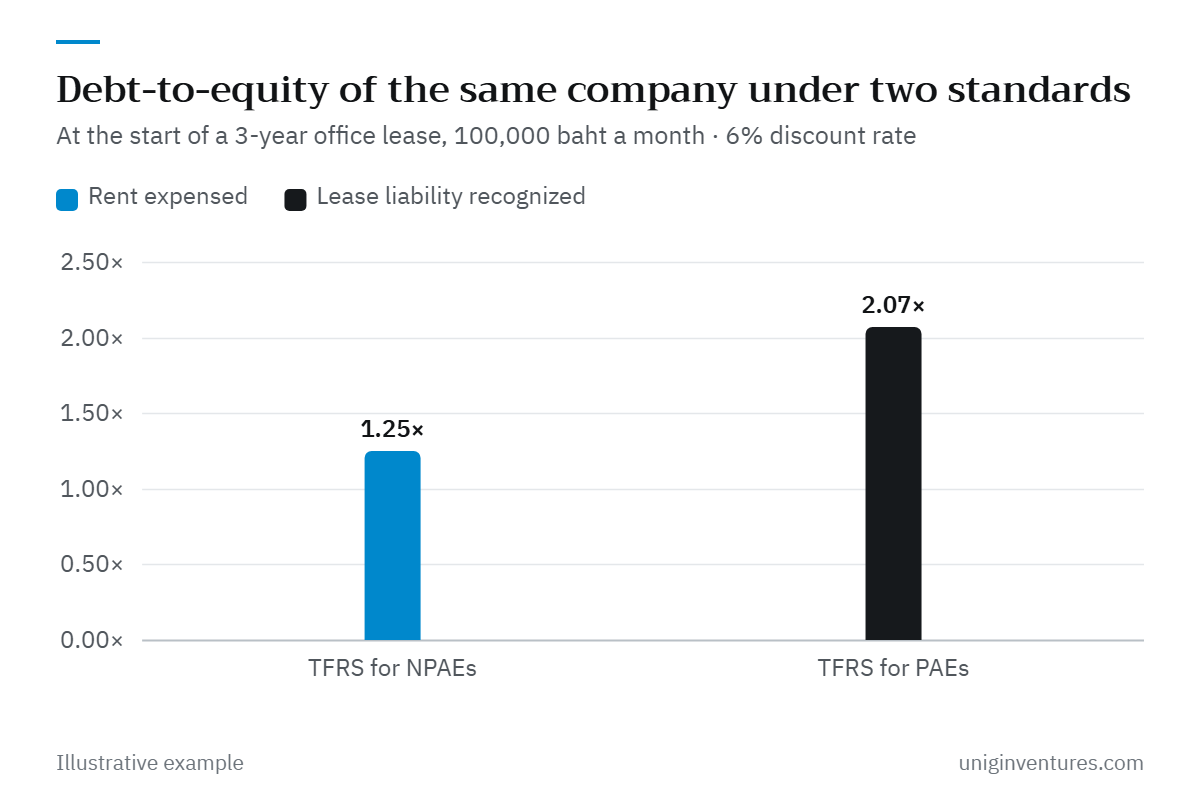
Nothing about the business changed, but the ratio a bank uses to set loan covenants did. EBITDA under TFRS 16 also rises, because rent moves into depreciation and interest. When comparing statements prepared under different standards, or one company's statements before and after a switch, you need to know which basis produced the numbers. TFRS 16 does exempt short-term leases of 12 months or less and leases of low-value assets, which can still be expensed.
When to Consider Moving to the Full Standards
- You plan to list. An entity filing financial statements with the SEC to offer securities to the public is no longer an NPAE (paragraph 2.2.1). Your accounting system, team and auditor need to be ready to report under the full standards before that point.
- You convert to a public limited company. The full standards apply at once (paragraph 2.2.3).
- Your investor or parent reports under IFRS. A fund or parent company that consolidates your results may ask for IFRS or full TFRS figures. Ask during term sheet talks what format they need and how often.
- Your transactions are complex. With bundled multi-year contracts or many leases, knowing your full-standard numbers early avoids a surprise when the switch comes.
Changing standards is a change in accounting policy, which generally means restating prior periods so the figures stay comparable. Under TFRS for PAEs it also means presenting a third balance sheet, at the start of the comparative period. This is not a one-month job. For companies without these plans, the revised TFRS for NPAEs offers enough options for most businesses without the burden of the full set.
Where to Start
- Read the first notes to your financial statements. They state the basis of preparation: whether the company uses TFRS for NPAEs or the full standards, and which options it has chosen.
- Ask your accountant which options apply: deferred tax, TAS 19, revaluation, consolidation. Have them written down as policy, since they must stay the same each year.
- List your leases with the remaining payments. If you talk to investors or banks used to TFRS 16, you can say how much liabilities would rise on that basis.
- Prepare a cash flow statement for internal use, even though the standard does not require one. Most investors and banks ask for it, and it is the statement that shows how long the company can keep going.
- If a large funding round or listing is ahead, talk to your auditor early about when to start reporting under the full standards.
This article is general information, not accounting advice for a specific case. Standards are as of October 2026. Check the latest TFAC notifications with your accountant or auditor.
Sources
- TFRS for NPAEs (revised 2022), TFAC Notification No. 48/2565 — Federation of Accounting Professions (Thai)
- Summary of differences between TFRS for NPAEs (revised 2022) and TFRS for PAEs (published October 2, 2023) — Federation of Accounting Professions (Thai)
- Tax knowledge for tax auditors: TFRS for NPAEs (revised 2022) documents — Revenue Department (Thai)