Salary or Dividends: How Thai Company Owners Can Pay Themselves Tax-Efficiently
Compare the combined tax on company and owner when you take salary, dividends or a mix. See the 23.5% crossover point, a worked example, and the legal conditions for paying dividends.
In this article
Owners who work in their own company have two main ways to take money out: a salary or dividends. Many choose by habit. Some take no salary at all and wait for a year-end dividend. Others set a salary so high that the company shows no profit. Both approaches can mean paying more total tax than necessary.
This article explains how each route is taxed in Thailand, the point where salary becomes more expensive than dividends, a worked example of four options from the same profit, and the legal conditions you must meet before paying a dividend.
Where each route is taxed
Salary
Salary actually paid for the business is a company expense, so it reduces the profit subject to corporate income tax. The owner pays personal income tax at progressive rates. The company must withhold tax every month and remit it on form P.N.D.1.
- Salary is Section 40 (1) income. Under Section 42 bis you can deduct a flat 50% as expenses, capped at 100,000 baht.
- The personal allowance is 60,000 baht, plus any other allowances you qualify for.
- If the owner is insured as an employee, the company and the owner each pay social security contributions of 5% of wages. From January 1, 2026, the wage ceiling rose to 17,500 baht, so the maximum contribution is 875 baht a month from each side.
| Net taxable income (baht) | Tax rate |
|---|---|
| 0 – 150,000 | Exempt |
| 150,001 – 300,000 | 5% |
| 300,001 – 500,000 | 10% |
| 500,001 – 750,000 | 15% |
| 750,001 – 1,000,000 | 20% |
| 1,000,001 – 2,000,000 | 25% |
| 2,000,001 – 5,000,000 | 30% |
| Over 5,000,000 | 35% |
Dividends
Dividends come out of after-tax profit, so the company pays corporate income tax first. For an SME with paid-up capital of no more than 5 million baht and revenue from sales of goods and services of no more than 30 million baht, the first 300,000 baht of net profit is exempt, profit above that up to 3 million baht is taxed at 15%, and profit above 3 million baht at 20%. Other companies pay 20% on all profit.
When it pays a dividend to an individual, the company withholds 10%. The recipient then has two choices:
- Treat the 10% withheld as final tax and leave the dividend out of other income.
- Include it on the P.N.D.90 return and claim the dividend tax credit under Section 47 bis.
Dividend tax credit = company tax rate ÷ (100 − that rate) × dividend
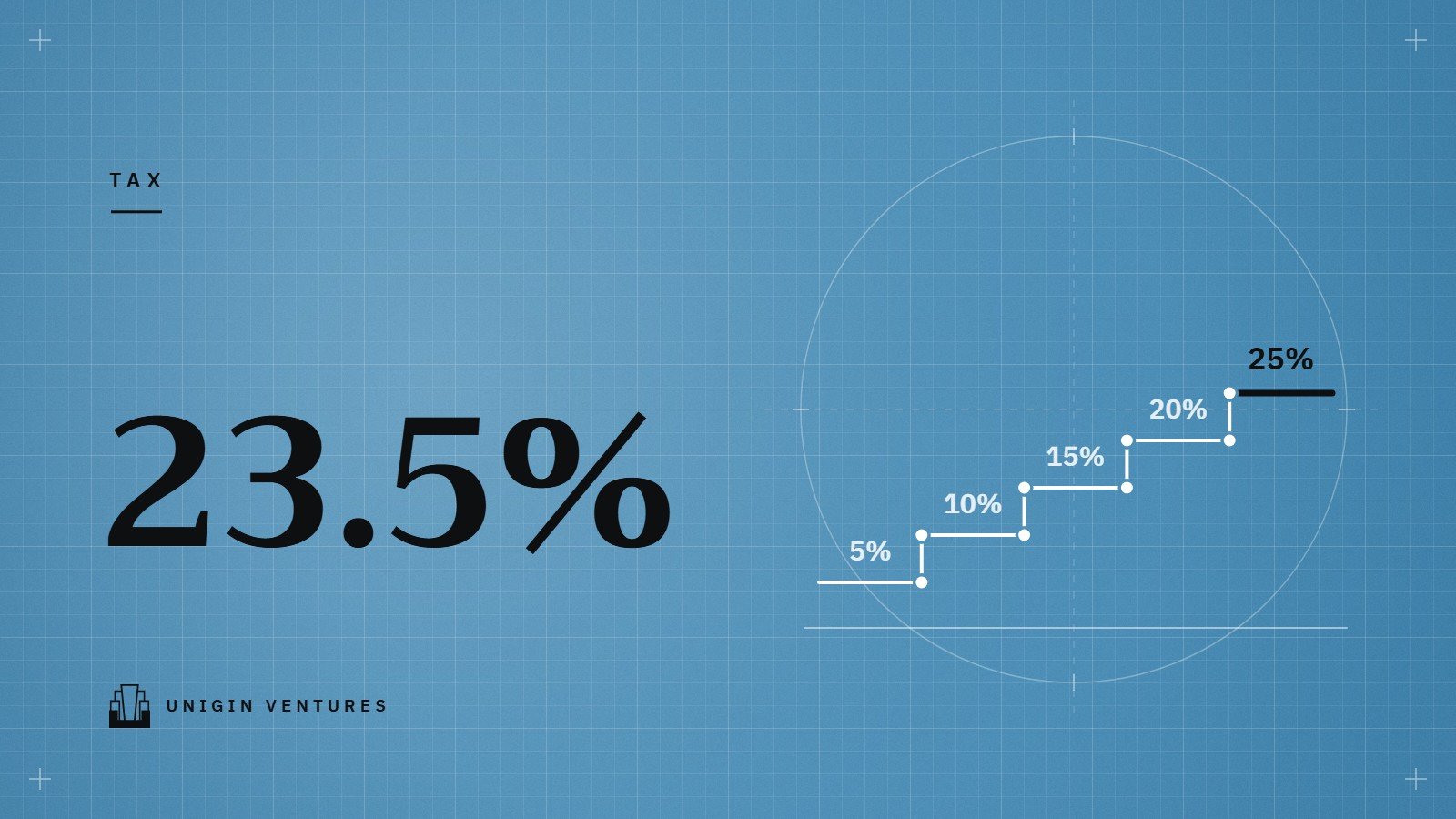
The crossover is 23.5%
The simplest comparison is to ask how much total tax the last baht of profit you take out bears under each route. If you treat the 10% dividend tax as final:
Total tax on the dividend route = corporate tax rate + (1 − corporate tax rate) × 10%
- Profit in the exempt band (an SME's first 300,000 baht): 10% in total
- Profit in the 15% band: 15% + 85% × 10% = 23.5%
- Profit in the 20% band: 20% + 80% × 10% = 28%
On the salary route, the last baht is taxed at the owner's top marginal rate. The rule is: keep adding salary while the owner's marginal rate is below the total tax on the dividend route. For an SME whose profit sits in the 15% band, salary wins until the owner's net taxable income reaches 1,000,000 baht (the 20% bracket). Once the owner moves into the 25% bracket, dividends at 23.5% are cheaper.
Four options, worked through
In this illustrative example, an SME earns 2,000,000 baht a year before the owner's pay and the company's share of social security. We also assume:
- The owner receives all dividends (minority shareholders are left out to keep the math simple), and the company pays out all after-tax profit.
- The company's legal reserve is already full.
- The owner has no other income and claims only the 60,000-baht personal allowance and 10,500 baht a year of social security contributions.
- The owner treats the 10% dividend tax as final.
| Baht per year | All dividends | 600,000 salary | 1,170,500 salary | All salary |
|---|---|---|---|---|
| Salary | 0 | 600,000 | 1,170,500 | 1,989,500 |
| Social security (owner + company) | 0 | 21,000 | 21,000 | 21,000 |
| Company profit | 2,000,000 | 1,389,500 | 819,000 | 0 |
| Corporate income tax | 255,000 | 163,425 | 77,850 | 0 |
| Dividend | 1,745,000 | 1,226,075 | 741,150 | 0 |
| Dividend tax at 10% | 174,500 | 122,608 | 74,115 | 0 |
| Personal income tax on salary | 0 | 20,450 | 115,000 | 319,750 |
| Total tax | 429,500 | 306,483 | 266,965 | 319,750 |
| Owner's net take-home | 1,570,500 | 1,672,517 | 1,712,035 | 1,659,250 |
A salary of 1,170,500 baht a year (about 97,500 baht a month) brings the owner's net taxable income to exactly 1,000,000 baht (1,170,500 − 100,000 expense deduction − 60,000 personal allowance − 10,500 social security). It produces the lowest total tax of the four options and leaves the owner 141,535 baht a year better off than taking everything as dividends.
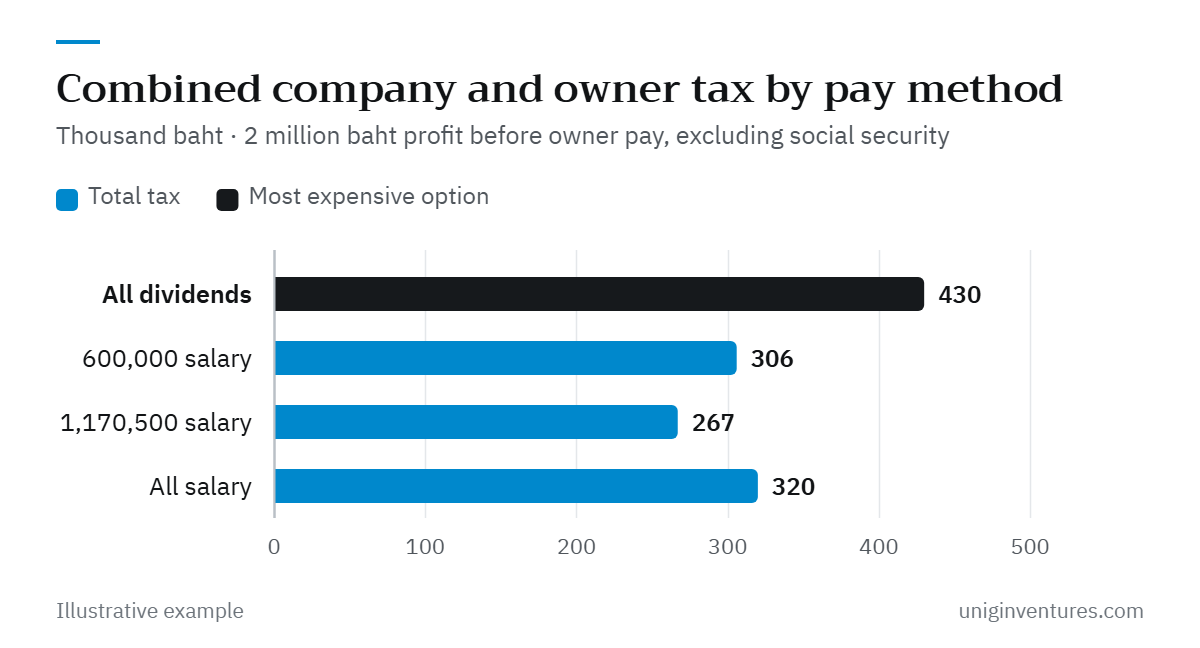
These figures hold only under the assumptions above. If the owner has other income or more allowances, the best salary level moves.
When the answer changes
- Company profit above 3 million baht. Profit above that line bears 28% on the dividend route, so salary stays cheaper until the owner reaches the 30% bracket.
- Company profit below 300,000 baht. The dividend route costs only 10%, so salary that pushes the owner into the 15% bracket or higher costs more.
- Owner with low total income. Including dividends on the return and claiming the tax credit may produce a refund. The credit depends on the tax rate the company actually paid on the profit distributed, so ask your accountant to run both methods before you file.
- Not paying out all profit. Profit kept in the company bears only corporate tax. Dividend tax arises only when you pay. If the company needs the cash to grow, retaining profit may make more sense.
Conditions you must meet
Before paying a dividend
The Department of Business Development summarizes the rules in Sections 1200–1205 of the Civil and Commercial Code:
- Dividends may be paid only out of profit and require a shareholders' resolution. During the year, directors may resolve to pay an interim dividend if they consider the company has sufficient profit.
- Each time a dividend is paid, at least 5% of profit must go to a reserve until the reserve reaches 10% of registered capital, or as the company's articles require.
- All shareholders must be notified, and payment must be completed within one month of the resolution.
If the company still has accumulated losses from earlier years, ask your auditor whether it can pay a dividend at all, because this year's profit alone may not be enough. A company that cannot pay dividends is left with salary as the only route.
Before setting the owner's salary
- Set a monthly rate that is actually paid on a regular basis, approved by resolution or in writing, with tax withheld and remitted every month.
- Keep the salary in line with the work the owner actually does. A large lump sum declared at year-end only to cut profit is harder to justify to the tax authorities.
- Check with the Social Security Office whether a director who owns the company qualifies as an employee under Section 33, since this affects both contributions and benefits.
Non-tax factors
- Company cash. Salary goes out every month, while dividends go out as a lump sum after the books close. A company with tight cash may not be able to sustain a high salary in a month when sales drop.
- Personal borrowing. Lenders usually want evidence of regular income, such as withholding tax certificates for salary.
- Investors. If you plan to raise funding, investors will check whether the founder's salary is reasonable for the size of the company, and accounts that include the owner's pay show the true cost of running the business.
Where to start
- Estimate the company's full-year profit before owner pay and see which tax band it falls into.
- Add up the owner's other income and allowances to see which salary level would push net taxable income into a bracket above the dividend route's total rate.
- Set the monthly salary at that level from the start of the year rather than adjusting in one lump at year-end.
- When the books close, check accumulated losses and the reserve, then decide how much to pay as dividends and how much to keep.
- Have your accountant or tax adviser check the numbers every year, because profit, other income and the rules can all change.
Sources
- Personal income tax rates — Revenue Department
- Revenue Code Sections 38–64 (Sections 42 bis, 47 bis and 50) — Revenue Department
- Allowances available to taxpayers — Revenue Department
- Corporate income tax guide for SMEs — Medium and Small Business Tax Administration Division, Revenue Department
- Revenue Department Order No. Por. 119/2545 (dividend tax credit) — Revenue Department
- Contribution wage base of 1,650–17,500 baht (from January 1, 2026) — Social Security Office
- Returns from doing business: profit shares and dividends — Department of Business Development