Deductible and Non-Deductible Expenses in Thailand: Section 65 ter and Caps
Why taxable profit ends up higher than accounting profit, five questions to ask before booking an expense, the 0.3% entertainment cap, the 1 million baht car limit, and a worked add-back example.
In this article
The income statement says the company made 1.5 million baht. The PND 50 corporate tax return calculates tax on 1.8 million. Many owners first meet this gap when the auditor sends the draft return for signature. The difference comes from expenses the company really paid and properly booked, but which Thai tax law does not allow as deductions.
This article explains which expenses are fully deductible, which are deductible only up to a cap, and which are not deductible at all under Section 65 ter of the Revenue Code. It includes five questions to ask before approving an expense, and a worked example of how much tax non-deductible expenses add.
Accounting profit and taxable profit are different numbers
Corporate income tax is charged on net taxable profit. That figure starts with the profit in the financial statements and is then adjusted under the Revenue Code. For most SMEs, the biggest adjustment is non-deductible expenses under Section 65 ter. These expenses stay in the financial statements as usual, but they are added back to profit when tax is calculated.
The PND 50 return has a dedicated schedule for them, titled "expenses not allowed as expenses under the Revenue Code," with separate lines for corporate income tax, entertainment, bad debts, reserves and other disallowed items. The total is added to net profit per the accounts.
Two things follow. Every baht of non-deductible expense carries an extra tax cost at the company's tax rate. And if the company fails to add an item back and a tax officer finds it later, the unpaid tax attracts a surcharge of 1.5% per month.
Five questions before booking an expense
Section 65 ter has 20 subsections, but five questions settle most SME expenses. If the answer to all five is yes, the expense is deductible.
- Was it paid specifically for the business or to earn profit? The owner's personal expenses, gifts made out of goodwill and spending unrelated to the business are not deductible, under subsections (3) and (13).
- Can you prove who received the money? An expense whose recipient the payer cannot identify is not deductible, under subsection (18). The supporting document therefore has to show the recipient's name, the date, the item and the amount.
- Was it actually paid, and does it belong to this accounting period? Expenses the company sets for itself without real payment, and expenses that belong to another period, are not deductible, under subsection (9).
- Is it an expense rather than an investment? Buying, extending, expanding or improving an asset is capital expenditure under subsection (5). It cannot be deducted in full in the year of payment and is deducted gradually as depreciation instead. Repairs that only keep an asset in its original condition are deductible in the year paid.
- Is it within the legal cap? Some expenses are deductible only up to a limit, and the excess must be added back. See the table below.
Expenses deductible up to a cap
| Expense | Deductible up to | Key conditions |
|---|---|---|
| Entertainment and hospitality | 0.3% of revenue, or of paid-up capital on the last day of the accounting period, whichever is higher, and no more than 10 million baht | Necessary by normal business custom; the guest is not an employee, unless the employee has a duty to attend; approved by an authorized person; supported by a receipt |
| Gifts to people being entertained | 2,000 baht per person per occasion | The first 2,000 baht also counts toward the 0.3% cap |
| Donations to public charity or for public benefit | 2% of net profit | Given to organizations specified by law |
| Spending on education or sports | A further 2% of net profit | As specified by law |
| Passenger cars and passenger vehicles with no more than 10 seats (purchased) | A cost of 1 million baht per vehicle | Depreciation on the cost above the cap is not deductible |
| The same types of vehicle (leased) | 36,000 baht per vehicle per month, or 1,200 baht per day | Rent above the cap is not deductible |
| Salaries of shareholders or partners | A reasonable amount | The part paid in excess of what is reasonable is not deductible |
Entertainment is the item SMEs get wrong most often, because the cap is lower than people expect. A company with revenue of 20 million baht can deduct only 60,000 baht of entertainment for the whole year. The Revenue Department publishes a worksheet for checking this yourself, based on amounts paid including VAT. Its own example is a 5,000 baht gift basket: 2,000 baht counts as entertainment, and the other 3,000 baht is added back before the overall cap is even applied.
The vehicle caps, set by Royal Decree No. 315, do not apply to cars that a car dealer or car rental business holds for sale or for rent.
Expenses that are never deductible
- Personal expenses. The owner's family costs, private travel and items unrelated to the business.
- Tax penalties, tax surcharges and criminal fines, as well as corporate income tax itself, under subsection (6).
- Expenses with no identifiable recipient, such as cash paid without a receipt, or a cash bill that does not show who the seller is.
- Expenses set by the company without real payment, and charges for the use of assets the company itself owns and uses, under subsections (9) and (10).
- Reserves, such as provisions for costs that have not yet been incurred, under subsection (1). Contributions to a provident fund registered under the law are deductible within the rules of subsection (2).
- VAT and input tax of a VAT-registered business, under subsection (6 bis), because the company already claims the credit through the VAT system. Some input tax that cannot be credited may be booked as an expense under specific exceptions, so check each case with your accountant.
- Expenses payable out of profit after the accounting period has ended, under subsection (19).
Prior-year losses are not an expense of the current year, but the law allows net losses carried forward from up to five previous accounting periods to be set against profit, under subsection (12).
Worked example: how much tax non-deductible expenses add
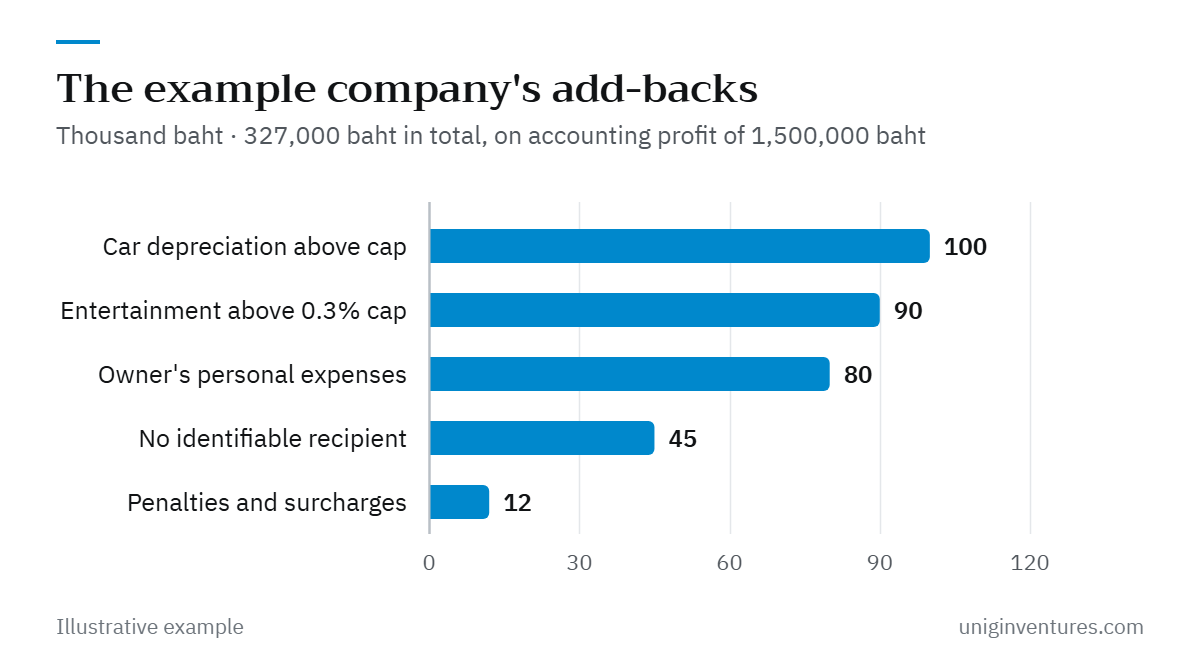
Illustrative example: a company has revenue of 20 million baht, paid-up capital of 2 million baht, and net profit of 1,500,000 baht in its financial statements. The accountant finds five expenses that need adjusting.
| Item | Booked (baht) | Deductible (baht) | Added back (baht) |
|---|---|---|---|
| Depreciation on a 1,500,000 baht passenger car, depreciated over 5 years | 300,000 | 200,000 | 100,000 |
| Client entertainment; cap is 0.3% × 20,000,000 = 60,000 | 150,000 | 60,000 | 90,000 |
| Owner's personal expenses paid by the company | 80,000 | 0 | 80,000 |
| Cash expenses with no document identifying the recipient | 45,000 | 0 | 45,000 |
| Penalties and surcharges for late tax filing | 12,000 | 0 | 12,000 |
| Total | 587,000 | 260,000 | 327,000 |
The entertainment cap is the higher of 0.3% of revenue (60,000 baht) and 0.3% of paid-up capital (6,000 baht). For the car, tax depreciation can be calculated on a cost of only 1,000,000 baht, or 200,000 baht a year.
Net taxable profit = profit per financial statements + non-deductible expenses = 1,500,000 + 327,000 = 1,827,000 baht
This company qualifies for the SME tax rates (paid-up capital of no more than 5 million baht and revenue of no more than 30 million baht). The first 300,000 baht of profit is exempt, and profit above that up to 3 million baht is taxed at 15%.
- With no non-deductible expenses: (1,500,000 − 300,000) × 15% = 180,000 baht
- After the add-backs: (1,827,000 − 300,000) × 15% = 229,050 baht
- Additional tax: 49,050 baht, or 15% of the 327,000 baht of non-deductible expenses
The tax actually paid is therefore 15.27% of accounting profit, not the 12% the owner expected. If the company's profit were in the 20% band, the same non-deductible expenses would cost 65,400 baht in tax.
Make expenses deductible on the day you pay
- Get a document that identifies the recipient every time. A tax invoice or receipt issued in the company's name. If the seller cannot issue a receipt, prepare a payment voucher with the recipient's name, address and signature, and keep the transfer record.
- Keep entertainment in its own account. Record who was entertained, the occasion and who approved it, and track the running total against the 0.3% cap every quarter.
- Don't pay personal costs through the company. If it has already happened, record the amount as money the director owes the company, not as an expense.
- Work out the tax before buying or leasing a car. A passenger car costing more than 1 million baht, or leased for more than 36,000 baht a month, has a non-deductible portion every year of its life.
- File and pay tax on time. Penalties and surcharges cost you twice, because you pay them and still cannot deduct them.
Where to start
- Ask your accountant for the "expenses not allowed" schedule from your latest PND 50 and see which line is largest.
- Calculate this year's entertainment cap from your revenue forecast and tell the sales team the number.
- Build the five questions into your expense claim form or approval process.
- Go through last month's cash expenses, find the ones with no document identifying the recipient, and fix the way those payments are made.
- Ask your accountant every quarter for the running total of add-backs. Don't wait to find out at year-end.
Most non-deductible expenses don't come from complicated tax planning. They come from incomplete documents and caps nobody tracks. A company that checks expenses against the same questions every time it pays will know its tax bill before the filing deadline. Tax law has many more exceptions and details, so talk to your accountant or tax adviser before paying anything large or unusual.
Sources
- Conditions for calculating net profit under Section 65 ter (non-deductible expenses) — Revenue Department (in Thai)
- Revenue Code, Chapter 3 Income Tax, Sections 65–76 (text of Section 65 ter) — Revenue Department (in Thai)
- Ministerial Regulation No. 143 (1979) on entertainment expenses — Revenue Department (in Thai)
- How to book entertainment expenses correctly under tax law (cap calculation example) — Revenue Department (in Thai)
- Royal Decree No. 315 (1997) on passenger car expenses — Revenue Department (in Thai)
- Corporate income tax manual for SMEs (tax rates and surcharges) — SME Tax Administration Division, Revenue Department (in Thai)