Sales Commission on Gross Profit, Not Revenue: Stop Paying for Discounts
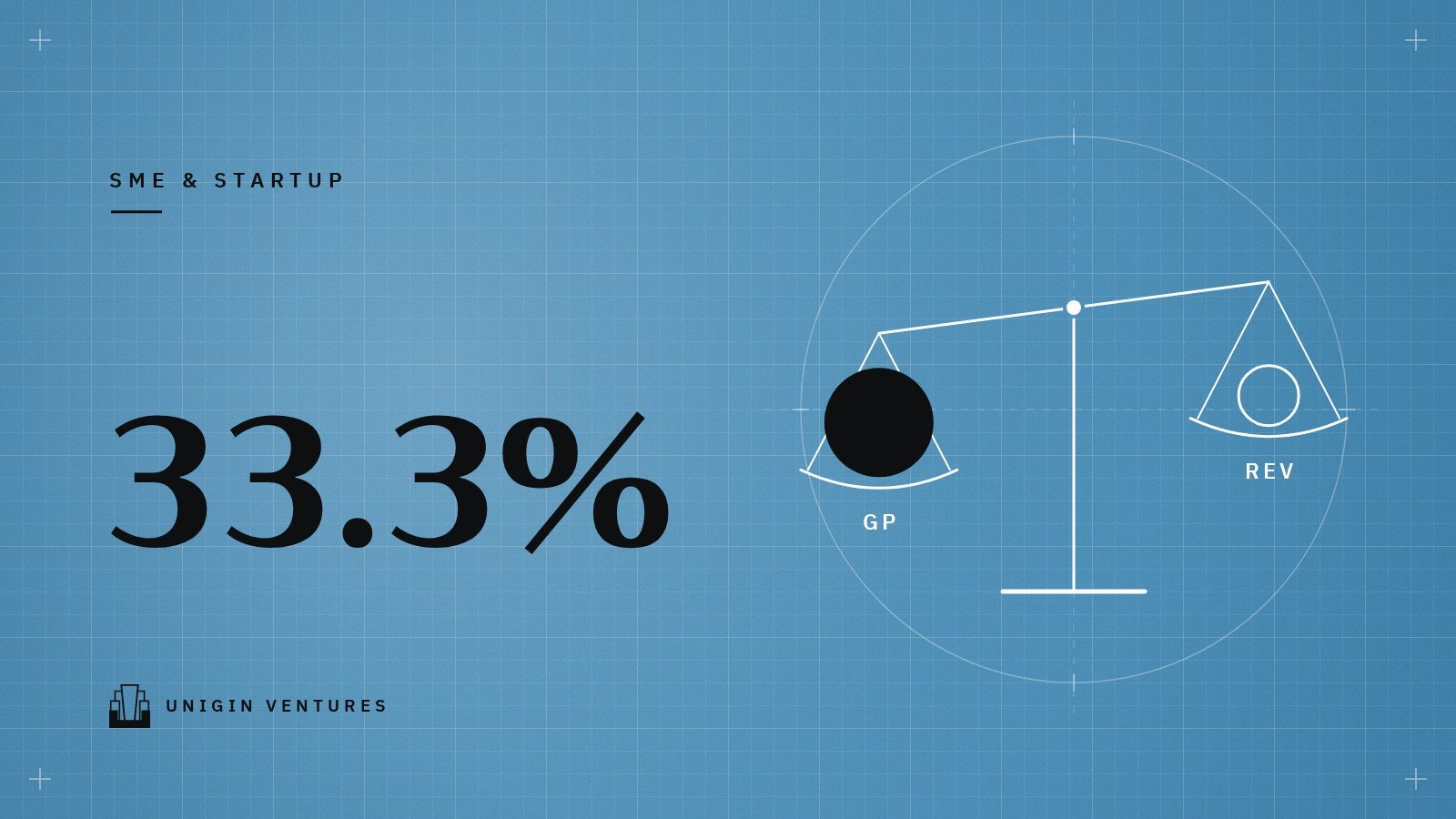
A 10% discount at a 30% gross margin wipes out 33.3% of gross profit, yet a revenue-based commission falls only 10%. Compare the two plans and design one that pays on gross profit.
In this article
Many companies pay salespeople a percentage of revenue. It is easy to calculate and easy to explain. The weakness shows when a salesperson offers a discount. Every baht of discount comes straight out of the company's gross profit, while the salesperson's commission drops only slightly. A salesperson can close a deal with a discount at almost no personal cost, and the company absorbs nearly all of it.
This article shows with numbers why a discount costs more gross profit than it appears to, compares commission on revenue with commission on gross profit, and walks through how to design a new plan: the profit definition, the rate, margin floors, paying on collection, and moving an existing sales team to the new plan.
A discount costs more gross profit than it looks
The cost of the goods does not fall when you give a discount, so the whole discount disappears from gross profit. The effect depends on the product's gross margin:
Drop in gross profit (%) = discount (% of list price) ÷ gross margin at list price (%)
On a product with a 30% gross margin, a 10% discount cuts the deal's gross profit by 10 ÷ 30 = 33.3%. At a 20% margin, the same discount wipes out half of it. If commission is a share of revenue, the salesperson's commission falls by only 10%, the size of the discount. The same discount carries very different weight for the salesperson and for the company.
For the same reason, a price increase will not stick if the sales team keeps handing discounts back. See the pricing side in raising prices without losing customers.
The two plans side by side
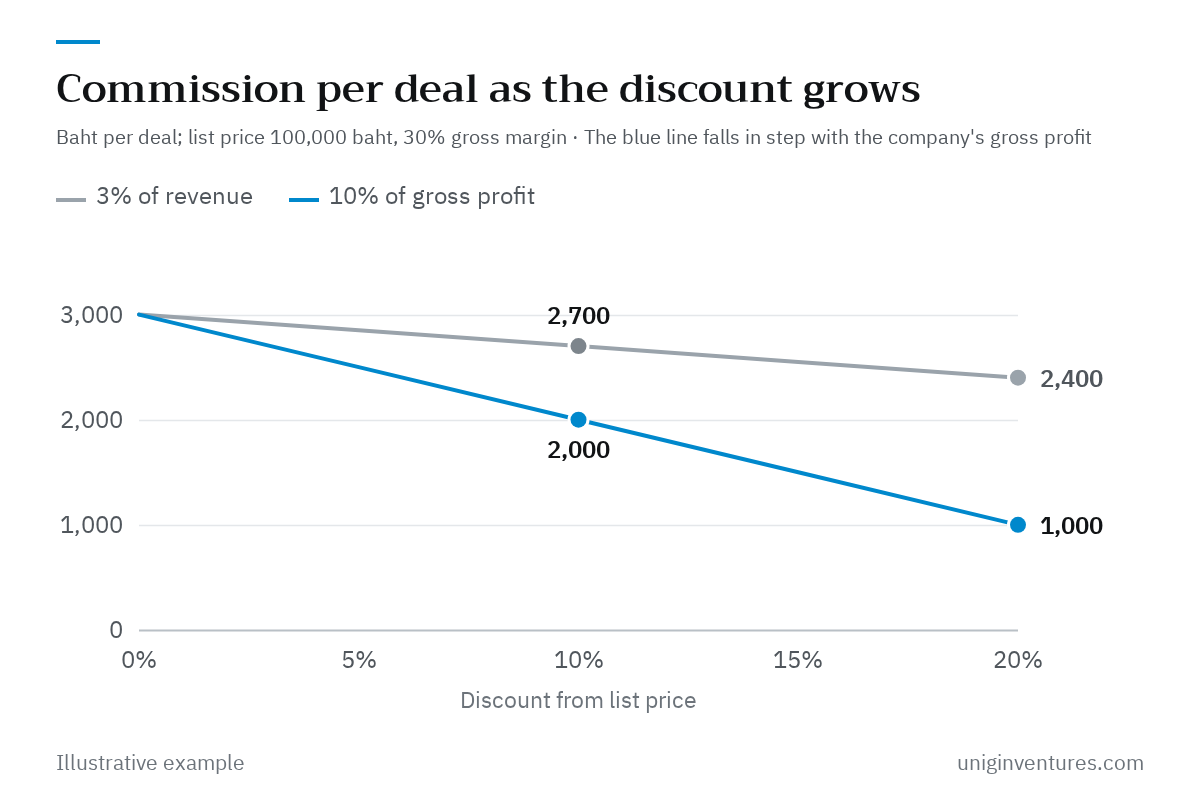
In an illustrative example, a deal has a list price of 100,000 baht and cost of goods of 70,000 baht, for a gross profit of 30,000 baht (30%). Plan one pays 3% of revenue. Plan two pays 10% of gross profit. At list price, both pay 3,000 baht.
| Discount | Revenue | Gross profit | 3% of revenue | As a share of gross profit | 10% of gross profit |
|---|---|---|---|---|---|
| 0% | 100,000 | 30,000 | 3,000 | 10.0% | 3,000 |
| 5% | 95,000 | 25,000 | 2,850 | 11.4% | 2,500 |
| 10% | 90,000 | 20,000 | 2,700 | 13.5% | 2,000 |
| 15% | 85,000 | 15,000 | 2,550 | 17.0% | 1,500 |
| 20% | 80,000 | 10,000 | 2,400 | 24.0% | 1,000 |
At a 20% discount, the company keeps a third of its gross profit, but the revenue-based commission keeps 80% of its value and its share of gross profit rises from 10% to 24%. Under the gross-profit plan, commission falls in step with the company's profit.
Look at it another way: the extra volume needed to make up for the discount. If every deal carries a 10% discount, the company must sell 50% more to earn the same total gross profit (30,000 ÷ 20,000 = 1.5 times). A salesperson paid on revenue needs only 11.1% more deals to earn the same commission (3,000 ÷ 2,700 = 1.11 times). Under the gross-profit plan, the salesperson needs 50% more, the same as the company. Discounting pays off for a salesperson on a revenue plan even when it does not pay off for the business.
Designing a gross-profit commission plan
Define the gross profit you pay on
The number you pay on does not have to match gross profit in the financial statements. It should reflect what the salesperson controls: price, discount and product mix.
Commissionable gross profit = net sales after discounts − standard cost of goods − deal-specific costs the salesperson agreed to give the customer
- Net sales after every form of discount, including free goods, invoice-level discounts and volume rebates.
- Standard cost is a unit cost for each product set in advance, for example every quarter, used instead of the actual cost that moves with purchase prices. Salespeople do not control purchasing, so they should not gain or lose from it. Announce changes to standard costs before they take effect.
- Deal-specific costs such as free delivery, installation or an extended warranty that the salesperson offers. If you leave them out, discounts come back as free services.
Set the rate from target pay
Commission rate = target annual commission ÷ target annual gross profit for the role
In an illustrative example, the company wants a salesperson who hits target to earn 240,000 baht a year in commission, and the role's gross profit target is 2,400,000 baht a year. The rate is 240,000 ÷ 2,400,000 = 10%. Before you switch, run the last 6–12 months of actual deals through both the old and the new plan. An average performer should earn about the same. The people who earn much less tend to be the ones who discount the most, which is the behavior the new plan is meant to change.
Margin floors and tiers
- Margin floor. For example, deals below a 15% gross margin earn no commission unless approved before the quote goes out. The figure is illustrative; set yours from your own costs.
- Accelerator. For example, 10% up to target and 12% on gross profit above target. Use no more than two or three tiers. A plan salespeople cannot calculate themselves will not change what they do.
Pay when the customer pays
A deal that is never collected has no profit to share. Pay commission after the customer pays, and state in writing that if goods are returned, or the invoice is still unpaid past a set point such as 90 days, the commission on that deal is deducted from the next payout. This gets the sales team thinking about customer credit before they close. See how to track overdue invoices in aged receivables and bad debts.
What you need before you switch
- Cost by product in your sales or accounting system. If you do not have it yet, start with the products that make up about 80% of total sales. See the method in contribution margin by product.
- Discounts recorded line by line on invoices, not buried in the product price or issued later as credit notes that are not tied to the deal.
- Quotes that show the effect immediately. Salespeople should see the gross profit and their own commission before they offer a discount. A spreadsheet where they enter the price and get the numbers is enough to start.
- A monthly statement for each salesperson listing every deal with revenue, discount, gross profit and commission, so people can check their own numbers.
If you are not ready to share costs with the sales team, a middle path is to keep paying on revenue but cut the rate as the discount grows. For example, pay 3% on discounts up to 5%, 2% on discounts above 5% and up to 10%, and require approval for anything above 10%. These figures are illustrative. The method is rougher because it ignores margin differences between products, but it still puts a price on discounting for the salesperson.
Tax, and moving an existing team to the new plan
Commission paid to employees is assessable income for the employee. The company must withhold tax under Section 50(1) of the Revenue Code, which covers income under Section 40(1) and (2), just as it does for salaries, and remit it with Form PND 1 for the month it pays. See the monthly steps in monthly employer duties.
Changing the plan for people already on the team has to be done in a way they can trust:
- Write the plan down: who is eligible, the gross profit definition, the rate, floors, payment dates, clawbacks, how standard costs are updated, and what happens to open deals when someone leaves.
- Run both plans in parallel for 2–3 months. Keep paying under the old plan, but send each salesperson a statement under the new one every month.
- Start at the beginning of a quarter, not in the middle of a period when people are closing deals.
- Talk to a labor law specialist first. Commission is part of the pay agreed in the employment contract. If the change could reduce what some employees earn, review the employment contracts and work rules, and reach a written agreement with the employees.
Where to start
- Pull the last 12 months of deals with list price, discount, net sales and cost for each.
- Calculate gross profit by deal and by salesperson. See who discounts the most and how much gross profit they bring in.
- Set the commissionable gross profit definition and standard costs for your main products.
- Set the rate so an average performer earns about the same as today, then set a margin floor.
- Run both plans in parallel for 2–3 months, adjust based on the team's questions, and switch at the start of the next quarter.
The company and figures in this article are an illustrative example. The right rate, floor and payment terms depend on each company's margins, sales cycle and employment contracts.