
Raising Prices Without Losing Customers: Know How Much Volume You Can Lose
A formula for the volume you can lose after a price increase without reducing profit, a lookup table by margin, a worked example, how to choose what to raise, and what to track afterward.
In this article
Many owners know they need to raise prices. Materials, wages and freight have gone up several times. They hold back because they fear losing customers. The better question is not whether some customers will leave, because some usually do, but how many can leave before profit falls below where it is today. You can calculate that number from data the business already has.
This article gives the formula for the volume you can afford to lose, a lookup table, a worked example, and ways to raise and communicate prices that keep losses down.
How much volume a price increase can absorb
The number that matters is contribution margin: selling price minus variable cost per unit, such as materials, freight, commissions and payment fees. Contribution is what is left to pay fixed costs and produce profit. When the price goes up, the whole increase adds to contribution, so you can sell fewer units and still earn the same total contribution.
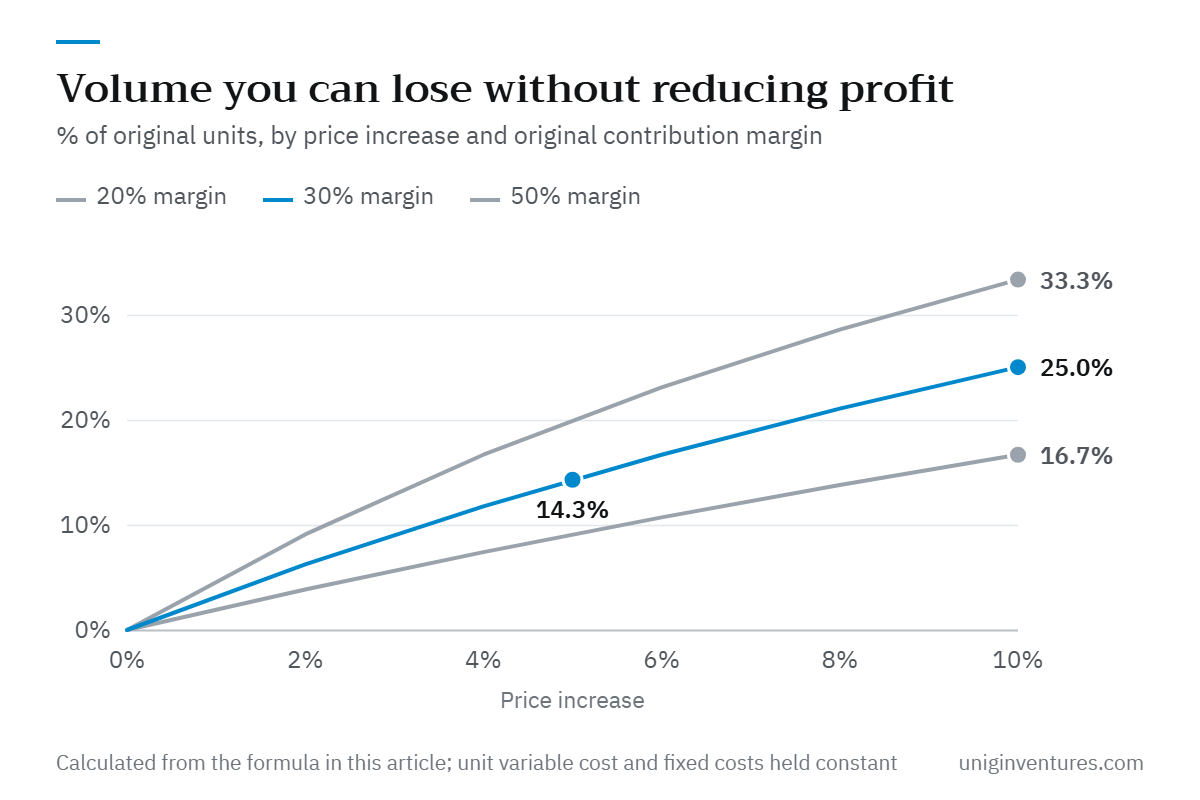
Volume (units) you can lose = % price increase ÷ (original contribution margin % + % price increase)
The formula comes from setting total contribution before and after the increase equal, assuming unit variable cost and fixed costs do not change. Lose fewer customers than this and profit rises. Lose more and it falls.
| Original contribution margin | 3% increase | 5% increase | 10% increase |
|---|---|---|---|
| 20% | 13.0% | 20.0% | 33.3% |
| 30% | 9.1% | 14.3% | 25.0% |
| 40% | 7.0% | 11.1% | 20.0% |
| 50% | 5.7% | 9.1% | 16.7% |
Notice that thin-margin businesses have more room to lose volume, because each extra baht of price is large relative to their existing contribution. They are also the businesses that suffer most from not raising prices.
A worked example
In an illustrative example, a company sells 10,000 units a month at 200 baht each. Variable cost is 140 baht per unit and fixed costs are 400,000 baht a month.
| Case | Units | Contribution per unit | Total contribution | Operating profit |
|---|---|---|---|---|
| Current price 200 baht | 10,000 | 60 | 600,000 | 200,000 |
| Price 210 baht, 5% volume loss | 9,500 | 70 | 665,000 | 265,000 |
| Price 210 baht, 14.3% volume loss | 8,571 | 70 | 600,000 | 200,000 |
| Price 210 baht, 20% volume loss | 8,000 | 70 | 560,000 | 160,000 |
The original contribution margin is 60 ÷ 200 = 30%, so a 5% increase can absorb a volume loss of 5 ÷ (30 + 5) = 14.3%. If the company loses only 5%, profit rises from 200,000 to 265,000 baht, up 32.5% on a 5% price change.
Compare a 5% price cut to 190 baht. Contribution per unit drops to 50 baht, and the company must sell 12,000 units, 20% more, just to keep total contribution at 600,000 baht.
When costs have already gone up
Now suppose a supplier raises prices and variable cost becomes 150 baht per unit. Without a price change, contribution falls to 50 baht per unit, total contribution to 500,000 baht and profit to 100,000 baht. Raising the price to 210 baht restores contribution to 60 baht. Here the right comparison is with not raising the price, not with last year. The increase still wins as long as volume falls by no more than 1 − (500,000 ÷ 600,000) = 16.7%.
Find out which customers are price-sensitive
The formula gives a ceiling. What you actually lose depends on each customer group. Segment customers using your own sales data and look for these signals:
- Switching cost. Customers who would have to change systems, retrain staff or requalify a new supplier are less sensitive to price.
- Share of their spend. If your product is a small part of the customer's total costs, a 5% increase barely registers.
- Ease of comparison. Standard products that can be compared in one click are more sensitive than custom work.
- Negotiation history. Customers who ask for a discount every time tend to follow price. Those who never negotiate usually value service and reliability more.
If you already price from customer value, you know which groups pay less than the value they receive. See value-based pricing, and find the products with thin margins that should move first in contribution margin by product.
Ways to raise prices that limit losses
- Do not raise every item by the same amount. Raise more on thin-margin products with less sensitive buyers. Raise less, or hold, on traffic-building items that are easy to compare.
- Repackage instead of raising list prices. Set minimum order sizes, charge separately for rush delivery, or turn free extras into priced options.
- Time it to the customer's cycle. Business customers budget in cycles. A notice before their budget round or contract renewal lands better than one mid-cycle. For customers under contract, always check the price adjustment and notice clauses first.
- Offer a choice. For example, lock in the old price for customers who order ahead or renew for a longer term before the effective date. You trade price for certain volume.
Communicating with customers
- Give written notice in advance, stating the new price, the effective date and the products affected.
- Give a short, true reason, such as higher material or freight costs. Do not apologize, and do not share internal cost figures.
- Say what the customer keeps: the quality, lead times or after-sales service you are maintaining.
- Talk to large accounts yourself. The owner or a senior manager should call or meet before the letter goes out.
- Prepare the sales team. Decide who can approve discounts, how much and on what terms. If salespeople keep giving discounts back, the increase disappears into quotes without anyone noticing.
Measure the result
Set the numbers to watch before the increase and track them monthly for at least three months:
- Units sold by customer group and product group, against the ceiling you calculated.
- Customers who stopped ordering, and the reasons the sales team actually hears.
- Average realized price after discounts, against list price.
- Total contribution, which tells you whether the increase worked.
Be careful reading the first month. Some customers buy ahead of the increase, so the following month looks weaker than normal. Use an average over several months.
Where to start
- Calculate the contribution margin of each main product at today's costs, not last year's.
- Use the formula or the table above to find the volume ceiling for each product at the price you have in mind.
- Split customers into more and less price-sensitive groups, then decide what to raise, by how much and for whom.
- Prepare the notice, talk to major customers and set discount authority for the sales team.
- Track results against the ceiling for three months and adjust the next round.
The company and figures in this article are an illustrative example. The formula holds when unit variable cost and fixed costs do not change with volume. If lower volume also lowers some costs, work through the case directly.