Monthly Employer Duties in Thailand: PND 1 and the New Social Security Ceiling
From the first hire, Thai employers withhold salary tax on PND 1 and remit social security every month. How to calculate both, a four-person example, the new 875 baht cap, and the 7th and 15th.

In this article
The day a Thai company hires its first employee, two monthly duties begin that cannot slip. You withhold income tax from salaries and remit it to the Revenue Department on form PND 1, and you deduct social security contributions and remit them together with the employer's share. Both have fixed due dates, both carry monthly surcharges when late, and since January 1, 2026 the social security wage ceiling has risen from 15,000 to 17,500 baht. A payroll formula still capped at the old figure under-deducts every month.
This guide covers what an employer has to do each month, how contributions and salary withholding are calculated, a worked example for a four-person company, and a calendar you can use as a checklist.
Two duties from the first hire
- Withholding tax on salaries. Each time you pay income under Section 40(1) of the Revenue Code (salary, wages, bonuses), you calculate and withhold tax, then file PND 1 and remit the tax.
- Social security under Section 33. Employees aged 15 to 60 are insured persons. The employer must file their names with the Social Security Office within 30 days of the employee becoming insured (Section 34 of the Social Security Act), using form SSO 1-03, and deduct contributions every time wages are paid.
Neither amount belongs to the company. You hold it on behalf of your staff and the state, so set it aside on payday instead of using it as working capital.
Social security contributions: a 1,650 to 17,500 baht base
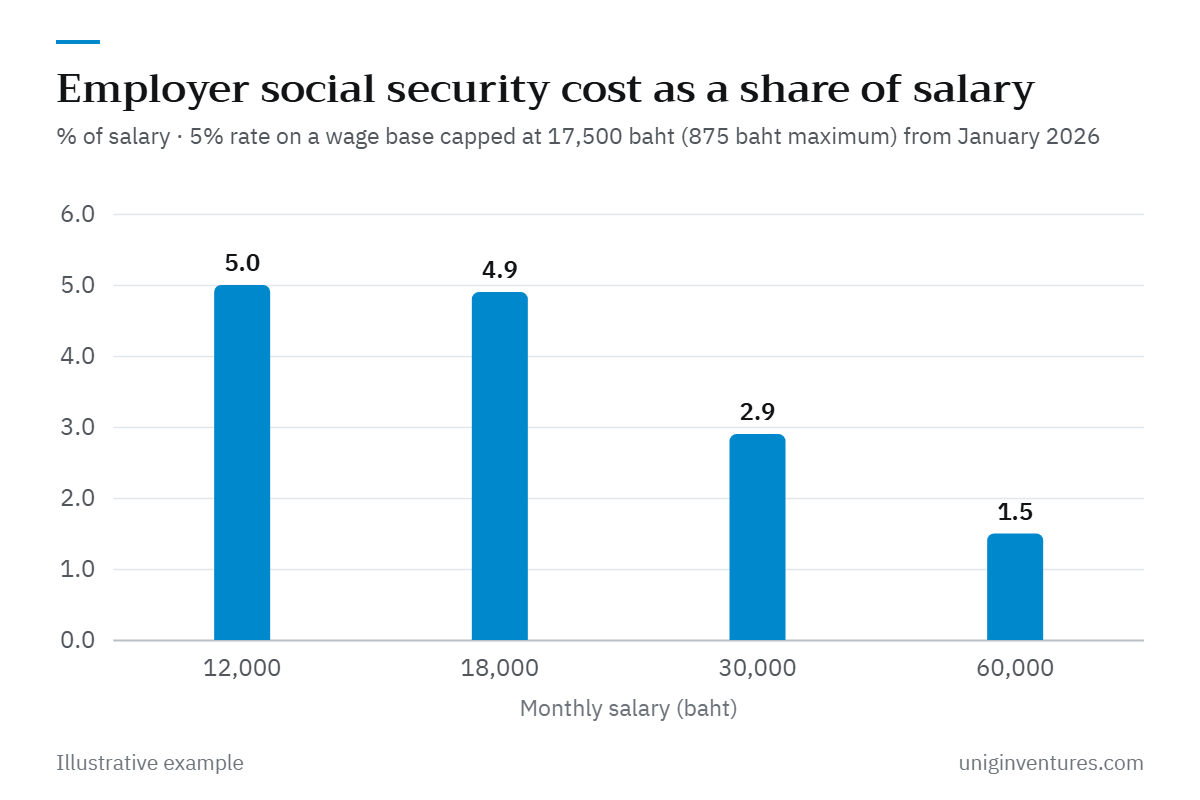
Employees and employers each contribute 5% of wages. The wage base has a floor of 1,650 baht and a ceiling set by a ministerial regulation published in the Royal Gazette on December 12, 2025, which raises the ceiling in steps.
| Period | Maximum wage base | Maximum contribution per side (5%) |
|---|---|---|
| Through December 31, 2025 | 15,000 baht | 750 baht |
| January 1, 2026 – December 31, 2028 | 17,500 baht | 875 baht |
| 2029 – 2031 | 20,000 baht | 1,000 baht |
| From 2032 | 23,000 baht | 1,150 baht |
The clearest effect for employers: for anyone earning 17,500 baht or more, the monthly contribution rises from 750 to 875 baht on both the employee and employer side, 125 baht each. If your payroll system still caps it at 750 baht, the company under-remits and owes surcharges on the shortfall.
The employer sends both shares to the Social Security Office by the 15th of the month after the deduction, with form SSO 1-10 or through the e-Service system (Section 47). Late or short payment carries a surcharge of 2% per month on the unpaid amount, with 15 days or more of a partial month counted as a full month (Section 49).
Separately, the employer alone pays an annual contribution to the Workmen's Compensation Fund at 0.2–1.0% depending on the type of business. It covers work-related injury and is not deducted from wages.
Salary withholding: annualize, then divide
The Revenue Department has employers calculate tax as if the salary were paid for a full year, then divide by the number of pay periods.
Withholding per period = tax on (monthly salary × 12 − 50% expense deduction capped at 100,000 − allowances) ÷ 12
- Expense deduction: a flat 50% of income, capped at 100,000 baht.
- Allowances: at minimum the 60,000 baht personal allowance plus the employee's actual social security contributions. Other allowances (spouse, children, life insurance) apply when the employee declares them with evidence.
- Rates: the first 150,000 baht of net income is exempt. Income above that is taxed in bands at 5%, 10%, 15%, 20%, 25%, 30% and 35%, with the top band applying above 5 million baht.
When a salary changes mid-year or a bonus is paid, recalculate from the expected annual income. The aim is for total withholding to land close to the employee's actual tax, so they do not face a large balance when filing PND 91.
Worked example: a four-person company
An illustrative example: a company pays salaries at month-end to four employees earning 12,000, 18,000, 30,000 and 60,000 baht. Each claims only the personal allowance and social security contributions.
| Salary | Employee contribution | Employer contribution | Annual net income | Monthly withholding |
|---|---|---|---|---|
| 12,000 | 600 | 600 | 4,800 | 0 |
| 18,000 | 875 | 875 | 45,500 | 0 |
| 30,000 | 875 | 875 | 189,500 | 164.58 |
| 60,000 | 875 | 875 | 549,500 | 2,910.42 |
| Total 120,000 | 3,225 | 3,225 | — | 3,075.00 |
Take the employee on 60,000 baht. Annual income is 720,000 baht. Deduct the full 100,000 baht expense allowance, the 60,000 baht personal allowance and 10,500 baht of contributions (875 × 12), leaving net income of 549,500 baht. Annual tax is 7,500 + 20,000 + 7,425 = 34,925 baht, or 2,910.42 baht a month. For the employee on 12,000 baht, the expense deduction is 50% of 144,000, or 72,000 baht, and annual contributions are 7,200 baht. Net income is 4,800 baht, below 150,000, so no tax is due.
This month the company pays out 123,225 baht in cash: 120,000 baht of salaries plus 3,225 baht of employer contributions. Employees receive 113,700 baht in total. The remaining 9,525 baht is 3,075 baht of tax to file on PND 1 and 6,450 baht of combined contributions to send to social security.
The employer's monthly calendar
| When | What |
|---|---|
| Payday | Withhold tax and the 5% contribution. Issue payslips showing both deductions. |
| Within 30 days of a start date | Register the new employee on SSO 1-03. |
| By the 7th of the following month | File PND 1 on paper and remit the tax. |
| By the 15th of the following month | File PND 1 online. Remit contributions with SSO 1-10. Report leavers on SSO 6-09 and changes on SSO 6-10. |
| Within one month of an employee leaving | Issue the withholding certificate (50 Tawi) to anyone who left during the year. |
| By February 15 of the following year | Issue annual 50 Tawi certificates to all employees. |
| By the end of February of the following year | File PND 1 Kor, the annual summary of salaries and tax. Online filing runs to March 8. |
The 15-day window for online filing (instead of 7 days) comes from a Ministry of Finance notification covering returns due from February 1, 2024 to January 31, 2027. After that, check whether it has been renewed.
What late or wrong filing costs
- Late withholding tax: a surcharge of 1.5% per month or part of a month under Section 27 of the Revenue Code, capped at the tax amount, plus possible penalties. If you fail to withhold or withhold too little, the employer is jointly liable with the employee for the shortfall (Section 54).
- Late contributions: 2% per month. If you deducted from an employee's pay but did not remit it, the employee's coverage stands as if paid, and the full burden falls on the employer.
- Missing or late registration: the Social Security Office states the penalty is up to six months' imprisonment, a fine of up to 20,000 baht, or both.
The most common mistakes are deducting contributions from the first paycheck but forgetting to register the employee, and paying a year-end bonus without recalculating withholding. The checklist below handles both.
Where to start
- Check the contribution formula in your payroll system. It should use the 17,500 baht ceiling (875 baht) from the January 2026 payroll. If you have been deducting 750 baht, calculate the shortfall and contact your local Social Security Office.
- Collect an allowance declaration from every employee at hiring and at the start of each year, and calculate per-period withholding from it.
- Ring-fence the deductions. Move withheld tax and contributions into a separate account on payday so the money never gets spent.
- Put the 7th and the 15th on the whole team's calendar, and file online for the extra time.
- Recalculate after every raise or bonus, and reconcile the year's withholding against the 50 Tawi certificates before filing PND 1 Kor.
If you have only just started hiring, see when to hire, which covers the cost of an employee beyond salary, and common withholding tax rates for SMEs for other types of payment.
This article is general information, not tax or labor law advice for any particular business. Rates and deadlines were checked in October 2026. Follow announcements from the Revenue Department and the Social Security Office, because the online filing extension runs for a fixed period and some provinces may receive temporary contribution reductions. The company and figures in the example are illustrative.
Sources
- Social Security Act B.E. 2533 (1990), as amended (Sections 33, 34, 47, 49) — Social Security Office
- Ministerial Regulation on the minimum and maximum wage base for Section 33 contributions, B.E. 2568 (2025) — Royal Gazette
- Announcement: wage ceiling adjustment from 2026 (Thai) — Social Security Office
- Employer duties: SSO 1-03, 1-10, 6-09 and 6-10 (Thai) — Social Security Office
- Reminder to employers on registering and deregistering employees on time (Thai) — Social Security Office
- Ministry of Finance notification extending deadlines for online filing (Thai) — Revenue Department
- Withholding tax on salaries under the personal income tax structure (Thai) — Revenue Department
- Personal income tax rates (Thai) — Revenue Department
- Ruling 0706/5749 on the deadline for withholding tax certificates (Thai) — Revenue Department
- Revenue Code Sections 38–64, including Section 54 liability (Thai) — Revenue Department
- Revenue Code Sections 14–27, including the Section 27 surcharge (Thai) — Revenue Department