PND 51: Estimate Half-Year Corporate Tax Without a 20% Surcharge
Thai SMEs pay half-year tax on half their estimated annual profit. Fall short by more than 25% and a 20% surcharge may apply. The calculation, the safe harbors and how to choose an estimate.
In this article
Six months into the accounting year, every Thai company has to guess its full-year profit and pay half the tax on that guess. The return is PND 51 (Por.Ngor.Dor. 51). Guess too low and the Revenue Department can add a 20% surcharge on the tax you underpaid. Guess too high and you tie up cash until the annual return. Many owners leave the number to the accountant at the last minute, and a few minutes of planning would avoid both problems.
This article explains who must file, how the half-year tax is calculated for an SME, when the 25% shortfall rule triggers a surcharge, the safe harbors that count as reasonable cause, and how to choose an estimate.
Who Files and When
- Most companies and juristic partnerships estimate net profit (or loss) for the full accounting period and pay tax on half of that estimate (Revenue Code Section 67 bis (1)).
- Listed companies, commercial banks, finance companies, securities companies and credit foncier companies, and others specified by the Director-General, pay tax on their actual net profit for the first six months instead (Section 67 bis (2)).
- Exemption: a company whose first or last accounting period is shorter than 12 months does not file for that period.
- Deadline: within two months after the end of the first six months of the accounting period. For a December year end, that is 31 August on paper. Filing online adds 8 days, to 8 September, under a Ministry of Finance announcement that covers returns due from 1 February 2024 to 31 January 2027.
A company that expects a loss still prepares the estimate. The form has a box for a net loss, and the Revenue Department's guidance says a company that does not file on time can be fined up to 2,000 baht in addition to any surcharge.
How the Tax Is Calculated for an SME
Thai SMEs pay corporate income tax at reduced rates if paid-up capital at the end of the accounting period is no more than 5 million baht and revenue from sales of goods and services is no more than 30 million baht, along with the other conditions in Royal Decree No. 530:
| Net profit | Rate |
|---|---|
| Up to 300,000 baht | Exempt |
| 300,001 to 3,000,000 baht | 15% |
| Over 3,000,000 baht | 20% |
Other companies pay a flat 20%. On the PND 51 form, the tax base is half of the estimated net profit, and the rate table is applied to that half. Withholding tax deducted from the company's income during the first six months is then credited against the result.
Half-year tax = tax rates applied to (estimated annual net profit ÷ 2) − withholding tax suffered in the first six months
In an illustrative example, an SME estimates net profit of 2,000,000 baht for the year. Half is 1,000,000 baht. The first 300,000 baht is exempt and the next 700,000 baht is taxed at 15%, so the half-year tax is 105,000 baht. If customers withheld 30,000 baht of tax during the first six months, the company pays 75,000 baht with PND 51. The half-year tax is a credit against the full-year tax on the annual return (PND 50).
The 25% Rule and the 20% Surcharge
Section 67 ter sets the penalty. If the estimate falls short of the actual net profit by more than 25% without reasonable cause, the company pays a surcharge of 20% of the tax underpaid. The Revenue Department measures the shortfall like this:
Shortfall % = (actual net profit − estimated net profit) × 100 ÷ actual net profit
A few points from the Revenue Department's guidance and filing instructions:
- The 20% surcharge is computed on the tax before deducting withholding tax.
- There is no surcharge for overestimating, and no surcharge if you estimated a profit and the year ended in a loss.
- The surcharge counts as tax and can be reduced under Revenue Department rules.
- Filing late or not filing also triggers the 20% surcharge. If you file and pay voluntarily before receiving a written notice, the surcharge is reduced to 1.5% a month.
Safe Harbors That Count as Reasonable Cause
Revenue Department Order Por. 50/2537, as amended by Por. 152/2558, treats a shortfall of more than 25% as having reasonable cause in two cases:
- The half-year tax filed is at least half of the corporate income tax filed for the previous accounting period. This is the simplest test to plan around, because you know last year's tax when you prepare the estimate.
- The estimated net profit is at least the net profit filed for the previous period, but the half-year tax is below half of last year's tax because the company received a tax exemption or reduced rate.
Choosing an Estimate: A Worked Example
Continue the illustrative example. Last year the company's net profit was 2,400,000 baht and its corporate income tax was 315,000 baht (15% of 2,100,000). Half of last year's tax is 157,500 baht. This year turns out stronger than expected, and actual net profit is 3,200,000 baht.
| Estimate for the year | Half-year tax | Shortfall | Result |
|---|---|---|---|
| 2,000,000 | 105,000 | 37.5% | Over 25%, no safe harbor: surcharge |
| 2,400,000 | 135,000 | 25.0% | Not more than 25%: no surcharge |
| 2,700,000 | 157,500 | 15.6% | Meets safe harbor 1 whatever the result |
| 3,000,000 | 180,000 | 6.3% | No surcharge, but more cash paid early |
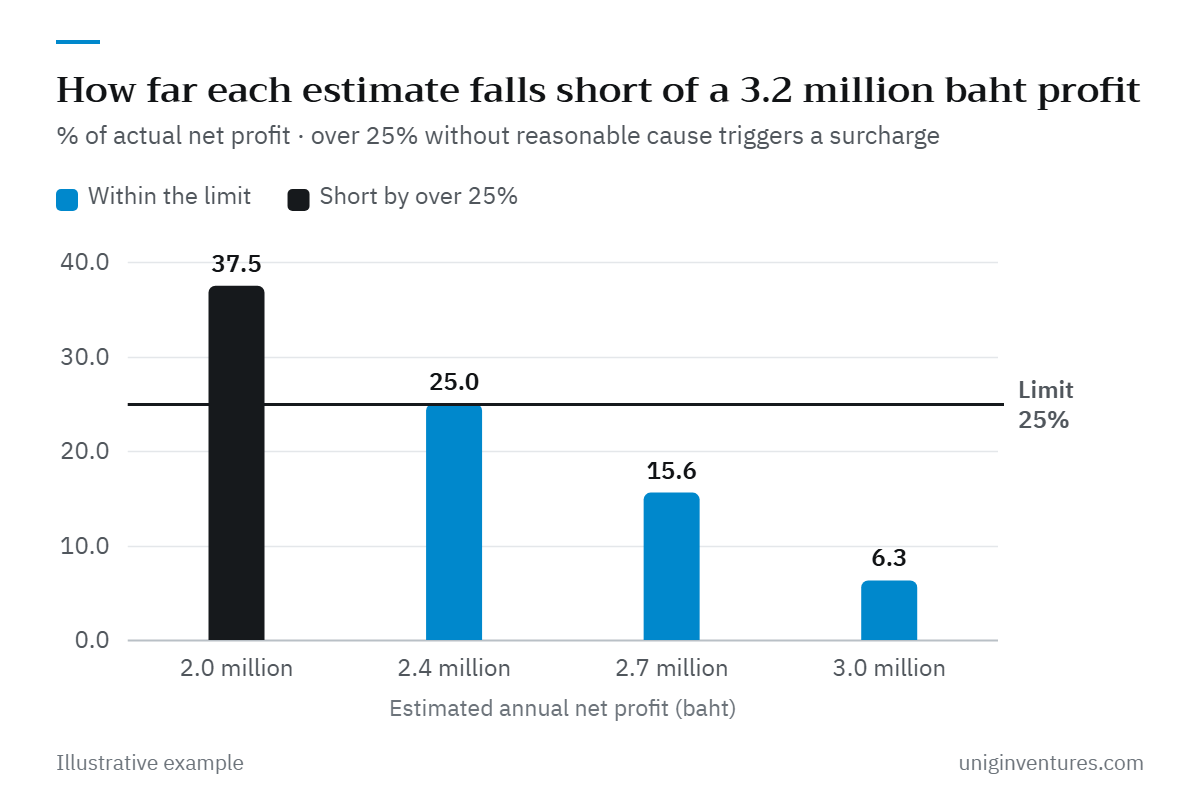
With the 2,000,000 baht estimate, the tax on half the actual profit would have been 195,000 baht (15% of 1,300,000), so the company underpaid 90,000 baht. The surcharge is 20% of that, or 18,000 baht, on top of the tax itself. The 2,700,000 baht estimate costs 52,500 baht more cash in August than the low estimate, but it meets the first safe harbor no matter how the year ends.
Where to Start
- Close the books for the first six months by the end of July, so the estimate starts from real numbers, not a guess (see a monthly close in 10 working days).
- Write down last year's net profit and tax. Half of last year's tax is your safe harbor target.
- Forecast the second half with known orders, seasonality and planned spending, then compare the result with last year's profit.
- Choose an estimate that clears the 25% test or a safe harbor, and weigh the extra cash against the surcharge risk.
- File online to get the extra 8 days, and keep a short note of how you built the estimate in case the Revenue Department asks.
This article is general information, not tax advice for a specific company. Rates and rules are as checked in October 2026; follow the latest Revenue Department announcements, as the online filing extension in particular is set for a fixed period. The company and figures above are illustrative examples. Check your own case with your accountant or tax advisor.
Sources
- Revenue Code, Sections 65–76, including Sections 67 bis and 67 ter — Revenue Department
- Order Por. 50/2537 on reasonable cause for half-year estimates, as amended — Revenue Department
- Frequently asked questions on filing PND 51 — Revenue Department
- Instructions for PND 51, accounting periods starting from 1 January 2026 — Revenue Department
- Corporate income tax rates and calculation — Revenue Department
- Ministry of Finance announcement on extended deadlines for online filing — Revenue Department