Thai VAT Registration at 1.8 Million Baht: What Counts and When to File
The 1.8 million baht threshold counts revenue, not profit, and you have 30 days from the day you cross it. How VAT changes your prices and margins, and the section 89 penalty for registering late.
In this article
A young business that sells well often notices too late that its revenue has passed 1.8 million baht and that it should have registered for value added tax (VAT). By the time it finds out, several months may have gone by. The VAT for those months is still due, even though it was never collected from customers, and penalties and surcharges come on top.
Based on the Thai Revenue Code and the Revenue Department's own pages, this article explains what the 1.8 million baht threshold counts, how many days you have to register, how registration changes your prices and margins, and what late registration costs, with a simple way to track monthly revenue so you see the threshold coming.
What the 1.8 million baht threshold counts
Section 81/1 of the Revenue Code exempts small businesses from VAT: businesses selling goods or services that are subject to VAT, whose tax base does not exceed the prescribed threshold. The Revenue Department's page states that a business with revenue from regularly selling goods or providing services of more than 1.8 million baht a year must register.
Three points are worth remembering.
- Only revenue from activities subject to VAT counts. Activities exempt from VAT by law are a separate matter. If you have several kinds of income, ask your accountant to separate clearly which income counts toward the threshold.
- It counts revenue, not profit. A shop with 2 million baht of sales and 200,000 baht of profit is already over the threshold.
- The threshold is an annual figure. If you opened mid-year or your revenue is close to the line, ask your accountant or the Area Revenue Office when the counting period for your business starts.
A business below the threshold may still register. Section 81/3 gives small businesses under section 81/1 the right to notify the Director-General and register, and section 85 lets an operator about to start business apply to register before it begins. Businesses that sell mostly to VAT-registered companies often choose this route, because their customers want tax invoices.
Register within 30 days of crossing the threshold
Section 85/1 requires an operator whose tax base exceeds the small-business threshold to apply for VAT registration within 30 days from the day its revenue exceeds the threshold. The 30 days run from the day cumulative revenue crosses the line, not from month-end or year-end, so as you approach the threshold you need to know your running total day by day.
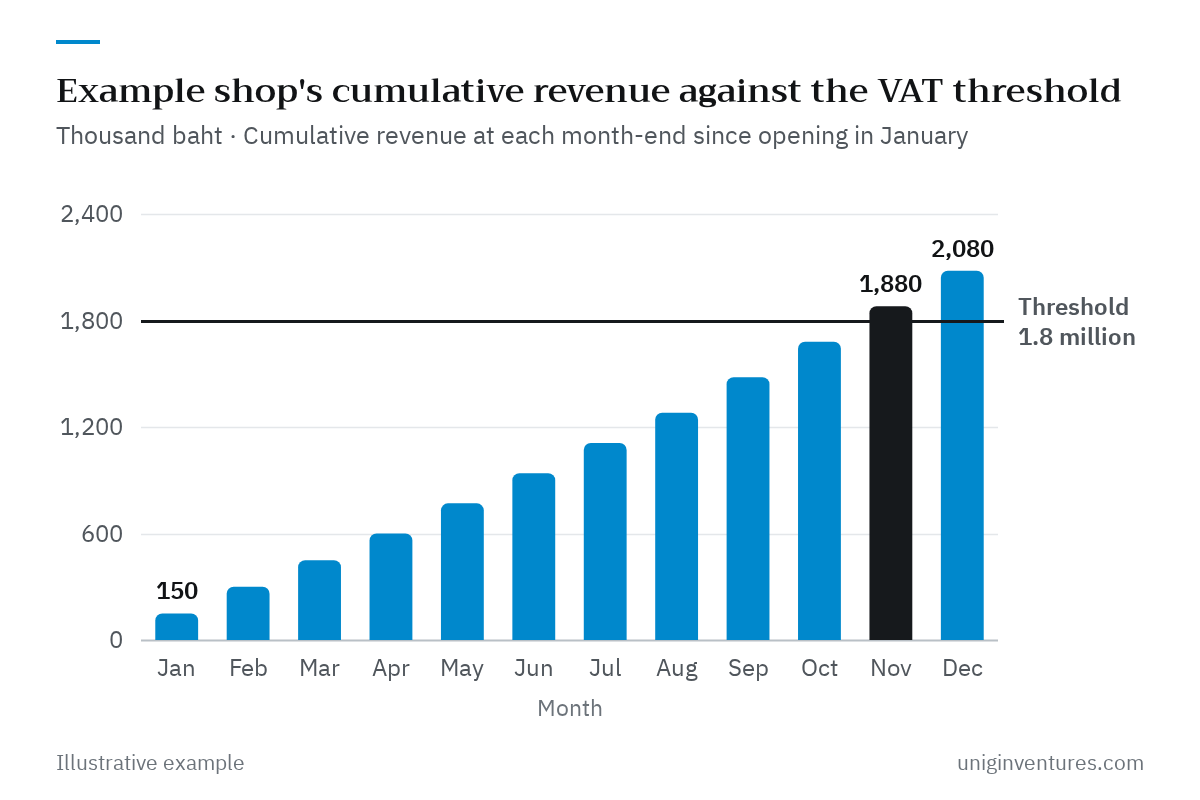
Illustrative example: an online home-decor shop opens in January. It sells 150,000 baht a month for the first four months, 170,000 baht a month from May to August, and 200,000 baht a month from September. Cumulative revenue at the end of October is 1,680,000 baht, so another 120,000 baht of sales takes it to 1.8 million. Suppose cumulative revenue passes 1.8 million baht on November 18. The shop must apply for registration within 30 days from that day.
You apply on Form P.P.01 at the registration unit for the area where your business is located, or online through the Revenue Department's website. The department's registration page also notes that an operator using the right to register files Form P.P.01.1, the notice of using that right, together with Form P.P.01.
What changes once you register
- Tax invoices. Section 86 requires a VAT registrant to issue a tax invoice for every sale of goods or services, and section 86/13 prohibits anyone who is not registered from issuing one.
- A monthly return. You file Form P.P.30 by the 15th of the following month under section 83, whether or not you made any sales that month.
- Tax is output tax minus input tax. Under section 82/3, VAT you pay to registered suppliers becomes a credit instead of a cost.
- The rate. Section 80 sets the rate at 10% and allows it to be reduced by royal decree. The rate in use is 7%, extended in rounds. The latest, Royal Decree No. 807, extends the reduced rate until September 30, 2027. Watch for Revenue Department announcements as that date approaches.
The effect on prices and margins
The effect on profit depends on who your customers are. VAT-registered business customers can claim the VAT you charge as input tax, so adding VAT does not raise their cost. Consumers bear the full tax, so a retailer has to choose between raising prices and absorbing the tax. Continuing the illustrative example, the shop sells an item for 100 baht that costs it 70 baht, all bought from VAT-registered suppliers (VAT included).
| Item | Before registering | Registered, price kept at 100 | Registered, price raised to 107 |
|---|---|---|---|
| Price the customer pays | 100.00 | 100.00 | 107.00 |
| Output VAT to remit | – | 6.54 | 7.00 |
| Net revenue | 100.00 | 93.46 | 100.00 |
| Cost after input VAT credit | 70.00 | 65.42 | 65.42 |
| Gross profit | 30.00 | 28.04 | 34.58 |
Keeping the price unchanged cuts gross profit from 30.00 baht to 28.04 baht, not by the full 6.54 baht, because 4.58 baht of input VAT that used to be a cost becomes a credit. Raising the price to 107 baht and selling the same quantity lifts gross profit to 34.58 baht, but some customers may leave. This example assumes all costs carry VAT. If most of your costs are wages or purchases from unregistered suppliers, you will recover less input VAT (to work out how much volume you can afford to lose after a price rise, see raising prices without losing customers).
What late registration costs
An operator who should have registered but did not still owes the tax for the months it should have been registered, even though it charged customers no VAT and could not issue tax invoices. That tax comes out of the business's own profit, and two more costs are added.
- Penalty. Section 89 (1) imposes a penalty for operating without registering under section 85/1 of twice the tax due in each tax month for the whole period of non-compliance, or 1,000 baht per tax month, whichever is greater. Illustrative example: in a month with 10,000 baht of tax due, the penalty is 20,000 baht.
- Surcharge. Section 89/1 adds a surcharge of 1.5% a month on tax not paid in full or on time.
Penalties can be reduced. Revenue Department Order Tor.Por. 81/2542, clause 5/1, sets reduced penalty rates for operating without registration. The rate depends on whether you come forward before an officer finds the problem and on how late you are. Coming forward early earns a much larger reduction than being found later. If you realize you have missed the deadline, have your accountant work out the tax owed and contact the Area Revenue Office right away rather than waiting for a summons letter.
If your revenue has passed the threshold and P.P.30 returns that should have been filed are outstanding, see how to file additional returns and request penalty reductions in late or incorrect tax filing.
Where to start
- Build a table of cumulative monthly revenue from activities subject to VAT, from the start of the counting period, leaving out exempt income and income unrelated to sales.
- Set an alert at 1.5 million baht. Once you reach it, check the total weekly or daily and record the day cumulative revenue passes 1.8 million baht.
- Prepare before you reach the threshold: a system for issuing tax invoices, price tags or quotations that show VAT separately, a way to keep purchase tax invoices, and an accountant who will file P.P.30 every month.
- Work out the effect on profit as in the table above using your real figures, and decide whether to raise prices, hold them, or split the difference before the day you must start charging VAT.
- If most of your customers are VAT-registered companies, consider registering before you reach the threshold under section 81/3.
The shop, figures and dates in this article are illustrative examples. The legal points were checked against the Revenue Code on the Revenue Department's website on November 25, 2026. This article is general information, not tax advice for any particular business; consult your accountant or the Area Revenue Office before deciding.
Sources
- Persons required to register for VAT and registration deadlines (ผู้มีหน้าที่จดทะเบียนภาษีมูลค่าเพิ่ม และกำหนดเวลาการจดทะเบียน) — The Revenue Department
- How to register for VAT (วิธีการจดทะเบียนภาษีมูลค่าเพิ่ม) — The Revenue Department
- Value Added Tax — The Revenue Department
- Revenue Code, sections 80–82 (sections 80, 81/1, 81/3, 82/3) — The Revenue Department
- Revenue Code, sections 83–84 — The Revenue Department
- Revenue Code, sections 85–86 (sections 85/1, 86/13) — The Revenue Department
- Revenue Code, sections 87–90 (sections 89, 89/1) — The Revenue Department
- Revenue Department Order Tor.Por. 81/2542 on waiving or reducing penalties and surcharges — The Revenue Department
- Royal Decree No. 807 extending the reduced VAT rate until September 30, 2027 — The Revenue Department