Late or Wrong Tax Filings in Thailand: Surcharges, Penalties and Amended Returns
A 1.5% monthly surcharge, penalties of one or two times the tax and fines up to THB 2,000 apply differently to income tax and VAT, and to fixing errors yourself versus being caught. With a worked example.
In this article
Many owners learn about a tax mistake when their accounting firm calls: last month's PP 30 VAT return was never filed, or a sales tax invoice never made it into the output tax report. The first question is usually "how much will this cost?" The more useful question is "how much difference does it make if we fix it now rather than wait for the Revenue Department to find it?" Under the Revenue Code and the department's own rules, the cost of the two paths can differ many times over.
This article separates the costs of filing late or filing wrong, explains how corporate income tax and VAT treat them differently, works through an example, and sets out what to do once you find an error.
Three costs of filing late or filing wrong
| Item | What it is | Rate |
|---|---|---|
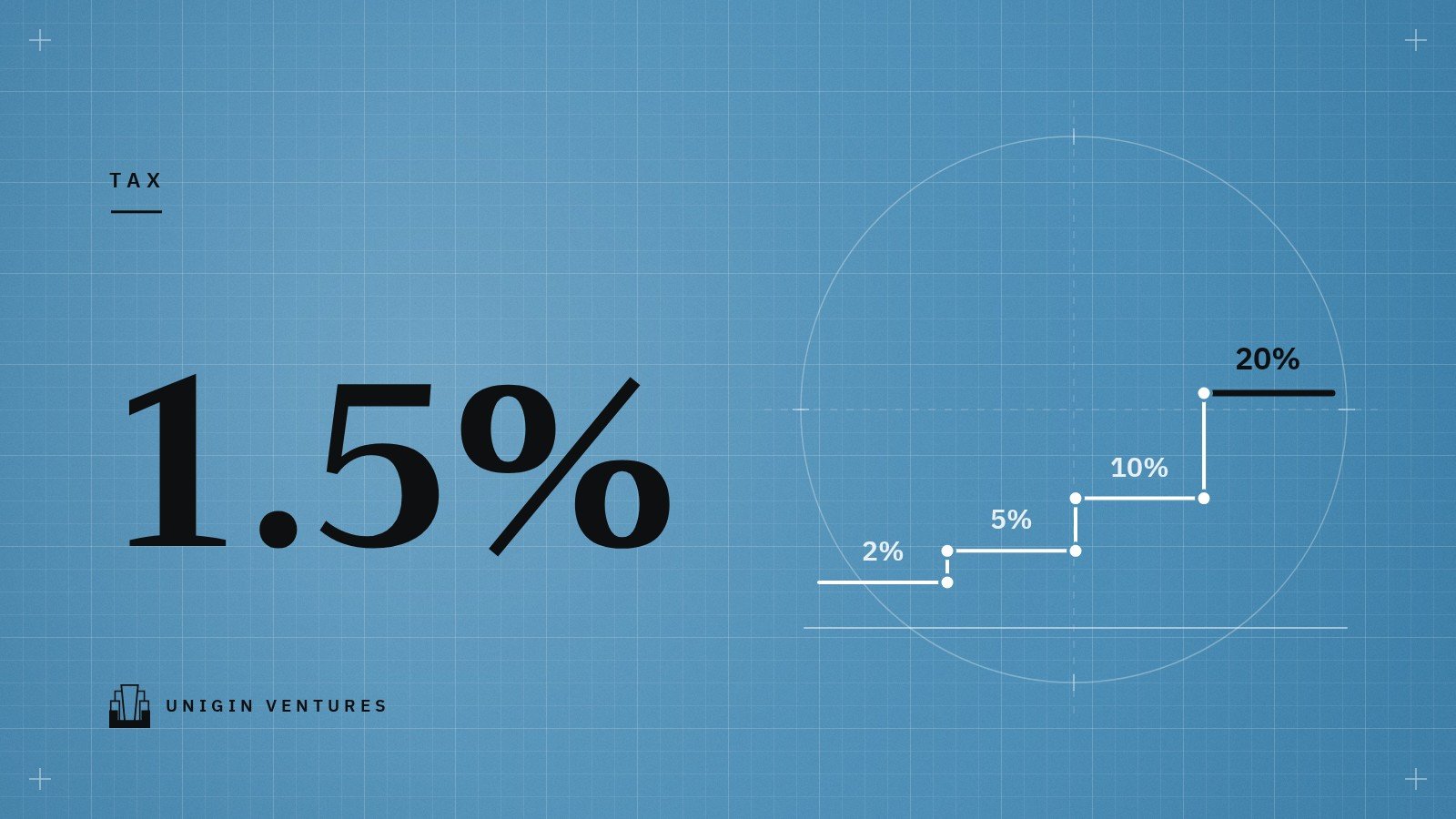
| Surcharge (ngoen phoem) | A time-based charge on late tax, similar to interest | 1.5% per month or part of a month on the tax due, capped at the tax amount |
| Penalty (bia prap) | A civil penalty set as a multiple of the tax | 1 or 2 times the tax, reducible under Revenue Department rules |
| Criminal fine | A fine for not filing on time | Up to THB 2,000 |
The surcharge under Section 27 of the Revenue Code runs from the day after the filing or remittance deadline until the day you pay, and a part of a month counts as a full month. The Revenue Department's PND 50 FAQ gives an example: if the deadline is May 30 and you file on June 1, you owe one month of surcharge. Two days late costs the same as a full month. VAT has the same rule in Section 89/1.
The penalty depends on the type of tax and on who discovers the problem, as the next two sections explain. For income tax, Section 27 bis treats penalties and surcharges as tax.
The criminal fine under Section 35 is up to THB 2,000 for failing to file the income tax returns listed in that section, unless the failure was due to force majeure. Section 90 sets a fine of up to THB 2,000 for a VAT-registered business that does not file its VAT return.
Income tax: filing late yourself versus being assessed
For the PND 50 annual corporate return, the Revenue Department's FAQ lists two consequences of filing late: a fine of up to THB 2,000 and a surcharge of 1.5% per month or part of a month. If the company files and pays on its own, even late, those two items are the whole cost.
Penalties arise when a tax officer makes the assessment.
- Filed, but tax was short. An officer can issue a summons to examine the return within two years of the filing date, extendable to five years with the Director-General's approval when there is reason to believe tax was evaded or when a refund is involved (Section 19). Additional tax assessed carries a penalty of one times the tax (Section 22).
- Never filed. When the officer assesses the tax, the penalty is two times the tax (Section 26).
Revenue Department Order Tor.Por. 81/2542 allows penalties to be waived or reduced only when the taxpayer had no intent to evade tax and cooperated well with the examination. For income tax penalties under Sections 22 and 26, the taxpayer still pays at least 50% of the penalty.
Illustrative example: a company owes THB 300,000 of corporate income tax on its PND 50. If it files and pays on its own less than a month late, it owes a surcharge of THB 4,500 and a fine of up to THB 2,000. If it never files and the officer assesses the tax, the two-times penalty is THB 600,000, and even after a reduction the company still pays at least THB 300,000, plus a surcharge that keeps growing every month.
The half-year return has its own rule. If the company underestimates its profit by more than 25% without a reasonable cause, it owes a surcharge of 20% of the tax shortfall. See PND 51: estimating half-year profit.
VAT: the sooner you fix it, the smaller the penalty
VAT differs from income tax because Section 89 attaches the penalty directly to the failure to file on time. It does not wait for an officer's assessment.
- Not filing the return on time: a penalty of two times the tax due (Section 89 (2)).
- Filing an incorrect return that misstates the tax due, understates output tax or overstates input tax: a penalty of one times the misstated amount (Section 89 (3) and (4)).
Order Tor.Por. 81/2542, most recently amended by Order Tor.Por. 369/2569 dated July 3, 2026, cuts these penalties sharply for businesses that file and pay on their own before receiving a warning or a written summons. The days are counted from the VAT payment deadline.
| Situation | Share of the penalty payable |
|---|---|
| Filed and paid voluntarily, up to 15 days late | 2% |
| Filed and paid voluntarily, more than 15 and up to 30 days late | 5% |
| Filed and paid voluntarily, more than 30 and up to 60 days late | 10% |
| Filed and paid voluntarily, more than 60 days late | 20% |
| Received a letter from an officer and filed within the time it set | 40% |
| Received a letter from an officer and filed after the time it set | 50% |
| Officer found the violation, business registered for more than one year | 50% |
Worked example
Illustrative example: a company owes THB 100,000 of VAT for one month but forgets to file its PP 30. The full penalty under Section 89 (2) is THB 200,000. The table shows the cost depending on when the problem is fixed (excluding the criminal fine of up to THB 2,000).
| Case | Surcharge | Penalty | Total (THB) |
|---|---|---|---|
| Filed voluntarily, 10 days late | 1 month: 1,500 | 2%: 4,000 | 5,500 |
| Filed voluntarily, 40 days late | 2 months: 3,000 | 10%: 20,000 | 23,000 |
| Filed voluntarily, 70 days late | 3 months: 4,500 | 20%: 40,000 | 44,500 |
| Found by an officer, paid 8 months late | 8 months: 12,000 | 50%: 100,000 | 112,000 |
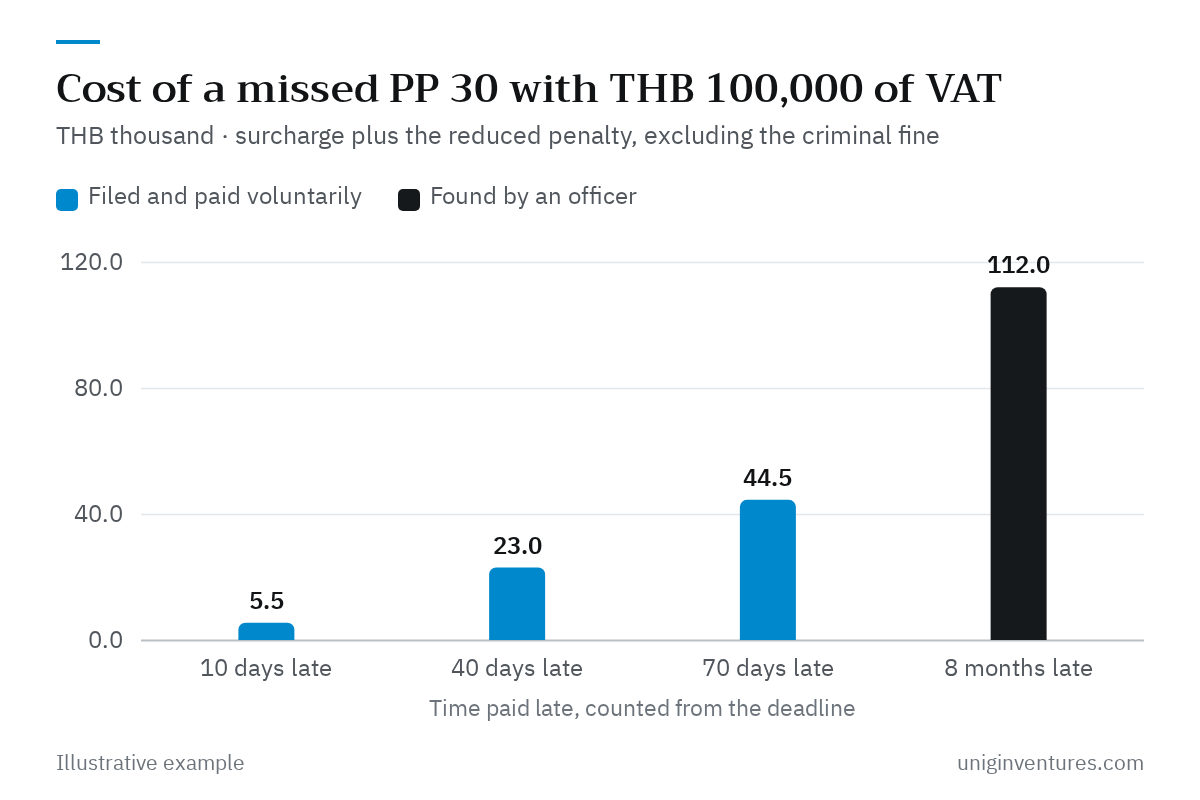
Fixing it yourself within 10 days instead of waiting to be caught saves THB 106,500 on a single month's VAT, and nearly all of that difference is penalty, not surcharge.
You found an error: file an additional return or claim a refund
When a return you already filed has wrong figures, the fix is an additional return, a corrected version filed on top of the original. Do not wait to adjust it in next month's or next year's return.
- Before the deadline. The Revenue Department's page on internet filing states that PND 1, PND 3, PND 53 and PP 30 additional returns can be filed online within the deadline. PP 30 must be filed per establishment, and businesses approved to file a combined return cannot file the additional return online. Because the surcharge starts only after the deadline, paying the shortfall before the deadline creates no surcharge.
- After the deadline. Pay the shortfall together with the surcharge on it. For VAT, filing and paying on your own before you receive a letter from an officer is the condition for the low penalty rates in the table above.
- Additional PND 50. Fill in every line with the correct figures, not just the difference. If the financial statements were also revised, attach statements signed by the auditor.
- Overpaid tax. Request a refund on form Kor.10 at the area revenue office within three years from the last day of the filing deadline (Section 27 ter).
Watch out for filing online without paying. The PND 50 FAQ states that if the tax is not paid by the deadline, the filing is incomplete and does not count as filed. The company then has to file at the area revenue office and pay the tax, surcharge and fine.
The line not to cross: intent to evade
All the rates above apply to mistakes and delays. Intent is a different matter. Section 37 punishes anyone who willfully makes false statements or uses fraudulent means to evade tax with three months to seven years in prison and a fine of THB 2,000 to 200,000. Section 37 bis punishes willfully not filing a return to evade tax with up to one year in prison or a fine of up to THB 200,000. The waiver and reduction rules are available only to taxpayers with no intent to evade.
Where to start
- Build a company tax calendar listing every return, its deadline and the person responsible, including the common withholding returns covered in withholding tax rates and e-Withholding Tax.
- Before filing each monthly PP 30, reconcile the sales in the output tax report with the ledger and the tax invoices actually issued.
- When you find an error, calculate the shortfall and file an additional return right away rather than waiting for the next cycle. The VAT penalty rises with every tier of days late and rises much further once an officer finds it.
- Keep a record of what happened and how you fixed it, so you can show there was no intent to evade if you are examined.
- The penalty reduction rules were amended in July 2026. Before filing late or filing an additional return, ask the area revenue office or your auditor which rate applies to your case.
Tax mistakes happen in every company. Whether one costs thousands or hundreds of thousands of baht depends on how long you wait to fix it and who finds it first.
Sources
- Revenue Code Sections 14–27 (Sections 19, 22, 26, 27, 27 bis, 27 ter), in Thai — Revenue Department
- Revenue Code Sections 28–37 (Sections 35, 37, 37 bis), in Thai — Revenue Department
- Revenue Code Sections 87–90 (VAT penalties, surcharges and offenses), in Thai — Revenue Department
- Order Tor.Por. 81/2542 on waiving or reducing penalties (amended by Tor.Por. 369/2569), in Thai — Revenue Department
- PND 50 frequently asked questions, in Thai — Revenue Department
- Filing PND 1/3/53 and PP 30/PT 40 over the internet, in Thai — Revenue Department