PND 50: From Book Profit to Taxable Profit, Step by Step
Accounting profit and taxable profit differ. Follow the PND 50 form line by line: disallowed expenses, exempt dividends and five-year loss carryforwards, with a worked example and checks before you sign.
In this article
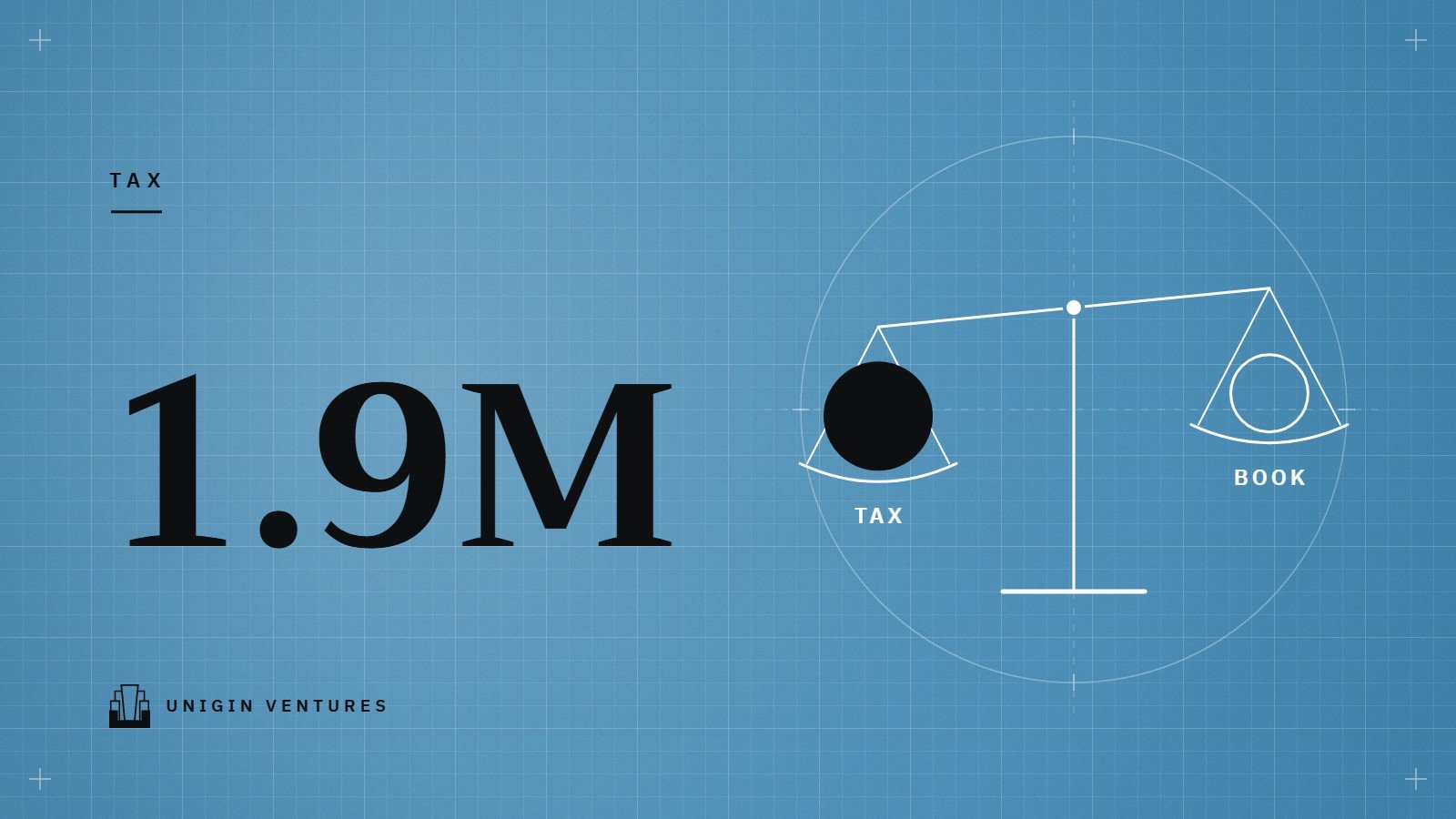
The income statement shows a profit of 1.86 million baht. The PND 50 return your accounting firm sends for signature calculates tax on 1.9 million. Many owners see the two numbers and don't know what to ask. Yet the gap between them is the part of the return that the Revenue Department examines most often, and the part where companies lose money in both directions: missing an add-back and getting assessed later, or forgetting a deduction and overpaying.
This article walks from accounting profit to taxable profit in the order the PND 50 form uses. It explains what each step adds or deducts, works through a full example, and ends with seven questions to ask before you sign the draft return.
Two profit figures, and why they differ
The financial statements follow accounting standards. Corporate income tax is charged on net profit as defined in Sections 65 to 65 ter of the Revenue Code. The two rule books mostly agree, but not entirely. The Revenue Code disallows some expenses that are correctly booked, leaves some income out of the tax base, and lets some items be deducted at more than the amount paid.
PND 50 therefore does not ask for taxable profit on its own. It starts from accounting profit and adds or deducts item by item until it reaches the figure that tax is calculated on. Auditors and tax officers read this section to see what the company adjusted. The return, with any tax due, must be filed within 150 days after the last day of the accounting period, every period, whether or not the company had income.
The path from accounting profit to taxable profit
According to the Revenue Department's filing instructions for PND 50 (the edition for accounting periods beginning on or after January 1, 2023), the calculation sits in Part 2 of the form, in this order:
| Line | Item | Where it comes from |
|---|---|---|
| 9 | Net profit or loss per the income statement | Audited financial statements |
| 10 | Add: income deemed to be income under the Revenue Code | Items the books do not record as income but the law counts |
| 11 | Add: expenses not allowed as expenses under the Revenue Code | Part 8 of the form |
| 13 | Less: exempt income or expenses eligible for additional deduction | The attachment for this line |
| 15 | Less: net loss deductible by law | The attachment on net losses adjusted under the Revenue Code |
| 17–19 | Add: charitable, education, sports and double-deduction expenses above their caps | Same attachment as line 13 |
| 21 | Taxable net profit or net loss | The figure tax is calculated on |
The line numbers belong to that edition of the form. If the Revenue Department revises the form, they may change, so go by the item names. Lines 12, 14, 16 and 20 are running subtotals.
Items you add back
Part 8 of the form splits non-deductible expenses into six groups. The total goes to line 11.
- Corporate income tax booked as an expense. Section 65 ter (6) disallows it, so line 9 is profit after tax and the tax is added back.
- Entertainment above the limit set by Ministerial Regulation No. 143 (1979), as amended. The overall cap is 0.3% of revenue or paid-up capital, whichever is higher, and no more than 10 million baht.
- Bad debts that do not meet the criteria of Ministerial Regulation No. 186 (1991), as amended.
- Reserves under Section 65 ter (1), such as an allowance for doubtful accounts, a warranty provision or an allowance for obsolete stock. Only insurance businesses and certain financial institutions are exempt from this rule.
- Double-deduction expenses as booked. They are added back at the amount actually paid, then deducted again at twice that amount in the attachment, as described in the next section.
- Other disallowed expenses, such as depreciation above the limits in Royal Decree No. 145, including passenger cars, whose depreciable cost is capped at 1 million baht; tax penalties and surcharges; directors' personal expenses; and expenses with no identifiable recipient.
Each type of disallowed expense is covered in more detail in Deductible and Non-Deductible Expenses and Depreciation: Book vs Tax.
Line 10 is used less often but worth knowing. A common SME case is an interest-free loan to a director. Section 65 bis (4) lets the assessment officer charge interest at market rate when there is no reasonable cause (see Separating Personal and Company Money).
An add-back is not always permanent
Add-backs come in two kinds. Permanent differences, such as penalties and excess entertainment, are never deductible. Temporary differences, such as an allowance for doubtful accounts, are added back this year, but once the debt is written off under the Ministerial Regulation criteria in a later year, it becomes deductible in that year. Without a schedule that tracks the running balance of temporary differences, companies often forget to take the deduction when they become entitled to it.
Items you can deduct
Income left out of the tax base (line 13)
The item SMEs meet most is dividends from Thai limited companies. The form asks you to report the full dividend in other income first, then deduct the exempt part in the attachment. Section 65 bis (10) provides:
- Dividends from a limited company incorporated under Thai law are, in general, counted as income at only half the amount, so half is deducted.
- They are excluded entirely if the recipient is a listed company, or holds at least 25% of the voting shares of the paying company and the paying company holds no shares in the recipient, directly or indirectly.
- The relief does not apply if the shares were held for less than three months before the dividend date, or are transferred within three months after it.
Income exempt under other laws, such as profit from BOI-promoted activities, also goes through this attachment and must be calculated separately as the filing instructions require.
Expenses deductible at more than the amount paid
Some royal decrees let companies deduct certain expenses at more than the amount paid, for example twice the amount. Each measure has its own conditions and time window, and many have expired. Before closing the books, ask your accounting firm which measures still apply to this period and whether you have the documents. For expenses the form describes as "deductible twice, up to 10% of net profit," the part above the cap is added back on line 17.
Losses carried forward (line 15)
Section 65 ter (12) allows net losses from up to five years before the current accounting period to be deducted. The loss that counts is the tax loss after adjustments, not the loss in the financial statements. A company that loses money in its early years should file PND 50 correctly every year even when no tax is due, because those figures are the deductions it will use once it turns profitable. Losses older than five years expire.
Donations (lines 17–19)
Donations for public charity or public benefit are deductible up to 2% of net profit. Donations for education or sports have a separate 2% cap. Anything above the caps is added back near the end of the calculation. Because the caps are based on adjusted net profit, they are calculated after the other lines.
A worked example of the full return
Consider an illustrative example. A limited company has paid-up capital of 2 million baht and revenue from sales and services of 25 million baht, so it pays tax at SME rates. Profit before tax in the financial statements is 2,100,000 baht. It booked an income tax expense of 240,000 baht, so net profit per the income statement is 1,860,000 baht. During the year:
- Entertainment was 115,000 baht. The cap at 0.3% of 25 million baht revenue is 75,000 baht, so 40,000 baht is excess.
- The allowance for doubtful accounts increased by 120,000 baht. No debt met the write-off criteria yet.
- A passenger car cost 1,300,000 baht. Book depreciation at 20% a year is 260,000 baht. Tax allows 20% of 1,000,000 baht, or 200,000 baht, so 60,000 baht is excess.
- Penalties and surcharges for late tax filings came to 30,000 baht.
- The company received 100,000 baht in dividends from an unlisted limited company in which it has held 10% for more than a year.
- A tax loss of 400,000 baht was carried forward from the 2024 accounting period.
- Withholding tax deducted during the year totaled 45,000 baht, and 105,000 baht of half-year tax was paid with PND 51.
| Item | Amount |
|---|---|
| Net profit per the income statement | 1,860,000 |
| Add: corporate income tax | 240,000 |
| Add: entertainment above the cap | 40,000 |
| Add: allowance for doubtful accounts | 120,000 |
| Add: excess car depreciation | 60,000 |
| Add: penalties and surcharges | 30,000 |
| Total after add-backs | 2,350,000 |
| Less: half of dividends excluded from income | −50,000 |
| Less: loss carried forward | −400,000 |
| Taxable net profit | 1,900,000 |
| Tax: first 300,000 exempt, remaining 1,600,000 × 15% | 240,000 |
| Less: withholding tax credits | −45,000 |
| Less: tax paid with PND 51 | −105,000 |
| Balance payable with PND 50 | 90,000 |
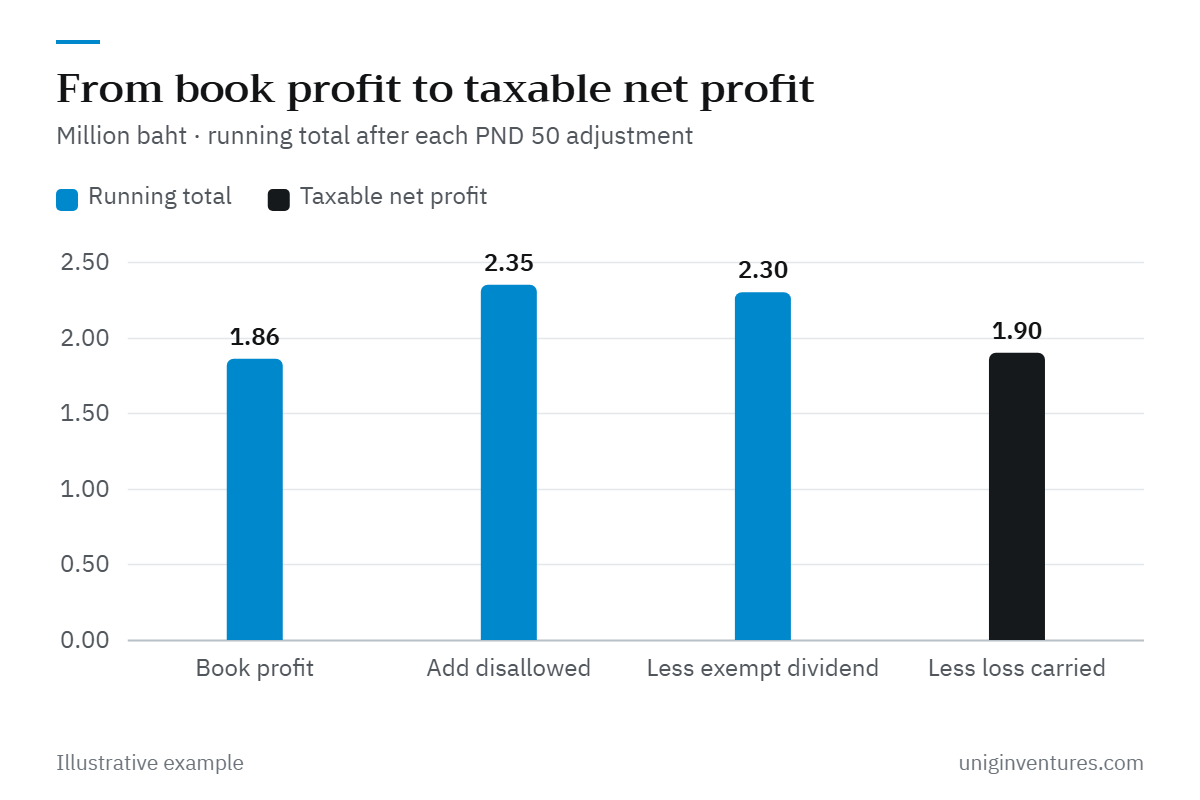
Three things stand out. First, the tax booked in the accounts (240,000 baht) must equal the tax calculated on the return. If it doesn't, the accrual is wrong and so is the profit in the statements. Second, forgetting the 400,000 baht loss carried forward would add 60,000 baht of tax (400,000 × 15%). Third, failing to add back the 120,000 baht allowance would underpay tax by 18,000 baht, which an assessment officer can find easily, and which brings penalties and surcharges with it.
Seven questions before you sign the return
- Does the profit on line 9 match the statements the auditor signed? It should match to the baht.
- Does the tax added back equal the tax expense in the accounts, and the tax calculated on the return?
- Have all reserves set up this year been added back? And have bad debts or other items added back in earlier years now met the criteria for deduction?
- Is entertainment above the 0.3% cap? Is depreciation on passenger cars based on a cost of no more than 1 million baht?
- Did the company receive dividends? If so, what percentage does it hold, for how long, and has the exempt part been deducted?
- Which years' losses are still available? Which will expire after this period?
- Are the tax credits complete? Withholding tax must match the certificates you actually hold, and PND 51 tax must match the receipt.
Where to start
- Ask for a tax reconciliation schedule with the draft return every year, item by item with reasons, not a single total.
- Keep a register of temporary differences, such as the cumulative doubtful-accounts allowance and depreciation differences, so you deduct them in the year you are entitled to.
- Keep a register of tax losses by the year they arose and the year they expire.
- Estimate the adjustments when you prepare PND 51, so the half-year estimate is closer to reality (see PND 51: Estimating Half-Year Tax).
- Cut unnecessary add-backs early in the year, for example by filing on time to avoid penalties and keeping entertainment within the cap.
This article is general information, not tax advice for any particular company. Rules were checked as of October 2026. The line order follows the PND 50 filing instructions for accounting periods beginning on or after January 1, 2023, which may be revised. The company and figures above are an illustrative example. Check your own case with your accountant or tax adviser.
Sources
- Revenue Code Sections 65–76, including Sections 65 bis (4) and (10) and 65 ter (1), (6) and (12) — Revenue Department (Thai)
- Instructions for PND 50, corporate income tax return, for accounting periods beginning on or after January 1, 2023 — Revenue Department (Thai)
- Corporate income tax rates and calculation — Revenue Department (Thai)
- Ministerial Regulation No. 143 (entertainment expenses) — Revenue Department (Thai)
- Ministerial Regulation No. 186 (bad debt write-offs) — Revenue Department (Thai)
- Royal Decree No. 145 (wear, tear and depreciation) — Revenue Department (Thai)