Non-Creditable Input VAT in Thailand: What You Can't Claim and Can Still Expense
Section 82/5 and Notification No. 42 explained: passenger cars, abbreviated invoices and entertainment, which items stay tax-deductible, the invoice errors that cost the most, and a booking checklist.
In this article
A VAT-registered company in Thailand can offset the VAT it pays on purchases (input tax) against the VAT it charges customers (output tax). Not every tax invoice qualifies, though. The law bars certain input tax from being credited, and if you claim it anyway and the Revenue Department finds it, you repay the tax with penalties and surcharges. Some of that input tax cannot be deducted as an expense for income tax either, so the full 7% is simply lost.
This article sets out which input tax is non-creditable by law, which of it can still be deducted as an expense, the invoice mistakes that cause most of the losses, and a monthly check to run before you book purchases.
Non-Creditable Input Tax Under Section 82/5
Section 82/5 of the Revenue Code lists six groups of input tax that cannot be credited against output tax.
- No tax invoice, or no way to show that the input tax was paid.
- A tax invoice with incorrect or incomplete particulars in a material respect.
- Input tax not directly related to the business, such as a director's personal purchases paid by the company.
- Input tax on entertainment or similar expenses, such as meals with customers.
- A tax invoice issued by someone not entitled to issue one, such as a seller that is not VAT-registered.
- Other input tax specified by the Director-General with ministerial approval, detailed in Director-General's Notification on VAT No. 42.
Items in Notification No. 42 That SMEs Meet Most Often
Notification No. 42 spells out the sixth group in several clauses. These are the ones most businesses run into every month.
- Passenger cars and passenger vehicles with no more than 10 seats Input tax on buying, hire-purchasing, leasing or taking transfer of these vehicles is non-creditable, and so is input tax on related goods and services such as fuel and repairs. Businesses that sell or rent out such vehicles are exempt from this rule.
- Abbreviated tax invoices issued by retailers are not creditable even if they show the tax amount. You need a full tax invoice.
- Copies of tax invoices You need the original (or the electronic file delivered through the e-Tax Invoice system).
- Purchases used for non-VAT business, and the apportioned share when a purchase serves both VAT and non-VAT activities.
Not Creditable, but Still Deductible as an Expense?
The next question is whether input tax you cannot credit can at least be booked as an expense to reduce corporate income tax. It depends on why it is non-creditable.
Section 65 tri (6 bis) bars a VAT-registered company from treating its input tax as an expense, except for entertainment-related input tax under Section 82/5(4) and other input tax specified by royal decree. Royal Decree No. 243 (1991) allows input tax under Section 82/5(6), meaning the items in Notification No. 42, to be treated as an expense. The result is summarized below.
| Group | Examples | Deductible as expense |
|---|---|---|
| 82/5(4) entertainment | Customer meals, customer gifts | Yes, within the entertainment rules |
| 82/5(6) Notification No. 42 | Passenger cars, abbreviated invoices | Yes |
| 82/5(1) and (2) | No invoice, materially wrong invoice | No |
| 82/5(3) | Personal expenses | No |
| 82/5(5) | Invoice from an unauthorized issuer | No |
The practical takeaway: input tax disallowed because of missing or defective paperwork does the most damage, because it is lost on both fronts. It is also the group you can prevent by checking documents.
One Month, Worked Through
An illustrative example: an equipment distributor records the following input tax in one month (VAT at 7%).
| Item | Input tax | Creditable | Deductible as expense |
|---|---|---|---|
| Inventory purchases, correct full tax invoice | 35,000 | 35,000 | — |
| Inventory purchase, buyer's tax ID wrong | 3,500 | 0 | 0 |
| Customer dinner | 1,400 | 0 | 1,400 |
| Fuel and repairs for a company sedan | 700 | 0 | 700 |
| Stationery, abbreviated tax invoice | 210 | 0 | 210 |
| Total | 40,810 | 35,000 | 2,310 |
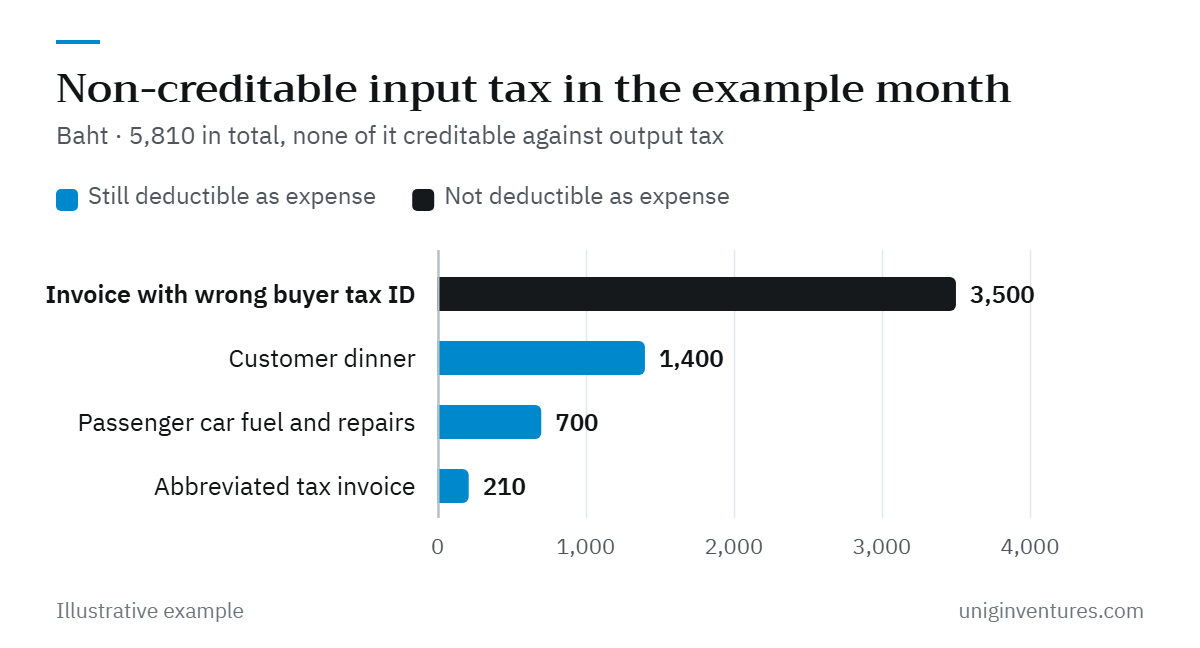
Of 40,810 baht of input tax, the company can credit 35,000 baht. The remaining 5,810 baht is non-creditable. Of that, 2,310 baht can still be deducted as an expense (worth 462 baht at a 20% corporate income tax rate), but the 3,500 baht on the defective invoice is lost entirely. That single invoice costs more than the other three items combined.
Check the Tax Invoice Before You Book It
Section 86/4 lists the particulars of a full tax invoice: the words "tax invoice" in a prominent place; the seller's name, address and tax ID number; the buyer's name and address; the invoice number; the name, type, quantity and value of the goods or services; the VAT amount shown separately; and the date of issue. In addition, Director-General's Notification No. 39, as amended by No. 199, requires that from January 1, 2015, an invoice to a VAT-registered buyer must show the buyer's tax ID number and state "head office" or "branch no. ..." as shown on the buyer's VAT registration certificate (PP 20).
A checklist the accounting team can run on every invoice:
- The company name matches the company affidavit, not an abbreviation or trade name.
- The 13-digit tax ID is correct, and head office or branch matches the PP 20.
- The address is the registered address.
- It is an original full tax invoice, not an abbreviated invoice or a copy.
- The seller is actually VAT-registered, which you can check in the Revenue Department's operator search.
- The VAT amount is shown separately from the price and is calculated correctly.
- The expense relates directly to the business and is not a passenger car or entertainment item. If it is, book it to a separate account.
If a material particular is wrong, ask the seller to cancel the invoice and issue a new one before you claim the input tax. The simplest prevention is to send every supplier your company's name, address, tax ID and branch in writing when you set them up as a vendor, and to ask for e-Tax Invoices where possible (see e-Tax Invoice and e-Receipt for SMEs).
Late Invoices: Can You Claim in a Later Month?
The general rule is to claim input tax in the tax month shown on the invoice. Section 82/3 allows a later month when there is a necessary reason as set by the Director-General, but no later than three years from the invoice date. Director-General's Notification No. 4, which defines the necessary reasons, names three: reasons arising from trade custom, force majeure, and receiving the invoice in a month other than the one shown on it. It requires the claim within six months from the month following the invoice month, and a note on the invoice stating which tax month it is claimed in.
The statute and the notification set different periods. The safe approach is to claim in the month you receive the invoice and never let it pass six months. If you hold invoices older than that, check with your accountant or the local Revenue office before claiming.
Where to Start
- Pull the last three months of input tax reports and flag any abbreviated invoices, passenger car costs or entertainment items that were credited by mistake.
- Open a separate account for non-creditable input tax that is still deductible, so it does not mix with tax that is lost.
- Send every supplier your company details in writing: full name, address, tax ID and branch.
- Check invoices against the checklist before payment, not at month-end close, when getting a replacement is harder.
- Train staff who spend petty cash to ask for a full tax invoice whenever they buy for the company from a VAT-registered shop.
This article is general information, not tax advice for any specific business. Laws were checked against the Revenue Department website as of October 2026. The company and figures in the example are illustrative.
Sources
- Revenue Code Sections 82/3 and 82/5 (input tax) — Revenue Department (Thai)
- Director-General's Notification on VAT No. 42: input tax not creditable under Section 82/5(6) — Revenue Department (Thai)
- Revenue Code Sections 65–76 (Section 65 tri (6 bis)) — Revenue Department (Thai)
- Royal Decree No. 243 (1991) on input tax treated as an expense — Revenue Department (Thai)
- Revenue Code Section 86/4 (tax invoice particulars) — Revenue Department (Thai)
- Director-General's Notification on VAT No. 39: additional tax invoice particulars — Revenue Department (Thai)
- Director-General's Notification on VAT No. 4: claiming input tax in a later month for necessary reasons — Revenue Department (Thai)