Related-Party Deals in Thailand: The 50% Test, Disclosure Form and TP Files
If one owner holds at least 50% of two companies, they are related. Who must file Thailand's transfer pricing disclosure form, the fines, the documents, and why small SMEs still need fair prices.
In this article
Many Thai business owners run more than one company: a factory and a trading arm, an operating company and a company that owns the building, or a Thai company with a parent overseas. Money and goods move between them every month, often at prices nobody negotiated very hard. To the Revenue Department, these are related-party transactions, and the price you put on them decides which company reports the profit.
This article explains which companies count as related under the Revenue Code, when you must file the annual transfer pricing disclosure form, what happens if the Revenue Department asks for documentation, and why a company far below the filing threshold still needs to price these deals properly.
Which Companies Count as Related
Section 71 bis, paragraph two, of the Revenue Code defines related companies and juristic partnerships as two or more entities that are linked in one of these ways:
- Direct or indirect holding: one entity holds at least 50% of the total capital of the other, directly or indirectly.
- Common shareholder: a shareholder or partner who holds at least 50% of one entity, directly or indirectly, also holds at least 50% of the other.
- Capital, management or control: a relationship under which one entity cannot act independently of the other, as defined by ministerial regulation.
The second test is the one most owners miss. If you personally own 60% of Company A and 70% of Company B, the two companies are related, even though neither holds a single share in the other.
The Revenue Department's explanatory note for the disclosure form adds two counting rules. Count all shares regardless of class, and count indirect holdings in proportion to ownership. As an illustrative example:
A holds 80% of B, and B holds 70% of C
A's indirect holding in C = 80% × 70% = 56%, at least 50%, so A and C are related
If A held 60% of B and B held 60% of C: 60% × 60% = 36%, so this chain alone does not make A and C related
On the third test, the Revenue Department's Q&A on the form states that, as of 8 February 2022, no ministerial regulation had been issued to define control relationships, so companies linked only by control were not covered by Sections 71 bis and 71 ter. Check whether that is still the case before you rely on it.
Who Must File the Disclosure Form
Section 71 ter requires a related company to report its related parties and the total value of transactions with them for each accounting period, on the form the Director-General prescribes. Ministerial Regulation No. 370 (2020) exempts companies whose revenue for the period is not more than 200 million baht. In practice, a company must file if all three of these apply:
- It is a company or juristic partnership under Section 39 of the Revenue Code.
- It is related to another entity under Section 71 bis, paragraph two.
- Its total revenue in the income statement for the period is more than 200 million baht. The test uses the filer's own statements, not the group's, and does not include other comprehensive income.
Two details catch first-time filers. The law requires the report whether or not the relationship lasted the whole year and whether or not there were any transactions in the year. And the form covers related parties both in Thailand and abroad.
What goes on the form
The form lists each related party and the total value of transactions with it, split by type. Under the explanatory note, the types include revenue from the business, other income, purchases of raw materials or goods, purchases of land, buildings and equipment, royalties, and loans borrowed and lent, with loan balances reported as principal plus compounded interest at the end of the period. It also asks about consolidated statements, business restructuring and transfers of intangible assets to related parties.
Deadline, filing method and fines
- Deadline: with the corporate income tax return under Section 69, within 150 days of the end of the accounting period.
- Method: online through the Revenue Department website. The Department's guidance says it has given online filers 8 extra days, to 158 days. Check the extension notice for your year. Paper filing is allowed only with a letter explaining why e-filing was not possible.
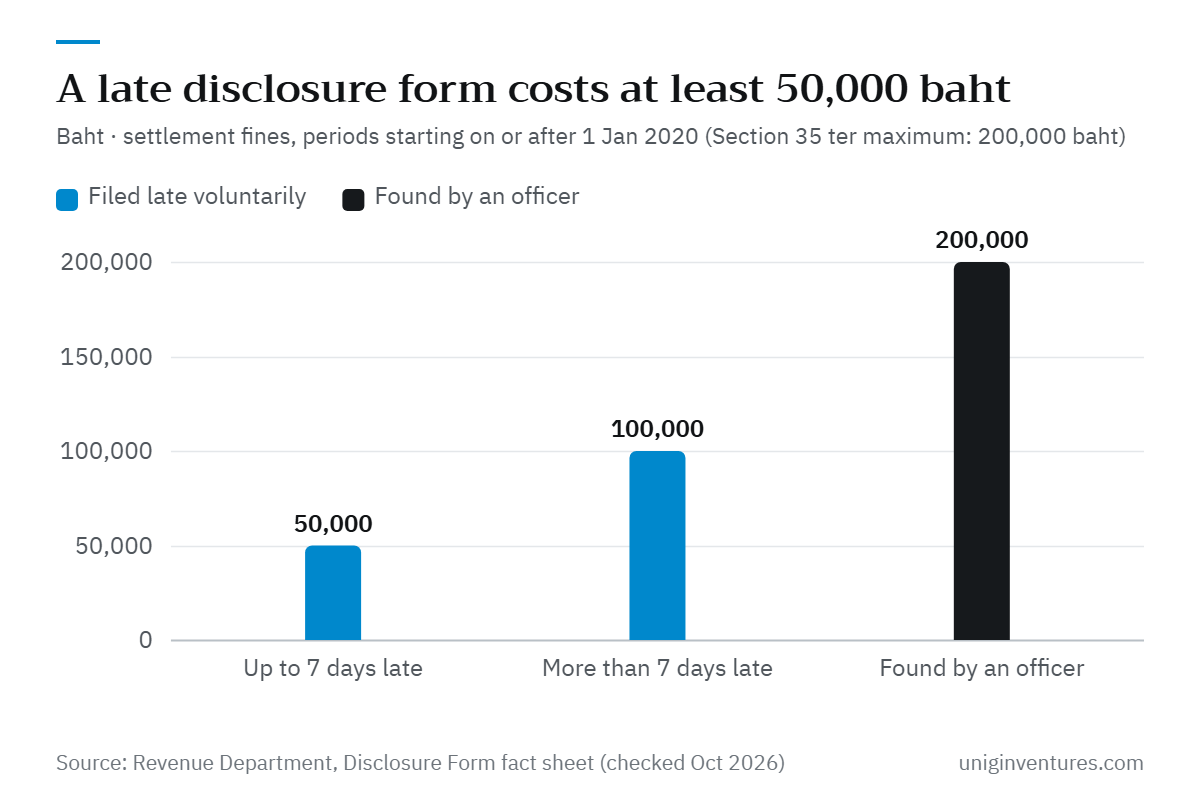
- Fine: Section 35 ter sets a fine of up to 200,000 baht for failing to file, filing late without reasonable cause, or filing incomplete or incorrect information.
The Revenue Department's guidance on the form sets settlement fines for late filing for accounting periods starting on or after 1 January 2020:
When the Revenue Department Asks for Documentation
The disclosure form is a risk-screening tool. The detailed analysis comes later, if the Revenue Department asks for it. Under Section 71 ter, paragraph two:
- Within five years of the date you filed the form, an assessment officer, with the Director-General's approval, may send a notice asking for documents that support your related-party pricing.
- You have 60 days from receiving the notice. The Director-General may extend this, but to no more than 120 days in total.
- For the first notice a company receives, the deadline is 180 days.
Director-General Notification No. 407, effective for accounting periods starting on or after 1 January 2021, lists what the documentation must contain. It must be in Thai and covers three areas:
- The company: its business, local organization chart and headcount, value chain, key customers and competitors, the structure of related parties it deals with, any business restructuring, and transfers of intangible assets.
- Each type of related-party transaction: counterparties and their countries, amounts, the pricing policy and assumptions, a list and summary of the contracts, an analysis of functions, assets and risks, the financial data used, the pricing method chosen and why other methods were not, and comparable independent transactions or companies.
- Any other documents the assessment officer specifies.
The notification lets some companies skip the comparables, for example those with revenue of not more than 500 million baht that have no related-party transactions with foreign companies or with companies taxed at a different rate, and that meet the other conditions in the notification.
Below 200 Million Baht, the Pricing Rules Still Apply
The 200-million-baht exemption covers the reporting and documentation duties in Section 71 ter. It does not cover the pricing rules.
- Section 71 bis lets the assessment officer adjust the income and expenses of related companies to the amounts independent parties would have agreed, where their terms differ and profit appears to have been shifted. Ministerial Regulation No. 369 (2020) says the comparison starts with the same kind of transaction the company makes with independent parties, and otherwise uses similar transactions between other companies in Thailand or abroad.
- Section 65 bis(4) applies to every company, related or not. If it transfers property, provides services or lends money for no payment, or below market price without reasonable cause, the officer may assess the amount at the market price on that date.
The interest-free loan to a sister company is the classic case. As an illustrative example, Company A lends 5,000,000 baht to a sister company for a year with no interest. Suppose the officer assesses interest at a market rate of 5% a year.
Interest assessed = 5,000,000 × 5% = 250,000 baht of extra income for Company A
Corporate income tax at 20% = 50,000 baht
Plus surcharges and penalties under the Revenue Code, and the interest may also be subject to specific business tax
The adjustment usually hits only one side. Company A pays tax on interest it never received, while the sister company may not be able to deduct interest it never paid. Section 71 bis does give a company that overpaid because of an adjustment the right to claim a refund within three years of the filing deadline, or within 60 days of written notice of the adjustment, under the Director-General's rules.
Where to Start
- Map your group: list every company and partnership where you, your family or your companies hold shares, with percentages, including indirect ones. Mark every pair that crosses 50%.
- List the flows between them: sales of goods, services, management fees, rent, royalties, loans and guarantees. Note the price and how it was set.
- Write a pricing policy for each flow: one page that says what the price is based on, for example the price charged to outside customers, cost plus a stated margin, or a market interest rate. Put it in a signed contract.
- Clean up interest-free loans: charge interest at a rate you can support, or record why the loan has a reasonable business cause.
- Check the 200-million-baht line every year: if any company in the group crosses it, add the disclosure form to the year-end closing calendar, and start keeping the Notification No. 407 documents in Thai before a notice arrives.
This article is general information, not tax advice for a specific case. Laws are as of October 2026.
Sources
- Revenue Code, Sections 65–76, including Sections 65 bis(4), 71 bis and 71 ter — Revenue Department
- Ministerial Regulation No. 369 (2020) on adjusting income and expenses of related companies — Revenue Department
- Ministerial Regulation No. 370 (2020) setting the 200-million-baht revenue threshold under Section 71 ter — Revenue Department
- Director-General Notification on Income Tax No. 407 on transfer pricing documentation — Revenue Department
- Explanatory note for the related-party Disclosure Form (FY2022 update) — Revenue Department
- Q&A on completing the Disclosure Form — Revenue Department
- Disclosure Form fact sheet: filing channel, deadline and fines — Revenue Department