BOI Incentives for Thai SMEs and Startups: Conditions and Tax Caps
BOI promotion is not just for big factories. Thai SMEs can qualify from 500,000 baht of investment with a tax exemption cap of up to 200%. Here are the conditions, the SME efficiency measure and the obligations.
In this article
Many SME owners assume Board of Investment (BOI) promotion is only for large factories or foreign companies. In fact, the BOI has special conditions for Thai SMEs, with a minimum investment of just 500,000 baht, plus a measure for existing businesses that want to invest in new machinery, digital systems or energy savings.
The incentives come with obligations. You must invest according to plan, keep separate accounts and report on the conditions. This article covers what the BOI offers, the conditions for SMEs and software startups, how the tax exemption cap works, and what to check before you apply. It is based on the BOI's Investment Promotion Guide 2025 (B.E. 2568) edition, which is updated from time to time, so always check the latest announcements before you apply.
What the BOI offers
Incentives fall into two groups:
- Tax incentives: corporate income tax (CIT) exemption on profits from the promoted activity, import duty exemption on machinery, and import duty exemption on raw materials used to produce exports.
- Non-tax incentives: such as permission to own land, to bring in foreign skilled workers and experts, and to remit money abroad in foreign currency.
The length of the CIT exemption depends on the activity group the BOI assigns:
| Activity group | CIT exemption | Exemption cap |
|---|---|---|
| A1+ | 10–13 years | No cap |
| A1 | 8 years | No cap |
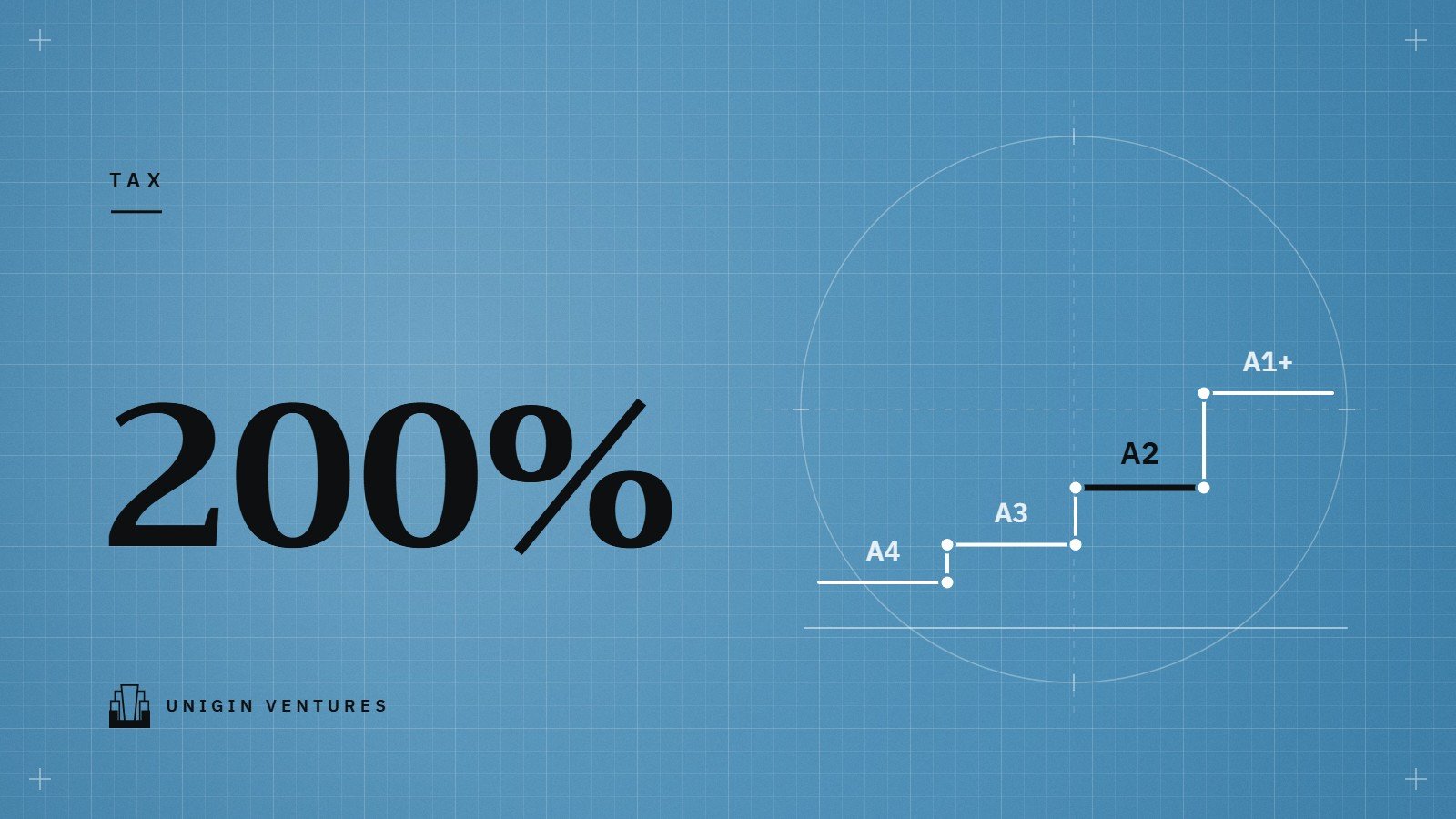
| A2 | 8 years | Capped by investment |
| A3 | 5 years | Capped by investment |
| A4 | 3 years | Capped by investment |
| B | None | — |
For groups A2–A4, the total tax exempted cannot exceed a set percentage of the investment, excluding land and working capital. For general projects the cap is 100% of the investment. Whichever runs out first, the time period or the cap, ends the benefit.
Two further benefits are often overlooked. First, dividends paid out of the exempt profits during the exemption period are excluded from the recipient's taxable income. Second, losses incurred during the promotion period can be deducted from net profits for up to five years after the exemption period ends.
Special conditions for SMEs
The BOI offers SMEs two routes: a new investment project, and an efficiency improvement measure for existing projects. Here is how they compare with a general project:
| Condition | General project | SME new project | SME efficiency improvement |
|---|---|---|---|
| Minimum investment (excluding land and working capital) | 1,000,000 baht | 500,000 baht | 500,000 baht |
| Shareholding | Not specified (except some activities) | Thai individuals hold at least 51% of registered capital, and more than half of the authorized directors are Thai individuals | |
| Total revenue from all businesses | Unlimited | Up to 500 million baht a year in the first 3 years from first project revenue | Up to 500 million baht a year in the 3 years before applying |
| Used machinery bought in Thailand | Not allowed | Allowed, up to 10 million baht | Not allowed; new machinery only |
| CIT exemption cap (groups A2–A4) | 100% of investment | 200% of investment | 5 years, 100% of the improvement investment |
Under both SME routes, the company must register under the "SME ONE ID" program with the Office of SMEs Promotion (OSMEP) before applying. New projects must also keep a debt-to-equity ratio of no more than 4 to 1.
The SME efficiency improvement measure
This measure was issued under BOI Announcement No. 5/2568 (2025). It suits SMEs with an existing business, whether or not it was promoted before (if it was, the earlier CIT exemption must have ended). The investment can cover one or more of these areas:
- Replacing machinery and adopting automation
- Using digital technology
- Upgrading to Industry 4.0
- Saving energy, using renewable energy, or reducing environmental impact
- Upgrading to international sustainability standards
- Transitioning to new industries
The incentives are import duty exemption on machinery and a five-year CIT exemption capped at 100% of the improvement investment. The period starts on the date of first revenue after the promotion certificate is issued, and the approved plan must be completed within three years of the certificate date. (Non-SME businesses get three years of CIT exemption.) Eligible spending includes machinery and equipment, consulting fees, technology training, and software or cloud services. Some items count in full and some at half, so check the guide before you build your investment budget.
Can a software startup apply?
Yes, if it falls under "development of software, digital platform, or digital content," which is in group A2. The main conditions in the 2025 guide are:
- A minimum investment of 1,500,000 baht a year, calculated from salaries of Thai IT staff hired after applying and/or temporarily employed Thai IT staff.
- Development must take place in Thailand, and retail or wholesale trading is excluded.
- The CIT exemption cap is set annually at 100% of actual spending that year, such as salaries of newly hired Thai IT staff, training, and the cost of ISO 29110 or CMMI certification.
- The project must reach full operation within 12 months of the certificate, with no extension.
A startup should weigh one point carefully: the main incentive is an exemption on profits. If the company is still losing money during the exemption period, the tax benefit is small, even with the right to carry losses forward afterward. Non-tax incentives, such as bringing in foreign experts, may be worth more to a team that needs specialized talent.
Example: which runs out first, the cap or the time
Illustrative example: an existing SME factory is promoted under the efficiency improvement measure and invests 4,000,000 baht in automation. Its exemption cap is therefore 4,000,000 baht, usable over five years. Assume exempt net profit of 2,500,000 baht a year and a 20% CIT rate.
Tax exempted per year = 2,500,000 × 20% = 500,000 baht
Total over 5 years = 500,000 × 5 = 2,500,000 baht, below the 4,000,000 baht cap
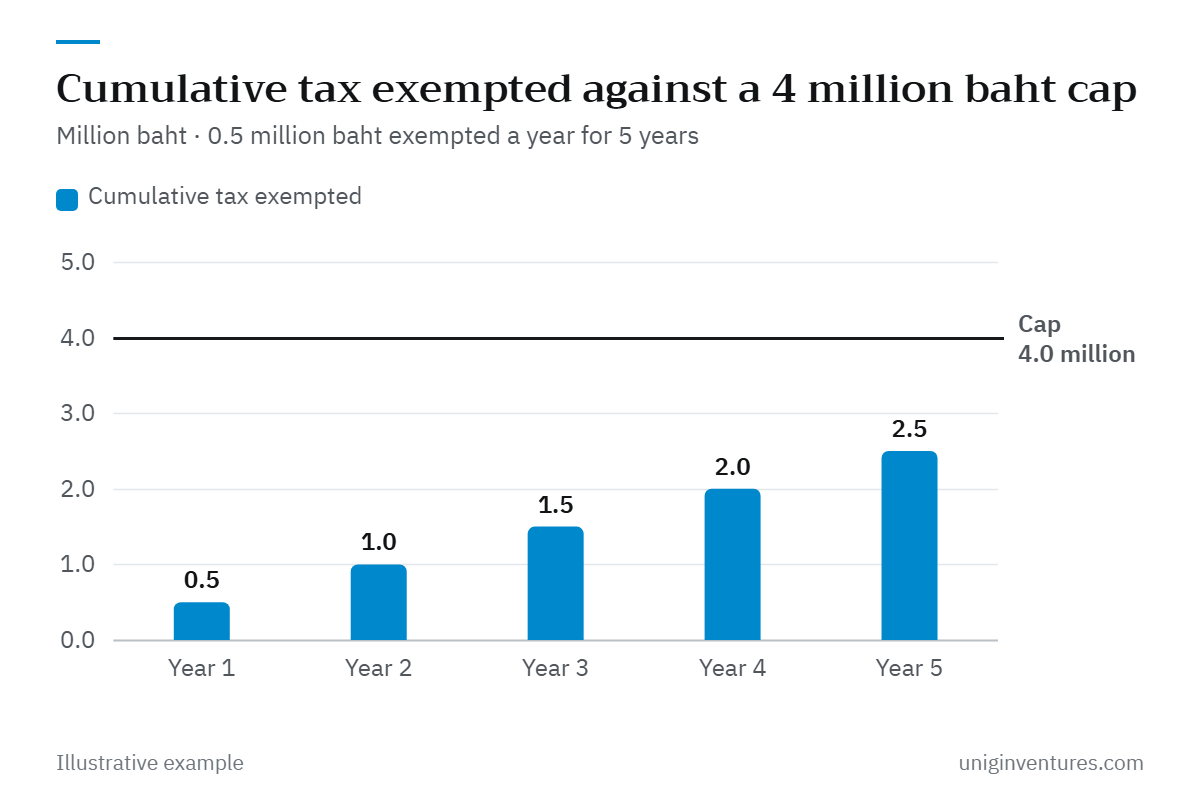
Here, time runs out before the cap, and the unused 1,500,000 baht expires with the period. With higher profits, the cap would run out first instead, and profit above it would be taxed as usual. Loss-making years use none of the benefit, but the clock keeps running. Plan around both your expected annual profit and when revenue will start after the certificate is issued.
This simple calculation uses a flat 20% rate. If your company qualifies for the SME tiered CIT rates, the actual saving will be lower. The exemption also applies only to profit from the promoted activity, not to the whole company.
What you take on after promotion
- Separate accounts. If you run both promoted and non-promoted activities, you must separate revenue and expenses. Expenses that cannot be separated are allocated by revenue share. Your accountant needs to understand this from day one.
- Plans and deadlines. Invest and start operations as stated in the certificate. If you fail to meet the conditions, the incentives may be revoked.
- Claiming the incentives. Incentives are not automatic. You apply to use each one, such as machinery imports and the CIT exemption.
- Time and advisory costs. Check that the benefit you calculated justifies your team's time and any consultant fees.
Where to start
- Check that your activity is eligible and which group it belongs to, using the BOI's latest list of eligible activities.
- Check the SME criteria: Thai shareholding, authorized directors and total revenue.
- Register for SME ONE ID with OSMEP before you apply.
- Itemize your investment budget, noting which items count in full or at half, and calculate your exemption cap.
- Estimate annual profit from the promoted activity to see whether time or the cap runs out first, and whether the benefit outweighs the obligations.
- Talk to BOI staff before applying, at the head office or a regional investment economic center, because conditions differ by activity and change over time.
BOI promotion is not right for every company. But for an SME already planning to invest in machinery or automation, or to build a software team, a few hours spent checking the conditions before investing could mean millions of baht in tax you never have to pay.
Sources
- Investment Promotion Guide B.E. 2568, Office of the Board of Investment (in Thai)
- A Guide to the Board of Investment (Investment Promotion Guide 2025), Thailand Board of Investment
- Investment promotion measures for SMEs, Office of the Board of Investment (in Thai)
- Taxation of BOI-promoted businesses, Office of the Board of Investment (in Thai)