Specific Business Tax and Stamp Duty: What Thai SMEs Need to Know
Companies pay 3.3% SBT on land sales however long they held it, interest on loans may be taxable, and unstamped contracts carry surcharges up to six times the duty. Rates, payers and checks.
In this article
Most Thai SME owners know VAT, corporate income tax and withholding tax. Two other taxes tend to appear when nobody planned for them: specific business tax (SBT), which applies when a company sells land or lends money, and stamp duty, which attaches to almost every contract the company signs.
Neither tax is always large. But if you miss one, the surcharge can be several times the tax, and an unstamped contract cannot be used as evidence in a civil case until the duty is paid. This article covers when each tax applies, the rates, who pays, and worked examples.
What Specific Business Tax Is and Who Pays It
SBT replaces VAT for certain activities. Section 91/2 of the Revenue Code lists eight groups: banking; finance and securities businesses; life insurance; pawnshops; activities ordinarily carried on like a commercial bank, such as lending money; selling real estate in the course of trade or for profit; selling securities on the Stock Exchange of Thailand; and other activities set by royal decree, which include factoring.
Unlike VAT, the tax base is gross receipts before any deductions (Section 91/5), and there is no input tax to offset.
| Activity | Tax base | Rate | Including local tax |
|---|---|---|---|
| Banking, finance, bank-like activities, factoring | Interest, discounts, fees, service charges | 3.0% | 3.3% |
| Real estate sold in the course of trade or for profit | Gross receipts | 3.0% | 3.3% |
| Life insurance, pawnshops | Interest, fees | 2.5% | 2.75% |
| Securities sold on the stock exchange | Gross receipts | 0.1% | Exempt |
A local tax of 10% of the SBT is added on top, so the 3.0% rate becomes 3.3% of receipts.
For an SME outside financial services, the two cases that come up most often are a company selling land or a building, and a company lending money to someone else.
When Your Company Sells Land or a Building
Royal Decree No. 342 (1998) sets out which real estate sales count as trade or profit. The key points for owners:
- Individuals pay SBT on a sale within five years of acquiring the property, unless an exception applies, such as an inheritance or a home where the seller has been on the house registration for at least one year.
- Companies and registered partnerships pay SBT on real estate held in their business with no five-year condition. A company that has owned land for ten years still pays when it sells.
The tax is paid at the Land Office on the day of the transfer, not in a monthly return, and the officer will not register the transfer until it is paid in full (Section 91/10). Once SBT is paid, the receipt for the transfer is exempt from stamp duty, which would otherwise be 1 baht per 200 baht, or 0.5% (stamp duty schedule, instrument 28(b)).
As an illustrative example, a company sells land it used as an old warehouse for 10,000,000 baht.
Specific business tax at 3.0% = 300,000 baht
Local tax at 10% of SBT = 30,000 baht
Total 330,000 baht (no further 0.5% stamp duty of 50,000 baht)
This is cash you need on transfer day, separate from transfer fees and other taxes the Land Office collects. If you are deciding whether to hold land in the company or personally, or negotiating a sale price, put this figure in the calculation from the start.
When Your Company Lends Money
Section 91/2(5) gives "lending money" as an example of bank-like activity. Interest your company receives may therefore be subject to SBT at 3.0%, or 3.3% with local tax, even if lending is not your main business.
The common exemption is in Royal Decree No. 240 (1991), Section 3(32), as amended by Royal Decree No. 571. It exempts two kinds of interest for companies that are not banks, finance businesses or life insurers:
- Loans between companies in the same group, where "same group" means one entity holds at least 25% of the voting shares of the other, and has held them for at least six months before the loan.
- Deposit interest, or interest on bills issued by financial institutions, at normal rates.
The exemption does not cover loans to a company you hold less than 25% of, a company whose shares you bought less than six months ago, or outside parties. In those cases, ask your accountant whether the loan counts as a bank-like activity before you sign.
As an illustrative example, Company A lends Company B 2,000,000 baht at 5% a year. Company A owns 10% of Company B.
Annual interest received = 2,000,000 × 5% = 100,000 baht
SBT at 3.0% = 3,000 baht, plus 300 baht of local tax, for 3,300 baht a year
Stamp duty on the loan agreement = 2,000,000 ÷ 2,000 = 1,000 baht (paid by the lender)
If Company A had held 25% or more for six months before the loan, the interest would be exempt from SBT, but the loan agreement would still need stamp duty as usual.
Obligations if you have SBT receipts regularly
- Register for SBT within 30 days of starting the activity (Section 91/12).
- File form P.T.40 monthly by the 15th of the following month, even in a month with no receipts (Section 91/10).
- Real estate sales do not need a monthly return, because the tax is paid at the Land Office on registration.
Stamp Duty: Which Contracts, How Much, Who Pays
Stamp duty applies to instruments, meaning the 28 kinds of document listed in the stamp duty schedule at the end of Chapter 6 of the Revenue Code. The table covers the ones SMEs use most. Any fraction of a unit is rounded up to a full unit.
| Instrument | Rate | Who pays |
|---|---|---|
| 1. Lease of land or buildings | 1 baht per 1,000 baht of total rent over the lease term (no stated term: treated as 3 years) | Lessor |
| 2. Share transfer | 1 baht per 1,000 baht of paid-up value or the price in the instrument, whichever is higher | Transferor |
| 3. Hire purchase | 1 baht per 1,000 baht of the total price | Owner (hirer-out) |
| 4. Hire of work | 1 baht per 1,000 baht of the fee | Contractor |
| 5. Loan or bank overdraft | 1 baht per 2,000 baht, capped at 10,000 baht | Lender |
| 7. Power of attorney | 10 baht (single act) or 30 baht (more than one act) | Grantor |
| 17. Guarantee | 10 baht if over 10,000 baht or unlimited | Guarantor |
As an illustrative example, here are three instruments a small company might see in one year:
- A three-year office lease at 50,000 baht a month: total rent 1,800,000 baht, duty 1,800 baht.
- A contract to build a system for a client for a fee of 3,000,000 baht: the contractor pays 3,000 baht of duty.
- A shareholder transfers 10,000 shares with a paid-up value of 100 baht each at 300 baht a share: duty is based on the higher 3,000,000 baht, so 3,000 baht.
A common mistake: hire-of-work contracts are often labeled "service agreements." If the job is to deliver a finished result, such as building, installing or developing a system, it is still hire of work, and the contractor owes the duty. Contracts made outside Thailand and performed outside Thailand are exempt.
Some electronic instruments pay duty in cash online with form Or.Sor.9 instead of affixing stamps. If your company signs contracts electronically, check the latest Revenue Department notifications on stamp duty for how that type of contract must be paid.
What Happens If You Forget
Duty is due when the instrument is made. If it was not paid, the Revenue Code sets surcharges that rise with time and depend on who finds the problem:
- You submit it yourself within 15 days of the due date: duty only (Section 113(1)).
- You submit it yourself after 15 days but within 90 days: a surcharge of 2 times the duty or 4 baht, whichever is higher (Section 113(2)(a)).
- You submit it yourself after 90 days: 5 times the duty or 10 baht, whichever is higher (Section 113(2)(b)).
- An officer finds the instrument was never stamped: 6 times the duty or 25 baht, whichever is higher (Section 114(2)(a)).
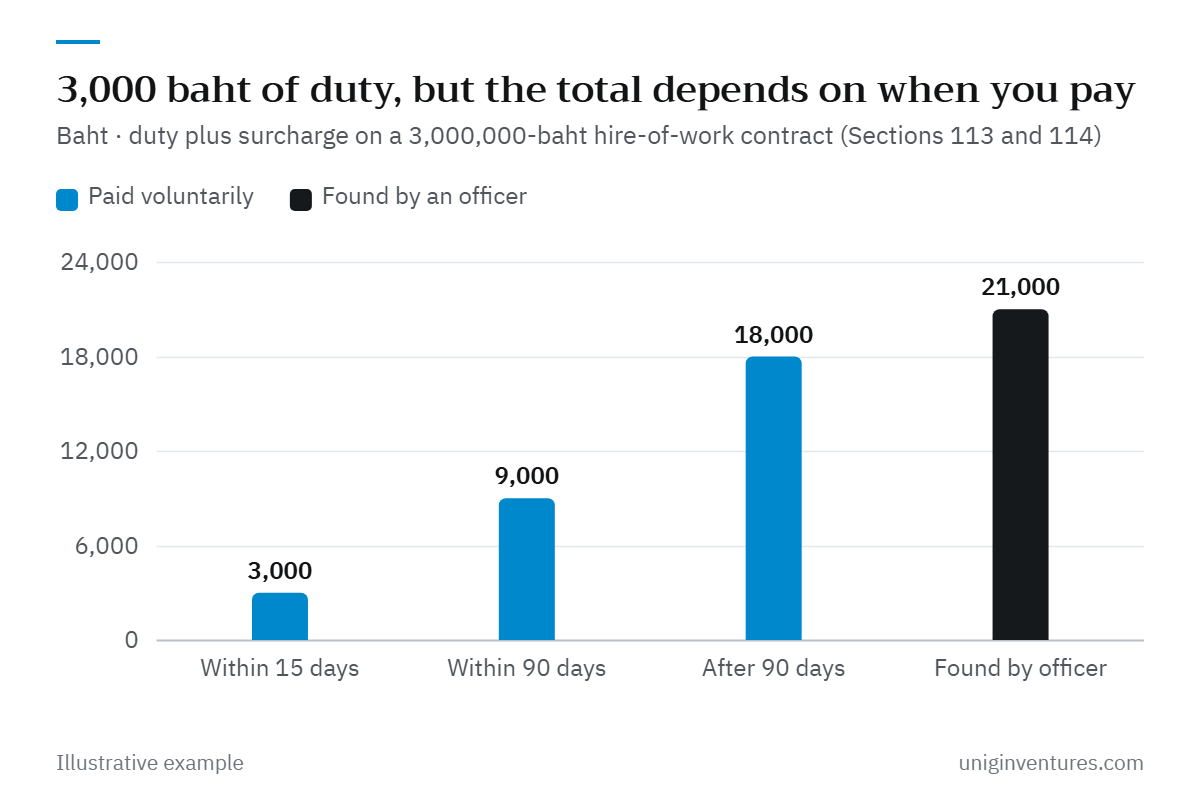
The bigger risk is Section 118. An instrument that is not fully stamped cannot be used as evidence in a civil case until the duty is paid. If you ever need to sue a client who did not pay under a hire-of-work contract, or a borrower who did not repay, you must pay the duty and surcharge before the court will accept the contract.
Where to Start
- List the contracts still in force: leases, hire-of-work contracts, loans and guarantees. Check which ones have not been stamped or paid. Finding them before an officer does means a smaller surcharge.
- Build stamp duty into your signing process: decide who calculates it, who stamps or pays in cash, and file the proof with the contract.
- Review intercompany loans: is the holding at least 25%, and was it held for six months before the loan? If not, ask your accountant about SBT before you transfer money.
- Before the company sells land or a building, set aside 3.3% of the sale price in the cash plan for transfer day.
- If you have SBT receipts regularly, confirm you are registered and file P.T.40 every month, even with no receipts.
This article is general information, not tax advice for a specific case. Laws are as of October 2026.
Sources
- Revenue Code, Chapter 5 Specific Business Tax, Sections 91–91/21 — Revenue Department
- Activities subject to specific business tax (including real estate conditions under Royal Decree No. 342) — Revenue Department
- Specific business tax base and rates (10% local tax) — Revenue Department
- Royal Decree No. 240 (1991) on SBT exemptions, Section 3(32) — Revenue Department
- Stamp duty rate schedule — Revenue Department
- Revenue Code, Chapter 6 Stamp Duty, Sections 103–129 (Sections 113, 114 and 118) — Revenue Department
- Director-General's notifications on stamp duty (cash payment and form Or.Sor.9) — Revenue Department