Tax for Thai Companies Selling Online: Revenue, VAT, Platform Fees and Ads
Book revenue on what customers paid, not on payouts. Measure the 1.8-million-baht VAT threshold correctly, claim input VAT on fees, and file P.P.36 for overseas ads, with a full-year example.
In this article
Many Thai online shops start in the owner's personal bank account. As sales grow, the owner registers a company but keeps the old bookkeeping habit: watch the money the platform transfers in and nothing else. Nobody records the fees the platform deducted. Ads paid to overseas companies have no tax paperwork behind them. The problems surface at year-end close or when the Revenue Department asks questions.
This guide covers the main taxes for a company that sells through marketplaces and social media: corporate income tax, value added tax (VAT), platform fees, and advertising paid to overseas companies. It ends with a full-year worked example and a checklist you can start on this month.
What the Revenue Department can see
Online sales data no longer sits only with the shop. Two channels send information directly to the Revenue Department.
- Large platforms keep a special account. A Director-General notification requires electronic platforms with more than 1,000 million baht of revenue in an accounting period to prepare a special account showing the revenue the platform receives from merchants. They must submit it within 150 days after the period ends, starting with accounting periods that begin on or after January 1, 2024.
- Banks report specific transactions. Under the Revenue Code Amendment Act (No. 48) of 2019, financial institutions and e-money providers must report anyone whose deposits or incoming transfers across all accounts reach 3,000 or more a year, or 400 or more with a combined value of 2,000,000 baht or more.
The Revenue Department says it does not assess tax from bank data alone. It combines the data with other sources to find high-risk cases. In practice, this means your company's books should reconcile with the platform's reports every month, and owners should stop taking company sales into personal accounts. Mixing the two makes both hard to explain.
Revenue is what the customer paid, not what the platform transferred
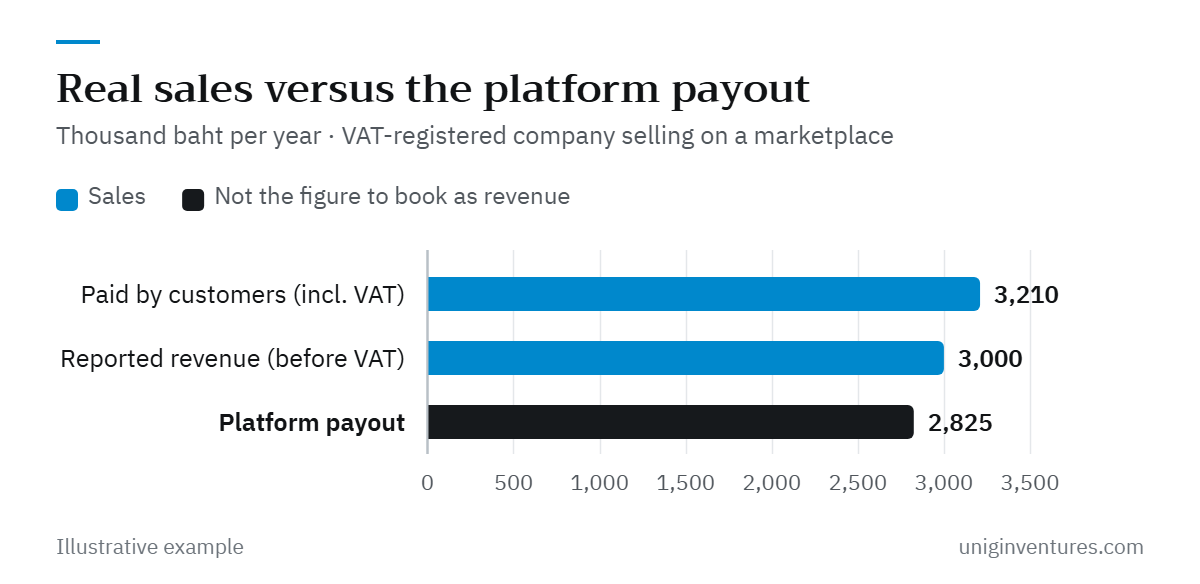
The most common mistake is to record revenue as the amount the platform pays out. That amount has already had commissions, payment fees and other service charges taken out. If your company is the seller of the goods, the correct treatment is:
- Record the full sales amount the customer paid as revenue.
- Record platform fees as an expense, backed by the platform's tax invoice or receipt.
- Reconcile every month: sales − fees − refunds = cash received. Investigate any gap you cannot explain.
The tax bill can come out the same either way, because revenue and expenses shrink by the same amount. But your reported sales will fall short of the data the platform sends to the Revenue Department. More importantly, several tax thresholds are measured on sales, not on cash received.
Corporate income tax
A company pays tax on net profit, not on sales. An SME with paid-up capital of no more than 5 million baht and revenue from sales of goods and services of no more than 30 million baht pays tiered rates.
| Net profit (baht) | Tax rate |
|---|---|
| 0 – 300,000 | Exempt |
| 300,001 – 3,000,000 | 15% |
| Over 3,000,000 | 20% |
Companies that do not qualify as SMEs pay 20% on all net profit. The 30-million-baht test uses sales revenue, so it must be measured on gross sales, not on payouts.
Online shops often miss deductions, or lose them for lack of documents: platform fees, ads, packaging, shipping, and payments to reviewers or affiliates. Every item needs proof of payment in the company's name and must be a business expense under Section 65 ter. Count and value inventory at each year-end, because cost of sales is based on goods actually sold, not on goods purchased.
VAT: measure the 1.8 million baht on sales
A business that regularly sells goods or services with revenue above 1.8 million baht a year must apply for VAT registration within 30 days of the day its revenue crosses that line. Revenue here means the value of sales, so look at gross sales.
Illustrative example: a shop with 1,900,000 baht of sales for the year pays total fees of about 10%, so it receives roughly 1,710,000 baht. If the owner looks only at payouts, the shop seems below the threshold, but its sales passed 1.8 million baht. Registering late means the company bears output VAT it never charged customers, and it may face penalties and surcharges.
The rate, and what changes once you register
- The rate is 7% (including local tax). It is a reduced rate below the statutory 10%, extended one period at a time. On July 27, 2026, the Cabinet approved extending it through September 30, 2027, according to Revenue Department press release 18/2569. Watch for the announcement before each expiry.
- Issue a tax invoice for every sale and file a P.P.30 return every month, even in months with no sales.
- Output VAT is calculated on the full price of the goods. Fees deducted by the platform do not reduce the output VAT base.
- You can claim input VAT on fees charged by Thai-registered platforms, on inventory and on packaging, if you hold a full tax invoice showing the company's name and tax ID. Complete the company details in each seller account so invoices are issued to the company.
- VAT-registered sellers of goods must keep a goods and raw materials report under Section 87. Shops with hundreds of SKUs should use a system that deducts stock per order.
Platform fees and withholding tax
As a general rule, when a company pays a service fee to a Thai juristic person, the payer withholds tax: 3% for services and 2% for advertising, filed on form P.N.D.53. But most marketplaces deduct their fees from sales before paying the shop, so the company never actually pays the fee out the way it pays an ordinary supplier.
Practice therefore depends on each platform's terms. What to do:
- Read the platform's seller guide or help center on withholding tax for corporate sellers.
- Download fee tax invoices or receipts every month and file them with the sales reports.
- Have your accountant confirm whether and how the company must withhold, then do it the same way every month.
Payments to individual reviewers or affiliates in Thailand are ordinary outgoing payments. Withhold tax according to the income type and give the recipient a withholding certificate.
Ads paid to overseas companies
Overseas companies bill much of the advertising on social media and search engines. How VAT works on these services depends on whether the buying company is VAT-registered.
- Not VAT-registered. Since September 1, 2021, the Revenue Code Amendment Act (No. 53) of 2021 has made overseas providers of electronic services liable for VAT on services used by buyers who are not VAT-registered. The tax is built into the price, and the company cannot claim it as input VAT.
- VAT-registered. The payer must remit VAT on the provider's behalf using form P.P.36, under Revenue Department Order Por.104/2544, within 7 days after the end of the month of payment. The company can then claim that VAT as input tax in the month it files the P.P.36. The net effect is usually zero, but if you skip the filing, you lose the input credit and may owe surcharges.
Set the company name and tax ID in each ad account to match its registration, and download invoices every month. If anyone on the team pays for ads with a personal credit card, switch to a company payment method.
A full-year worked example
Illustrative example: a company sells through a marketplace, is VAT-registered and qualifies as an SME. Its annual figures are below. Assume everything purchased during the year was sold, and other expenses carry no input VAT.
| Item | Baht |
|---|---|
| Paid by customers (incl. VAT) | 3,210,000 |
| Sales before VAT (reported revenue) | 3,000,000 |
| Output VAT at 7% | 210,000 |
| Platform fees 360,000 + VAT 25,200 | 385,200 |
| Cash transferred by the platform | 2,824,800 |
| Cost of goods 1,650,000 + VAT 115,500 | 1,765,500 |
| Overseas ads (plus 21,000 remitted on P.P.36) | 300,000 |
| Other expenses (staff, packaging, rent) | 600,000 |
VAT for the year
Output VAT 210,000 − input VAT (25,200 + 115,500 + 21,000) = net VAT payable 48,300 baht
Corporate income tax
Net profit = 3,000,000 − 1,650,000 − 360,000 − 300,000 − 600,000 = 390,000 baht
Tax = first 300,000 baht exempt + (90,000 × 15%) = 13,500 baht
If this company booked revenue from its payouts of 2,824,800 baht (2,640,000 baht before VAT) and ignored the fees, its reported revenue would be 360,000 baht too low. Profit would not change, but sales would not match the platform's data, and output VAT on the P.P.30 would be calculated on the wrong base.
Checklist to get it right
- Move every seller account into the company's name, link it to the company bank account, and enter the company's tax ID.
- Stop receiving company sales in personal accounts. If a customer pays the wrong account, transfer the money to the company and record it.
- At each month-end, download sales reports, payout reports and fee tax invoices from every platform.
- Reconcile sales, fees, refunds and cash received every month.
- Track cumulative sales against the 1.8-million-baht threshold and prepare to register for VAT before you reach it.
- Once registered, file a P.P.36 for overseas ads in every month you pay them.
- Count stock at least at each year-end, and have your accountant check withholding rules for each platform you use.
The rules in this article are general principles as of October 2026. For special cases, such as VAT-exempt goods, sales to overseas customers or consignment selling, consult your accountant or a tax adviser.
Sources
- Special account submission by electronic platforms — Revenue Department (Thai)
- Q&A on financial institutions reporting specific transactions — Revenue Department (Thai)
- Corporate income tax guide for SMEs — Revenue Department (Thai)
- Conditions for computing net profit under Section 65 ter — Revenue Department (Thai)
- Who must register for VAT — Revenue Department (Thai)
- Press release 18/2569: 7% VAT rate extended to September 30, 2027 — Revenue Department (Thai)
- Revenue Code Sections 87–90 (goods and raw materials report) — Revenue Department (Thai)
- Withholding tax guide for forms P.N.D.3 and P.N.D.53 — Revenue Department (Thai)
- Revenue Code Amendment Act (No. 53) B.E. 2564 — Revenue Department (Thai)
- Revenue Department Order Por.104/2544 (VAT on services from abroad) — Revenue Department (Thai)