
Paying Foreign Service Providers: When You Owe PP 36 VAT and PND 54 Withholding
Software, online ads and overseas consultants: who files PP 36 VAT, which payments need 15% PND 54 withholding, how tax treaties change the rate, and why net-of-tax contracts cost more.
In this article
A monthly software subscription, ads bought on an overseas platform, a design studio abroad, a consultant who bills in dollars. None of these invoices shows Thai VAT or a Thai tax ID. The company pays by card or wire transfer, and nobody files anything. Yet the Revenue Code makes the Thai payer responsible for remitting tax on behalf of foreign providers: VAT on Form PP 36 and, in some cases, withholding tax on Form PND 54.
The two forms follow different tests. VAT applies to almost any foreign service used in Thailand. Withholding tax applies only to certain types of income. This article sorts out which payment needs which form, when to file, and the contract terms that quietly raise your cost.
Two Forms, Two Different Tests
| Item | PP 36 | PND 54 |
|---|---|---|
| Tax | Value added tax | Corporate income tax withheld by the payer |
| Law | Section 83/6 | Section 70 |
| Applies to | Services from abroad used in Thailand | Income under Section 40(2) to (6) paid to a foreign company not carrying on business in Thailand |
| Rate | 7% | 15% (dividends 10%), or the tax treaty rate |
| Who bears it | The payer; a VAT-registered payer can claim it as input tax | The recipient; the payer deducts it from the transfer |
| Deadline | Within 7 days after the end of the month of payment | Within 7 days after the end of the month of payment |
If you file online, the Revenue Department's tax calendar for late 2026 sets the 15th of the following month for both forms, for example December 15, 2026 for payments made in November. A single payment may need both forms or only PP 36, so decide each form separately.
PP 36: Foreign Services Used in Thailand
Section 83/6 makes the person who pays for a service supplied from abroad and used in Thailand remit the VAT on the foreign provider's behalf. Revenue Department Order Por. 104/2544 defines such a service as any act of value, other than a sale of goods, that a foreign operator performs abroad and whose result the Thai recipient uses in Thailand. The same order says that licensing a copyright, trademark or patent the provider still owns, and hiring a foreign operator to write software whose copyright belongs to the Thai client, are both services in this sense.
Revenue Department rulings confirm the duty for several kinds of payments, including advertising on a foreign company's website (ruling 0706(Kor Mor 05)/1022), a license to use cartoon characters (ruling 0702/8336) and a data system service supplied from abroad (ruling 0702/6764). When a foreign operator comes to Thailand to provide services temporarily without registering for VAT, Section 83/6(1) also makes the payer remit the tax.
Who files depends on your VAT status and the type of service, because Section 83/6(2) separates electronic services from other services. Section 77/1(10/1) defines an electronic service as one delivered over the internet or another electronic network, substantially automated, and impossible to provide without information technology. Software subscriptions and ads bought through a platform's own system fit this description. Work done by people, such as consulting or design, is not automated, even when the deliverable arrives by email.
If Your Company Is VAT-Registered
File PP 36 for every service from abroad, both electronic services (Section 83/6(2)(a)) and other services (Section 83/6(2)(b)), then claim the VAT you remitted as input tax. The net tax effect is zero, but the cash goes out first, and if you never file, you have nothing to claim.
If Your Company Is Not VAT-Registered
- Electronic services Section 83/6(2)(a) makes the payer remit only when the user is a VAT-registered operator. For sales to unregistered users, the tax is the foreign provider's obligation under the e-Service tax law in force since September 1, 2021.
- Other services Section 83/6(2)(b) covers every user. An unregistered company still files PP 36 when it pays a foreign consultant or designer, and it cannot claim the VAT back, because Order Por. 104/2544 gives that right only to VAT-registered operators. The 7% becomes an added cost.
Tax Base, Credit Timing and Surcharges
- The 7% rate is a temporary reduction. Royal Decree No. 807 (2026) extends it to September 30, 2027. Watch for announcements as that date approaches.
- The tax base is the full amount before withholding. If you must also withhold under Section 70, compute VAT on the amount before withholding. If you agree to bear the foreign provider's income tax, add the tax you bear to the base until there is no further tax to bear (clause 4 of Order Por. 104/2544).
- Claim the input tax in the tax month you file PP 36 and receive the Revenue Department's receipt. File in the same month you pay, and you can claim it that month.
- Late remittance carries a surcharge of 1.5% per month or part of a month on the tax due (Section 89/1).
PND 54: Withholding Only for Income Listed in Section 70
Section 70 covers companies and juristic partnerships formed under foreign law that do not carry on business in Thailand and receive income under Section 40(2) to (6) paid from or in Thailand. The payer withholds 15% of the payment, or 10% for dividends, and files PND 54 within 7 days after the end of the month of payment. A payer who fails to withhold, or withholds too little, is jointly liable with the recipient, because Section 70 applies Section 54. Late remittance carries a surcharge of 1.5% per month or part of a month (Section 27).
Income under Section 40(2) to (6) covers income from a position or from performing work, fees for copyrights and other rights, interest and dividends, rent on property, and income from liberal professions. Business income under Section 40(8) is not on the list. The real question is therefore which type of income each payment is. The table summarizes Revenue Department rulings on payments SMEs make often.
| Payment | Ruling | PND 54 |
|---|---|---|
| License to use a computer program, even standard software sold to the public | Copyright fee under Section 40(3) (ruling 0702/6638, Oct 13, 2008) | Withhold 15% or the treaty rate |
| License to use cartoon characters on products | Royalty; 5% for the UK recipient under the treaty, 15% for the Indonesian and Malaysian recipients (ruling 0702/8336, Oct 6, 2016) | Withhold at the recipient country's rate |
| Cloud services and web-based software that grant no right to copy, modify or distribute and no technical know-how | Not a royalty; business profits under the Thailand–US treaty (ruling 0702/1626, Mar 19, 2025) | No withholding if the provider has no permanent establishment in Thailand |
| Custom programming paid by the hours worked, or with code ownership passing to the client | Income under Section 40(8) (ruling 0702/1626, Mar 19, 2025) | No withholding if the contractor has no permanent establishment in Thailand |
| A service performed entirely abroad with no technology or know-how provided | Income under Section 40(8) (ruling 0702/6764, Aug 29, 2018) | No withholding |
Every row is a service from abroad used in Thailand, so a VAT-registered company still files PP 36 even when no PND 54 is due. Ruling 0702/6764 says exactly that: no withholding under Section 70, but VAT must be remitted on PP 36.
Each ruling answers the facts of the company that asked, so the wording of your contract matters more than the line item on the invoice. Check three things: whether the contract grants rights to copy, modify or resell; whether it transfers technical know-how; and whether the provider's staff work in Thailand. If they do, the permanent establishment test in the relevant treaty applies, and an expert should review it before you pay.
Tax Treaties: Lower Rates, or No Withholding at All
The Revenue Department notes that withholding rates for foreign companies may be reduced or exempted depending on the type of income under a double tax agreement. Two provisions matter most for SME payments.
- Royalties Each treaty caps the rate the paying country can charge at a different level, and the cap varies by type of right. Start with the Revenue Department's table of royalty rate caps, then check the text of the treaty itself.
- Business profits If the recipient has no permanent establishment in Thailand, the rulings above treat it as owing no Thai income tax, so the payer withholds nothing.
Before you apply a treaty rate, ask the vendor for a certificate of residence issued by its home tax authority and keep it with the payment records. If you withhold more than the treaty rate, the foreign company can claim a refund on Form Kor. 10 within three years from the last day of the filing deadline (ruling 0702/8336). Withholding correctly from the start saves the vendor that process.
Worked Example: A Contract That Promises the Vendor the Full Amount
An illustrative example: Company A, which is VAT-registered, buys an annual software license from a foreign company with no presence in Thailand. The license fee is 100,000 baht. Assume the vendor's country has no tax treaty with Thailand, so the withholding rate is 15%. The table compares two tax clauses.
| Item | Contract A: price includes Thai taxes | Contract B: vendor receives the full amount |
|---|---|---|
| Income used to compute the tax | 100,000 | 117,647 |
| Withholding tax at 15% (PND 54) | 15,000 | 17,647 |
| Transfer to the vendor | 85,000 | 100,000 |
| VAT at 7% (PP 36) | 7,000 | 8,235 |
| Total cash paid out | 107,000 | 125,882 |
| Input tax credited back | 7,000 | 8,235 |
| Net cost | 100,000 | 117,647 |
Contract A is straightforward. The vendor bears its own income tax, so the company withholds 15,000 baht, transfers 85,000 baht and remits 7% VAT on the 100,000 baht before withholding.
Contract B says the vendor must receive the full 100,000 baht. Tax the company bears on the vendor's behalf counts as the vendor's income too (Section 39). If you keep taxing the tax you bear until nothing is left to bear, the income becomes 117,647 baht and the withholding tax 17,647 baht, about 17.65% of what the vendor receives. The VAT base must include the tax you bear as well, so the VAT is 8,235 baht.
Income when the payer bears the tax = amount the recipient must receive ÷ (1 − withholding rate)
100,000 ÷ (1 − 0.15) = 117,647 baht
The VAT comes back as input tax under both contracts, but the income tax you bear does not. The license fee is the same, yet Contract B costs 17,647 baht, or 17.6%, more. If the vendor's country had a treaty capping the rate at 5% (an assumption), Contract B would cost 105,263 baht.
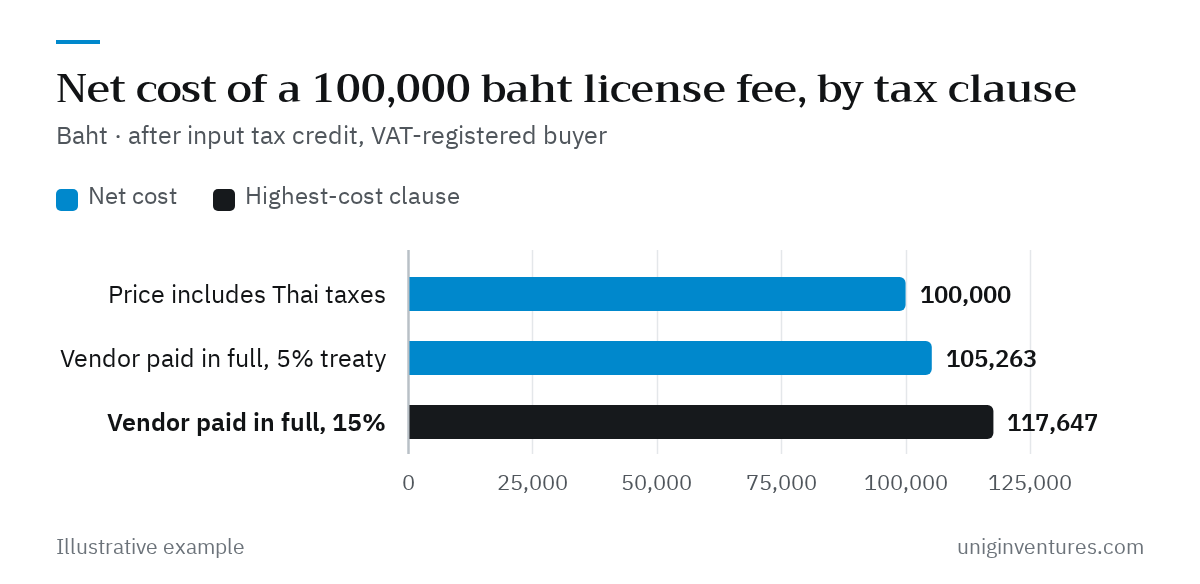
Read the tax clause before you sign. If it says the price excludes withholding tax, or that the payer bears all taxes (a gross-up), work out the real cost with the formula above before you compare quotes from other vendors.
Where to Start
- Pull the last 12 months of payments abroad from company credit cards, international transfers and online payment accounts, and group them by provider.
- Check who issued each invoice. If it is a Thai company issuing a tax invoice, the normal domestic input tax and withholding rules apply (see withholding tax rates SMEs use most). If it is a foreign company, use the rules in this article.
- Classify each payment as a royalty, a cloud service, contract work or another service, reading the contract against the three questions in the PND 54 section.
- Set a filing routine for every month with a payment. A VAT-registered company should file PP 36 in the same month it pays, so it can claim the input tax as early as possible.
- Agree on the tax clause before signing new contracts. State whether the price includes Thai taxes, and ask for the vendor's certificate of residence if you plan to use a treaty rate.
- Catch up on anything not yet filed. Have your accountant compute and file it soon, since surcharges accrue monthly. For large recurring payments you are unsure about, get advice from a tax adviser or request a ruling from the Revenue Department.
This article is general information, not tax advice for any specific business. Laws and rulings were checked against the Revenue Department website as of October 2026. Each ruling answers the facts of the company that asked. Payments to individuals abroad follow separate withholding rules that this article does not cover. The company and figures in the example are illustrative.
Sources
- Revenue Code Sections 83–84 (Sections 83/5 and 83/6, VAT remitted by the payer) — Revenue Department (Thai)
- Revenue Code Sections 77–79 (Section 77/1(10/1), definition of electronic service) — Revenue Department (Thai)
- Revenue Department Order Por. 104/2544: VAT on services performed abroad and used in Thailand — Revenue Department (Thai)
- Royal Decree No. 807 (2026) extending the reduced VAT rate to September 30, 2027 — Revenue Department (Thai)
- Revenue Code Sections 65–76 (Section 70) — Revenue Department (Thai)
- Corporate income tax on income paid from or in Thailand (rates and Form PND 54) — Revenue Department (Thai)
- Income Tax Guide for Foreign Company — Revenue Department
- Revenue Code Sections 38–64 (Sections 39, 40 and 54) — Revenue Department (Thai)
- Revenue Code Sections 14–27 (Section 27, surcharges) — Revenue Department (Thai)
- Revenue Code Sections 87–90 (Section 89/1, VAT surcharges) — Revenue Department (Thai)
- Ruling 0702/6638: computer program copyright fees under Section 70 — Revenue Department (Thai)
- Ruling 0702/8336: withholding tax and VAT on royalties paid abroad — Revenue Department (Thai)
- Ruling 0702/1626: payments abroad for computer programs and development services — Revenue Department (Thai)
- Ruling 0702/6764: corporate income tax and VAT on service fees paid abroad — Revenue Department (Thai)
- Ruling 0706(Kor Mor 05)/1022: withholding tax and VAT on advertising fees — Revenue Department (Thai)
- Treaty caps on withholding tax rates for royalties — Revenue Department (Thai)
- Tax calendar: online filing deadline of December 15, 2026 (PND 54 and PP 36) — Revenue Department (Thai)