Double Tax Deductions in Thailand: What SMEs Can Still Claim and What It Saves
Older and disabled employees' wages, staff training and e-Tax systems are deductible at twice the cost, but the saving depends on your tax bracket. Conditions, a worked example and deadlines.
In this article
Some company expenses in Thailand are deductible at more than their cost. Wages paid to employees aged 60 or over, wages paid to employees with disabilities, the cost of sending staff to training, and spending on an e-Tax Invoice system can all be deducted at twice the amount paid. Many companies still miss these deductions because they do not know the measures exist, do not keep the right documents, or miss a notification deadline.
This article explains how much tax an extra deduction actually saves, lists the measures we verified against official sources, and covers the conditions that most often cost companies the deduction, along with what to prepare before you close this year's books.
What a double deduction is worth
The royal decrees phrase it as an income tax exemption "equal to 100 percent of the expense." In practice, the company deducts the expense once as normal, then deducts the exempt amount once more, for a total of twice the amount paid. The extra deduction lowers taxable profit, so the tax saved depends on the rate of the bracket your profit falls in.
Tax saved = extra deduction × tax rate of the bracket your net profit falls in
Companies with paid-up capital of no more than THB 5 million and revenue of no more than THB 30 million pay corporate income tax in brackets: net profit up to THB 300,000 is exempt, the portion above THB 300,000 up to THB 3,000,000 is taxed at 15%, and the portion above THB 3,000,000 at 20%. Other companies pay 20%.
As an illustrative example, a company employs a 62-year-old at THB 12,000 a month for 12 months, or THB 144,000 in total. If the conditions are met, the company can deduct an extra THB 144,000. The tax saved depends on which bracket the company's profit falls in.
| Company's net profit | Bracket rate | Tax saved |
|---|---|---|
| Up to THB 300,000 (SME) | 0% | THB 0 |
| Within THB 300,000–3,000,000 (SME) | 15% | THB 21,600 |
| Above THB 3,000,000, or a non-SME company | 20% | THB 28,800 |
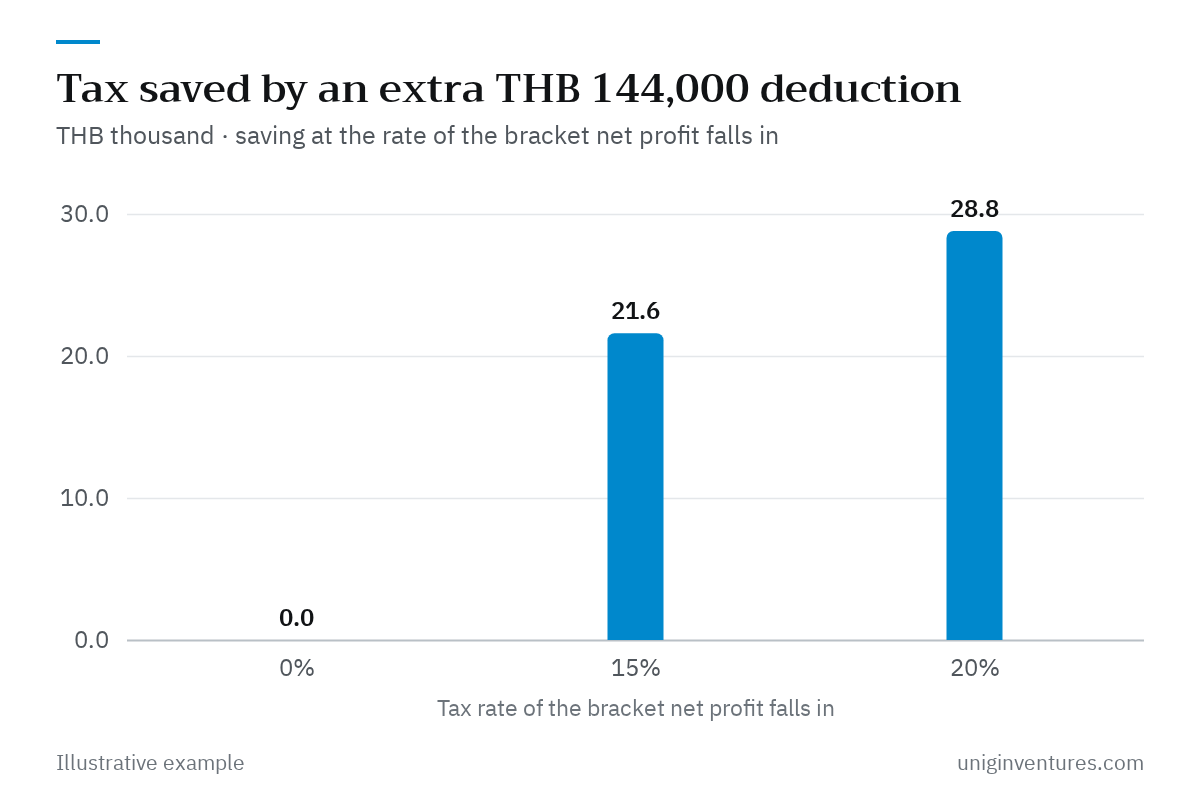
If the extra deduction moves profit across a bracket line, calculate each bracket separately. For example, with profit of THB 400,000 before the extra deduction, deducting THB 144,000 leaves THB 256,000. Tax falls from THB 15,000 (15% of THB 100,000) to zero, so the saving is THB 15,000, not THB 21,600.
Measures available and their main conditions
| Expense | Main conditions | Legal basis |
|---|---|---|
| Wages of employees aged 60 or over | Wage no more than THB 15,000 a month per person, no more than 10% of headcount, not a director or shareholder, notify the Revenue Department within 150 days after the accounting period ends | Royal Decree No. 639 |
| Wages of employees with disabilities | The employee holds a disability ID card under the law on the promotion and development of the quality of life of persons with disabilities | Royal Decree No. 499 |
| Accessibility facilities for persons with disabilities | Owners of buildings, premises, vehicles or services that provide equipment or services giving persons with disabilities access under the same law | Royal Decree No. 499 |
| Sending employees to education or training, and in-house training | Government institutions or institutions designated by the Minister of Finance; in-house training must meet the conditions set by the Director-General of the Revenue Department | Royal Decree No. 437 |
| Investment in and service fees for e-Tax Invoice & e-Receipt and e-Withholding Tax systems | Software, computer equipment, data storage and fees paid to system service providers, through December 31, 2027 | Cabinet resolution of June 17, 2026 and Royal Decree No. 808 |
| Education support contributions | For projects approved by the Ministry of Education, capped at 10% of net profit | Royal Decree No. 420 |
Older employees: the conditions people miss
The Revenue Department's FAQ says the employee must be at least 60, must already be the company's employee or be registered with the Department of Employment, must earn no more than THB 15,000 a month, and must not be a director or shareholder of the company. The deduction covers only up to 10% of the company's headcount, and the company must report the employees through the department's online system within 150 days after the end of the accounting period.
The THB 15,000 limit is a cutoff, not a cap. In the department's own example, an employee earning THB 15,000 gives a deduction of THB 30,000, while an employee earning THB 16,000 gives only the normal deduction of THB 16,000, not double.
Temporary measures: check the end date
The electronic tax system measure originally ended on December 31, 2025. On June 17, 2026, the cabinet approved extending it to December 31, 2027, and the Revenue Department listed Royal Decree No. 808 on its new-laws page on October 14, 2026. A tax measure to support the MICE (meetings, incentives, conventions and exhibitions) industry was on the cabinet agenda on October 6, 2026. Claim it only after the royal decree is in force, and read the conditions in the decree itself, not in news reports.
How to claim
- Book the expense as normal first. The actual cost is still recorded and deducted once under the general rules.
- Use separate sub-accounts for qualifying expenses, such as older employees' wages, wages of employees with disabilities, training and e-Tax system costs, so the year-end totals are ready (see designing a chart of accounts).
- Keep the evidence each measure requires, such as disability ID cards, employee dates of birth and records, receipts from training institutions, and tax invoices from system providers.
- Meet the notification deadline. The older-employee measure must be reported within 150 days after year-end, close to the PND 50 filing deadline. Do not leave it to the last day.
- Claim the extra amount on PND 50. The PND 50 return has an attachment for special tax benefits (see from book profit to taxable profit).
Mistakes that cost the deduction
- Treating it as a refund. An extra deduction reduces taxable profit; it is not cash paid back. A company with profit under THB 300,000 that year gains nothing.
- Not checking an older employee's pay against the THB 15,000 limit. One baht over means only a single deduction. Ask your accountant which payments count toward the limit before you agree on pay.
- The older employee is a shareholder, for example a founder's parent who still holds shares. That person does not qualify.
- Using a measure that has expired or is not yet in force. Check the start and end dates in the royal decree every time.
- Exceeding the cap on contributions. Education support contributions deducted at twice the amount may not exceed 10% of net profit in total.
Where to start
- Go through your staff list for anyone aged 60 or over or holding a disability ID card, and check their pay against the conditions.
- Add up this year's training and e-Tax system costs, with the supporting documents.
- Estimate full-year net profit from your PND 51 filing or latest accounts, and multiply the extra deduction by your bracket rate to see whether the paperwork pays off.
- Send the list to your accounting firm to check the conditions before closing the books, and schedule the older-employee report inside the 150 days.
This article is general information, not tax advice for any particular company. Rates and conditions were checked in October 2026. Figures in the examples are hypothetical. Tax measures change through royal decrees and Director-General notifications, so check the latest conditions with the Revenue Department or your auditor before you claim.
Sources
- Corporate income tax rates and calculation (in Thai) — Revenue Department
- Older-employee deduction reporting system: FAQ (in Thai) — Revenue Department
- Royal Decree No. 499 B.E. 2553 (employees with disabilities and accessibility) (in Thai) — Revenue Department
- Royal Decree No. 437 B.E. 2548 (employee education and training) (in Thai) — Revenue Department
- New laws (Royal Decree No. 808) (in Thai) — Revenue Department
- Cabinet extends electronic tax measures to end-2027 (in Thai) — Government Public Relations Department
- Double deductions and special benefits on the PND 50 attachment (in Thai) — Revenue Department
- Education support and donations (in Thai) — Revenue Department
- Cabinet meeting summary, October 6, 2026 (in Thai) — Royal Thai Government