A Chart of Accounts Built for Decisions: Designing One for Your SME
Design a chart of accounts that rolls up to the Thai statutory line items and still shows which products really make money: numbering, accounts versus dimensions, tax accounts and how to switch over.
In this article
- What the Law Sets and What It Leaves to You
- Number Accounts So They Roll Up to the Statements
- Split Revenue and Costs Around Your Decisions
- Accounts vs. Dimensions: Don't Open an Account for Every Customer
- Accounts That Make Tax Season Easier
- Switch to the New Chart Without Losing Comparisons
- Where to Start
Many owners get financial statements from their accounting firm every month and still can't answer simple questions: Does online selling make money? Which customers drove the jump in delivery costs? Why are miscellaneous expenses as large as two employees' salaries? The numbers are usually not wrong. The problem is a chart of accounts designed only to produce the statutory filing, not to help the owner make decisions.
This article covers what Thai law requires of your chart of accounts, how to number accounts so they roll up cleanly to the financial statement line items, how to split revenue and costs around the decisions you make, when to open a new account and when to use a dimension instead, which accounts make tax season easier, and how to switch to a new chart without breaking year-on-year comparisons.
What the Law Sets and What It Leaves to You
Section 7 of Thailand's Accounting Act B.E. 2543 (2000) empowers the Director-General of the Department of Business Development (DBD) to prescribe the types of accounts to keep, the entries they must contain, the time allowed for recording and the supporting documents required. Section 14 requires accounts and supporting documents to be kept for at least five years from the closing date.
The format of the financial statements filed with the DBD follows the DBD notification on line items required in financial statements B.E. 2566, dated October 27, 2023, which replaced the 2011 notification and its amendments. The DBD's explanatory notes say limited companies use Form 2, based on Thai Financial Reporting Standards for Non-Publicly Accountable Entities (TFRS for NPAEs). The income statement may classify expenses either by nature or by function. The by-function format includes cost of sales or services, selling expenses, administrative expenses and other expenses, and a company with no amount for a line item does not need to show it.
What the law does not set is your account numbers or how many sub-accounts you keep. You are free to design a chart more detailed than the statutory statements, as long as every account rolls up to exactly one line item.
Number Accounts So They Roll Up to the Statements
The structure most Thai accounting firms and software use starts each code with a major group and works down. The table below is one example structure, not a legal requirement. If your software ships with a starter chart, adapt that rather than starting from scratch.
| First digit | Group | Example accounts | Rolls up to |
|---|---|---|---|
| 1 | Assets | 1110 Bank deposits, 1210 Trade receivables | Cash and cash equivalents, trade receivables |
| 2 | Liabilities | 2110 Trade payables, 2310 Withholding tax payable | Trade payables, other current liabilities |
| 3 | Equity | 3100 Issued and paid-up capital, 3300 Retained earnings | Issued and paid-up capital, retained earnings (deficit) |
| 4 | Revenue | 4110 Wholesale, 4120 Retail store, 4130 Online | Revenue from sales |
| 5 | Cost of sales | 5110 Wholesale COGS, 5120 Store COGS, 5130 Online COGS | Cost of sales |
| 6 | Selling expenses | 6110 Delivery to customers, 6120 Platform fees | Selling expenses |
| 7 | Administrative expenses | 7110 Admin salaries, 7210 Audit fees | Administrative expenses |
| 8 | Other items | 8100 Interest expense, 8200 Income tax | Finance costs, income tax |
Rules that work with any structure:
- Leave gaps. Use 4110, 4120, 4130 instead of 4101, 4102, 4103, so a new sales channel can slot in without renumbering.
- One account, one line item. If an account has to be split across two lines of the statements, it is too coarse. Split it.
- Name accounts so someone else knows what goes in them, and add a short note to accounts that are often misused. For example, inbound freight is part of inventory cost; delivery to customers is a selling expense.
- Keep miscellaneous small. If the miscellaneous expense account grows to a material amount, look at what is in it and open accounts for the recurring items.
Split Revenue and Costs Around Your Decisions
A chart of accounts built for decisions starts from the questions the owner asks most often. If the question is "which sales channel makes money," revenue and cost of sales must both be split by channel. Splitting revenue while keeping cost of sales in one account still won't give you gross margin by channel.
Illustrative example: a distributor sells 12,000,000 baht a year. Its old chart had one revenue account and one cost of sales account, so the statements could only say gross profit was 3,810,000 baht, about 32% of sales. After splitting revenue and cost of sales by channel, the same numbers tell a different story.
| Channel | Sales | Gross profit | Gross margin |
|---|---|---|---|
| Wholesale | 6,000,000 | 2,520,000 | 42% |
| Retail store | 3,000,000 | 930,000 | 31% |
| Online | 3,000,000 | 360,000 | 12% |
| Total | 12,000,000 | 3,810,000 | 31.75% |
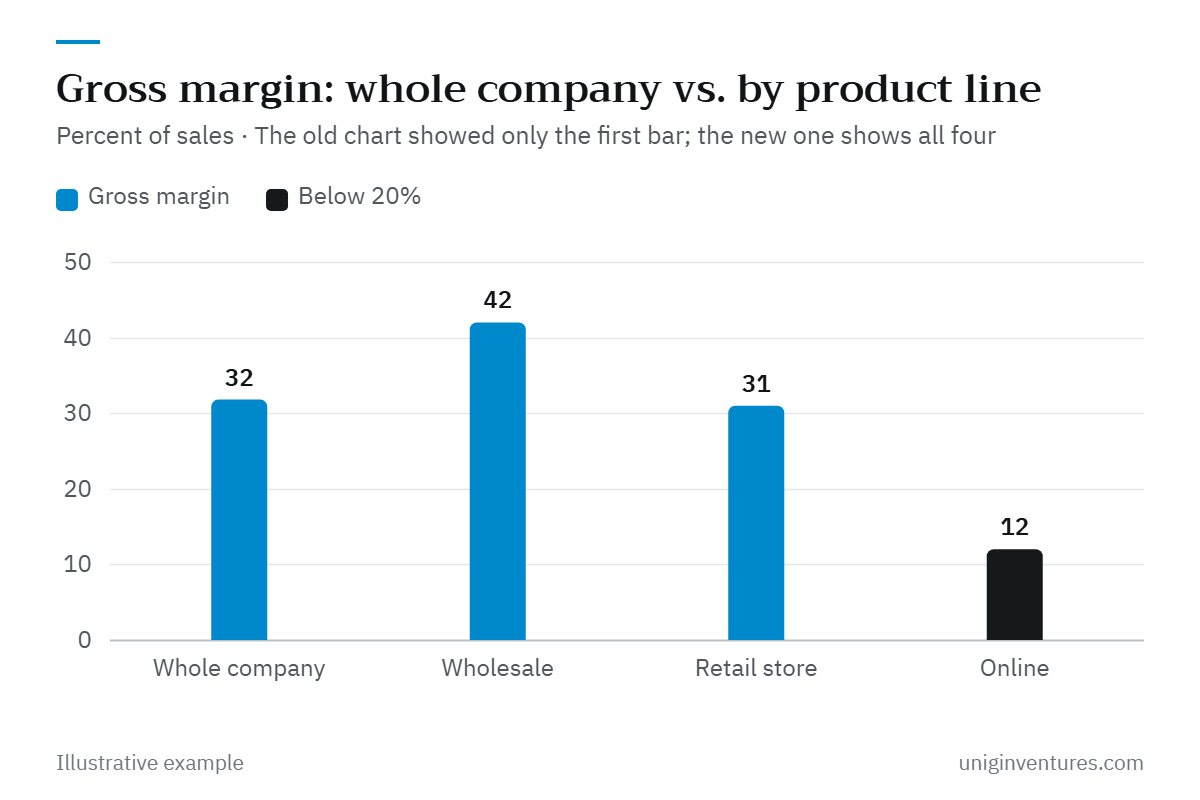
Online brings in a quarter of sales but less than a tenth of gross profit, before platform fees and delivery costs, which sit in selling expenses. If selling expenses are also split by channel, the owner can see each channel's contribution margin right away.
Classify expenses by function at the group level (cost of sales, selling, administrative) to match the statutory line items, and by nature at the account level (salaries, rent, delivery) to see where the money goes. That lets you produce either income statement format the notification allows and still analyze costs internally.
Accounts vs. Dimensions: Don't Open an Account for Every Customer
The opposite mistake is just as common: opening a sub-account for every customer, project or branch until the chart has hundreds of near-identical accounts. Staff pick the wrong one easily, and every new customer means editing the chart.
Separate "what kind of item" from "whose" and "where."
- Accounts say what type of transaction it is, such as online sales revenue or delivery to customers. Keep them limited and stable.
- Subsidiary ledgers say who it belongs to, such as receivables by customer, payables by supplier or a fixed asset register. Their total must equal the control account in the chart.
- Dimensions or cost centers say where it happened or which project it served, such as branch, department or project. Most accounting software lets you tag transactions this way without new accounts.
A simple rule: if the list keeps growing as the business grows (customers, projects), use a ledger or a dimension. If it is a fairly stable grouping that must roll up to the statements (main sales channels, expense types), use an account.
Accounts That Make Tax Season Easier
Setting up accounts around tax from the start saves a lot of digging when you file the annual PND 50 return. Accounts worth having:
- Input VAT, output VAT and input VAT not yet due, kept separate for VAT-registered businesses so they reconcile with the monthly PP 30 return.
- Withholding tax payable, split by the return it goes on, such as PND 1, PND 3 and PND 53, with tax withheld from you (awaiting credit) in a separate account.
- Non-deductible expenses. Section 65 ter of the Revenue Code lists expenses that cannot be deducted in computing net profit, including personal expenses and tax penalties or surcharges. Booking these to their own accounts as they happen means the book-to-tax adjustment is a lookup, not a search.
- Entertainment and donations, in separate accounts, because each has its own deduction limit for tax.
Switch to the New Chart Without Losing Comparisons
- Switch at the start of a fiscal year if you can, so the whole year uses one chart and the year-end close doesn't combine two.
- Build an old-to-new mapping table. Every old account needs a destination. If one old account splits into several new ones, write down the rule for splitting it.
- Carry forward balance sheet balances using the mapping, and check that total assets, liabilities and equity are unchanged.
- Restate last year's figures on the new chart, at least in management reports, so you can compare year on year. If last year's figures can't be split, say in the report when comparisons begin.
- Talk to your accounting firm or auditor first. They use the chart every day and must map it to the line items in the statutory statements.
Where to Start
- Write down three to five questions you want the monthly statements to answer, such as gross margin by channel or delivery cost as a share of sales.
- Get your current chart of accounts from your accounting firm and mark which questions it can't answer because items are lumped together.
- Review twelve months of miscellaneous and "other" accounts, and open accounts for the recurring items.
- Decide which data belongs in accounts and which belongs in dimensions or ledgers.
- Add tax-related accounts, especially for non-deductible expenses.
- Build the mapping table and switch at the start of the next fiscal year.
Sources
- Accounting Act B.E. 2543 (Sections 7 and 14) — Department of Business Development (Thai)
- Explanatory notes to the DBD notification on line items required in financial statements B.E. 2566 — Department of Business Development (Thai)
- Revenue Code Sections 65–76 (Section 65 ter, non-deductible expenses) — Revenue Department (Thai)