Monthly Bank Reconciliation: Separate Timing Items From Entries You Must Book
Your books and bank statement rarely match, but every baht of the gap should be explained. How to separate outstanding cheques from items to record, a sample workpaper, and a one-day routine.
In this article
The bank balance in your books and the balance on the bank statement for the same day almost never match exactly. There are cheques you have issued that the payee has not yet cashed, customer transfers nobody has recorded, and fees the bank deducted without notice. Leave the gap for a few months and the cash figure you make decisions with is wrong, and small errors or fraud can hide inside the totals for a long time.
A monthly bank reconciliation explains that gap down to the last baht. This article covers the types of reconciling items, which ones need a journal entry, a worked example, and a routine you can finish in a day.
Why reconcile every month
- Know your real cash. A balance that still excludes bank fees, direct debits or incoming transfers is not money you can actually use. A cash flow forecast that starts from the wrong balance is wrong throughout.
- Catch errors early. Duplicate entries, transposed digits and postings to the wrong account are easy to find within one month and very hard to find across a whole year.
- Deter fraud. When the person reconciling is not the person making payments, entries with no documents or unfamiliar payees get noticed.
- Be ready for auditors and investors. Auditors test year-end reconciling items against the following month's statement. If you reconcile monthly, the year-end close goes much faster.
Thailand's Accounting Act B.E. 2543 (2000) requires businesses to give their bookkeeper complete supporting documents so the accounts reflect the true financial position (Section 12), and to keep accounts and documents for at least five years from the closing date (Section 14). Bank statements and reconciliation workpapers are part of that record.
Reconciling items fall on two sides
The core of a reconciliation is deciding which side each difference belongs to, because each side is handled differently.
Bank side: timing only, no journal entry
- Deposits in transit: cheques or cash deposited on the last day of the month that the bank has not yet credited. Add them to the statement balance.
- Outstanding cheques: cheques the company has issued and recorded that the payee has not yet presented. Deduct them from the statement balance.
These items should clear on next month's statement. If they linger for several months, find out why.
Company side: needs an entry or correction
- Unrecorded incoming transfers, such as a customer payment sent without remittance advice. Identify the customer and record the receipt against their receivable.
- Items the bank charged or credited directly: fees, utilities paid by direct debit, interest received. Record them from the statement.
- Recording errors, such as a wrong amount or a duplicate. Post a correcting entry in the books.
ACCA's FA2 examiner's report draws the line clearly: bank charges, direct debits and automated receipts are adjusted in the company's ledger, while unpresented cheques and receipts not yet credited by the bank are adjusted against the statement balance. A simple rule: if the bank knows and you don't, fix your books. If you know and the bank doesn't yet, adjust the bank balance.
Worked example
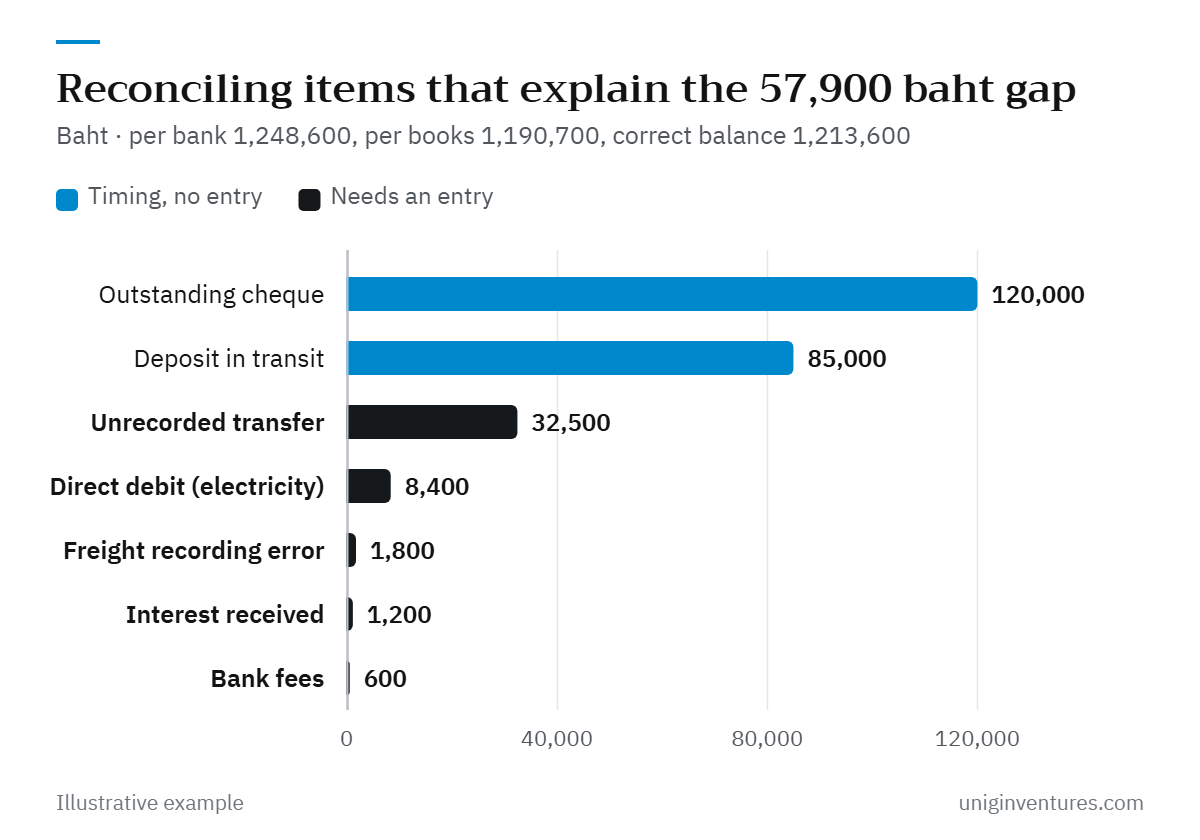
An illustrative example: on October 31, the bank statement shows a balance of 1,248,600 baht, but the bank account in the books shows 1,190,700 baht, a difference of 57,900 baht. Going through item by item finds the following.
| Item | Per bank | Per books |
|---|---|---|
| Balance at October 31 | 1,248,600 | 1,190,700 |
| Add: customer cheque deposited on the 31st, not yet credited | 85,000 | |
| Less: supplier cheque not yet presented | −120,000 | |
| Add: customer transfer not yet recorded | 32,500 | |
| Add: interest received | 1,200 | |
| Less: bank fees | −600 | |
| Less: electricity paid by direct debit | −8,400 | |
| Less: freight recorded as 4,600, actually paid 6,400 | −1,800 | |
| Correct balance | 1,213,600 | 1,213,600 |
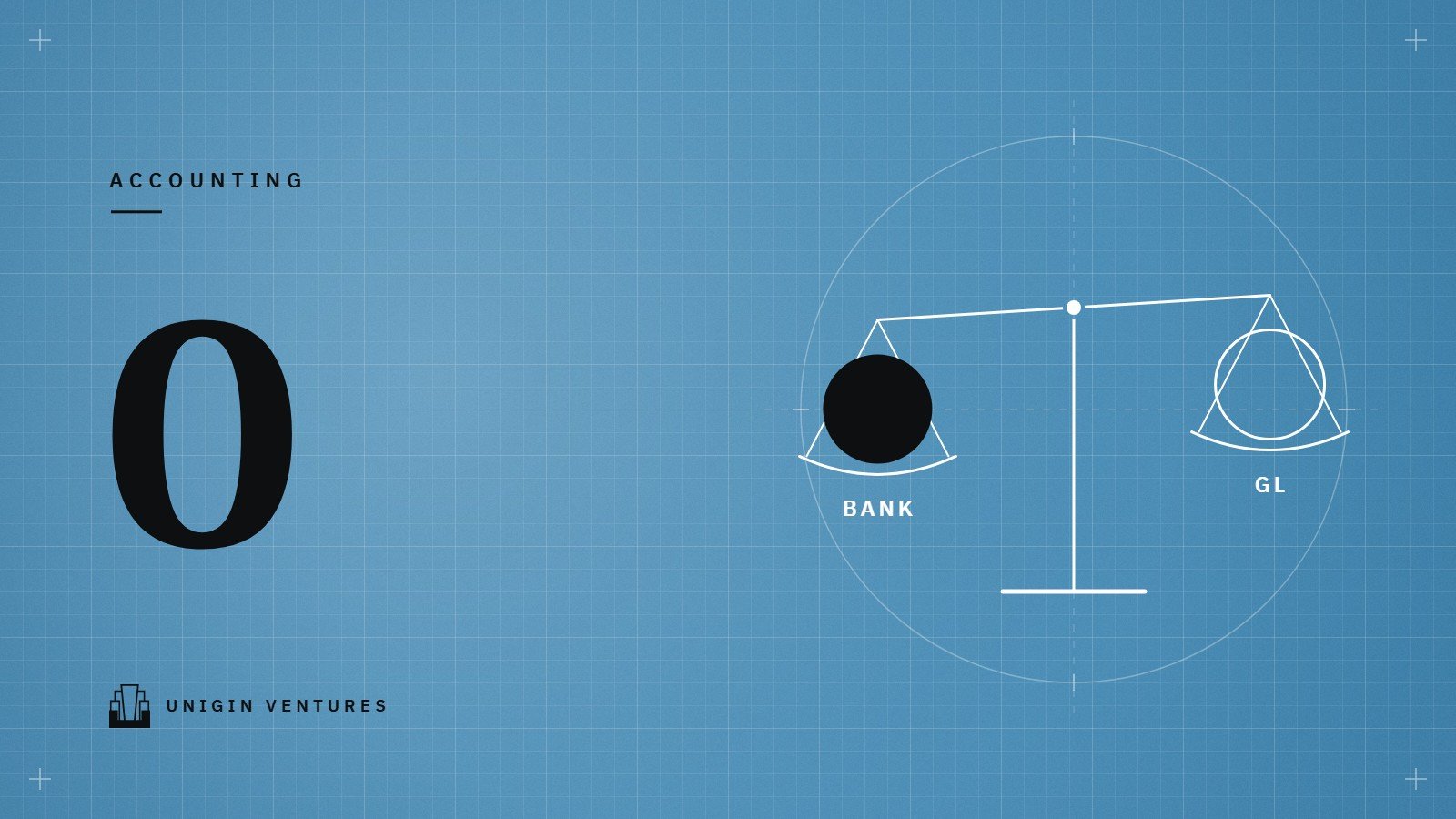
Both sides arrive at 1,213,600 baht, and the 57,900 baht difference is fully explained, leaving 0 baht unaccounted for: a net −35,000 baht on the bank side and a net +22,900 baht on the book side. The five book-side items need journal entries in October. The two bank-side items need no entry, but you should confirm they appear on the November statement.
Signals to follow up
- Cheques outstanding for more than two or three months. The payee may have lost them, or they should not have been issued. ACCA's audit answers call for examining old unpresented cheques to decide whether they should be written back.
- Deposits in transit that do not clear next month. They may be bounced cheques or money that was never actually deposited.
- A difference you cannot find. Do not book it to a "reconciliation difference" account and move on. If the difference divides evenly by 9, it is often a transposed number. If it equals one specific transaction, look for a duplicate or a missing entry.
- Payments with no documents. Every line on the statement should match an invoice, receipt or payslip.
The monthly routine
- Download statements for every account, including rarely used accounts and company credit cards, within the first three working days of the month.
- Match transactions between the statement and the books. Most accounting software can import bank files and match them for you. What remains are your reconciling items.
- Sort by side. Separate items waiting on the bank from items that need entries, and post the book-side entries in the same period.
- Prepare the workpaper in the format above. Both sides must agree exactly. File the statement with it.
- Have a second person review and sign. ACCA's model answers note that the person who receives cash and updates the books should not also reconcile, and that the reviewer should sign as evidence. In a small company the reviewer may be the owner.
- Clear last month's open items before starting the new month.
The bank reconciliation is the first step of the monthly close. See the rest of the process in closing the books in 10 working days. If company and personal money still flow through the same accounts, start with separating personal and company money. Reconciling becomes much easier.
The company and figures in the example are illustrative.
Sources
- Accounting Act B.E. 2543 (2000), Sections 12 and 14 (Thai) — Department of Business Development
- Examiner's report FA2 Maintaining Financial Records, September 2023 – August 2024 (bank reconciliations) — ACCA
- Audit and Assurance, September/December 2018 sample answers (bank reconciliation controls and audit) — ACCA
- Examiner's report F8 Audit and Assurance, June 2015 (auditing bank reconciliations) — ACCA