Aged Receivables and Bad Debts: Set the Allowance, Write Off for Tax
Build an aged receivables report, set a doubtful accounts allowance under TFRS for NPAEs, record write-offs, and meet the 200,000 and 2 million baht tests that make bad debts tax-deductible.
In this article
Your trade receivables look healthy on the balance sheet, but somewhere inside that number are invoices six months past due. One customer has closed down; another stopped answering the phone. Until you deal with them, both profit and assets are overstated. And when the day comes to write them off, missing paperwork can mean you cannot deduct the loss for tax either.
This article covers three connected steps: building an aged receivables report, setting up an allowance for doubtful accounts under the standard most Thai SMEs use, and writing off bad debts correctly for both accounting and tax.
Start with an aged receivables report
An aged receivables report splits each customer's balance by how many days it is past the due date. Common buckets are not yet due, 1–30 days past due, 31–60, 61–90 and over 90. Most accounting software produces it. The key is to count from the due date, not the invoice date, so a customer on 60-day terms doesn't show as late on day one.
Review the report every month at close and ask three questions:
- Did the over-60-day balance grow since last month?
- Which customers have overdue balances out of proportion to their sales?
- For each old item, who owns the follow-up, and how far has it gone?
The last question matters more than it seems. Evidence of collection efforts is exactly what you need later to write the debt off for tax.
Set up the allowance for doubtful accounts
Chapter 7 of the Thai Financial Reporting Standard for Non-Publicly Accountable Entities (TFRS for NPAEs, revised 2022) requires receivables to be measured at the amount expected to be received, meaning after deducting an allowance for doubtful accounts. It allows three estimation methods:
- Percentage of net credit sales: apply a historical loss rate to the period's credit sales.
- Percentage of receivables by age: older buckets get higher rates because they are less likely to be paid.
- Individual assessment: judge each debtor's ability to pay and the amount you expect to collect.
In practice, many companies use the aging method as a base and assess large or troubled customers individually. Increases in the allowance are recognized as an expense in profit or loss, and the allowance is shown as a deduction from receivables on the balance sheet.
Worked example: the aging method
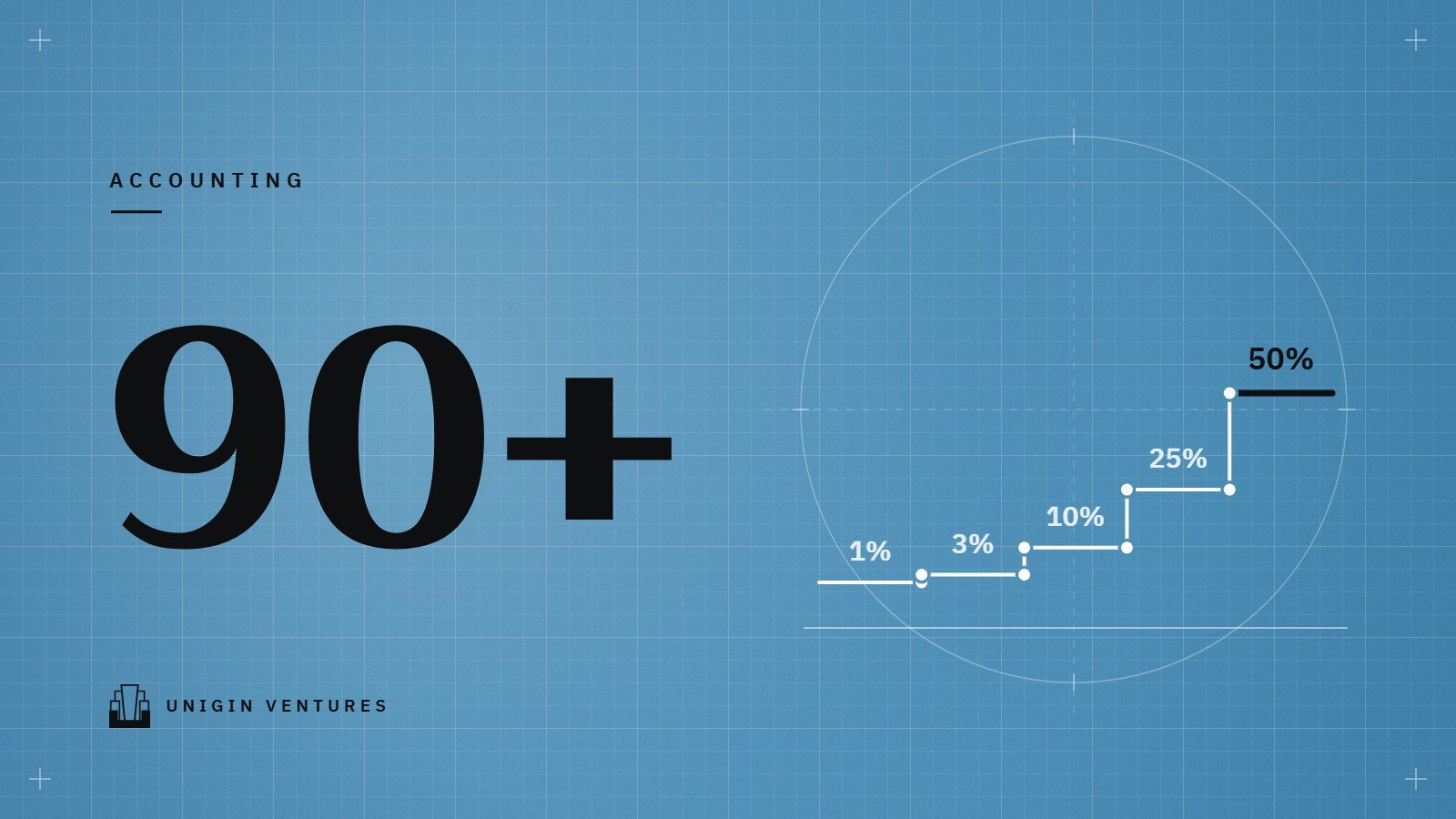
Illustrative example: a company has 6,800,000 baht of trade receivables at year end. The rates come from its own collection history.
| Age past due date | Receivables | Rate | Allowance |
|---|---|---|---|
| Not yet due | 4,000,000 | 1% | 40,000 |
| 1–30 days | 1,500,000 | 3% | 45,000 |
| 31–60 days | 600,000 | 10% | 60,000 |
| 61–90 days | 300,000 | 25% | 75,000 |
| Over 90 days | 400,000 | 50% | 200,000 |
| Total | 6,800,000 | 420,000 |
Net receivables are 6,800,000 − 420,000 = 6,380,000 baht. Notice that balances over 60 days total only 700,000 baht, about 10% of receivables, yet they account for 275,000 baht, about 65% of the allowance.
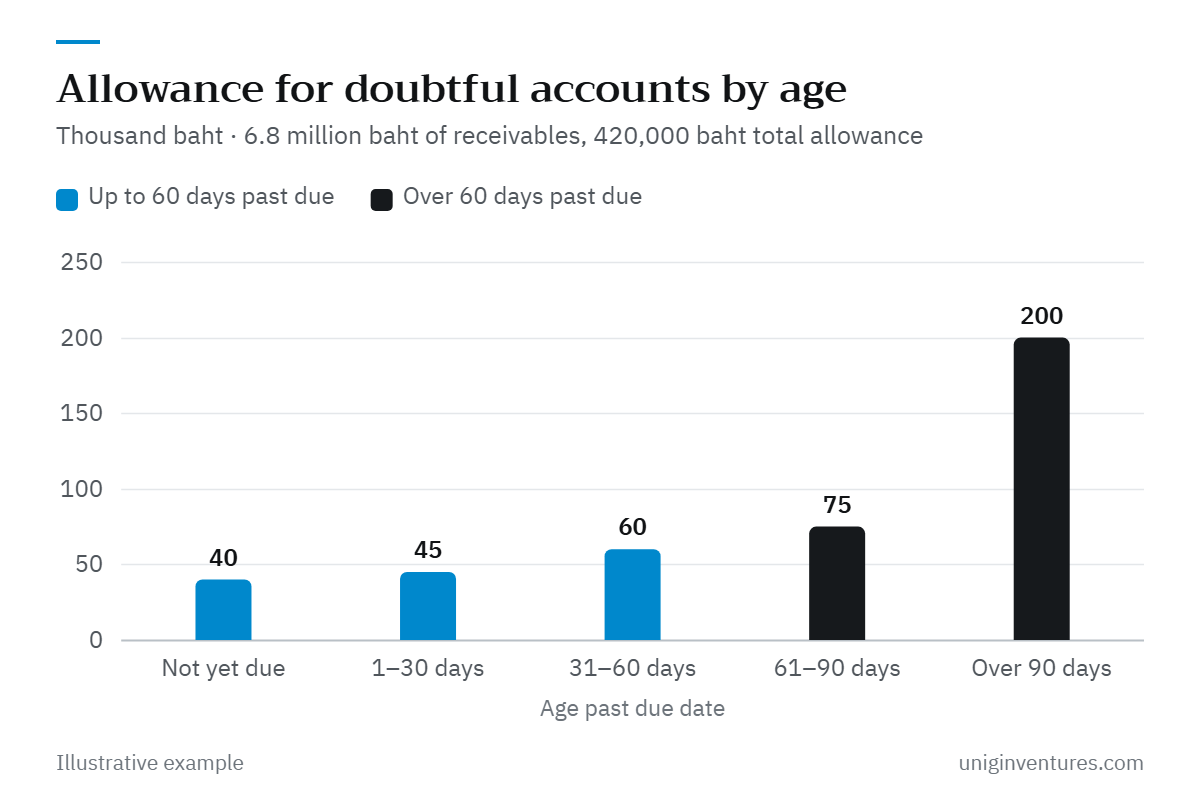
The rates in the table are only an example. Review your own at least once a year by checking what percentage of each age bucket from a year ago you ultimately failed to collect, and agree the method with your auditor.
Three accounting entries
Continuing the example, assume the allowance opened the year at 300,000 baht. During the year, one customer closed down owing 80,000 baht. The company exhausted its collection efforts and wrote the debt off.
- Write-off. Paragraph 7.7 of TFRS for NPAEs says to remove the receivable and reduce the related allowance: debit allowance 80,000, credit trade receivables 80,000. The allowance falls to 220,000 baht. This entry does not touch profit, because the expense was recognized when the allowance was set up.
- Year-end true-up. The required balance is 420,000 baht, so the company adds 200,000: debit doubtful accounts expense 200,000, credit allowance 200,000.
- Later recovery. Paragraph 7.8 says to reinstate the receivable and allowance and then record the receipt, or alternatively record the recovery as other income, disclosing the chosen policy in the notes.
The notes to the financial statements must also disclose bad debts written off and bad debts recovered during the period.
Tax: the allowance is not deductible; write-offs are, if you follow the rules
Section 65 ter (1) of the Revenue Code disallows reserves as expenses, with exceptions only for insurers and certain financial institutions. A typical SME must therefore add its doubtful accounts expense back when computing taxable profit on the PND 50. Under Section 65 bis (9), bad debts are deductible when written off under Ministerial Regulation No. 186 (1991), whose thresholds were last amended by Ministerial Regulation No. 374 (2021).
Basic conditions for every case
- The debt arose from the business, or was already included in income.
- It is not owed by a current or former director or managing partner.
- It is not time-barred, and there is clear evidence on which you could sue.
Requirements by size of each debtor's balance
| Balance owed by one debtor | Additional requirement |
|---|---|
| Up to 200,000 baht | Evidence of reasonable collection efforts without payment, and suing would cost more than you would recover |
| Up to 2,000,000 baht | Any one of: meet condition (1) for debts over 2 million; file a civil suit or a claim in another creditor's case and have the court accept it; or file or claim in bankruptcy proceedings and have the court or official receiver accept it. In the last two cases, directors must approve the write-off within 30 days after the end of the accounting period. |
| Over 2,000,000 baht | Any one of: (1) documented collection efforts without payment, and the debtor has died, disappeared, or ceased business with preferred creditors owed more than its assets; (2) a civil judgment enforced with no assets found; or (3) bankruptcy proceedings that reached a court-approved composition, or a bankruptcy judgment followed by a first distribution or closure of the case |
Under clause 7 of the regulation, a qualifying debt is deductible in the accounting period of the write-off. The exception is a debt of up to 2 million baht written off through litigation, which is deductible in the period the court or official accepts the suit or claim. If you later recover a debt you deducted, Section 65 bis (9) requires you to include it in income in the period you receive it.
Back to the example
The income statement shows 200,000 baht of doubtful accounts expense. For tax, the company adds the full amount back and deducts the 80,000 baht write-off that met the rules (the debtor owed under 200,000 baht, and there was evidence of collection efforts). Net, taxable profit is 120,000 baht higher than book profit, equal to the increase in the allowance from 300,000 to 420,000 baht. Without collection evidence, the 80,000 baht would not be deductible, and taxable profit would exceed book profit by 200,000 baht.
VAT on bad debts
If the company is VAT-registered and has already paid output VAT on the invoice, Revenue Department Notification on VAT No. 85 allows it to deduct the output VAT on the bad-debt portion in the tax month of the write-off. The key condition: the debtor must not be a VAT-registered operator. The sale must also have been covered by a full tax invoice, and the debt cannot be owed by a director or managing partner. Most VAT-registered B2B customers therefore do not qualify. Check with your accounting firm before filing the PP 30.
Prevent bad debts at the source
- Check credit before granting terms. Review the customer's financial statements on DBD DataWarehouse+ and set a credit limit for each customer.
- Keep documents that will hold up in court. Purchase orders, signed delivery notes, invoices and contracts. Without them, both collection and the tax write-off stall.
- Follow up in writing on a schedule. For example, a reminder before the due date, a follow-up on the due date, and formal demand letters at 30 and 60 days past due. Keep copies and proof of delivery.
- Stop shipping past a threshold. Decide in advance how many days overdue a customer can be before they must pay before the next delivery.
- Watch the limitation period. Section 193/34 of the Civil and Commercial Code sets a two-year limit for claims by traders for goods delivered and work performed, unless the work was done for the debtor's own business, in which case a different section applies. A time-barred debt cannot be written off for tax. Ask a lawyer which period applies to your receivables.
Where to start
- Run an aged receivables report as of this month-end, counting from the due date.
- Go through every item over 90 days one by one. Note what collection evidence exists and the debtor's total balance, so you know which tax tier applies.
- Derive allowance rates from your own history and agree the method with your auditor.
- Set a written collection schedule and assign an owner.
- Before year end, list the debts to be written off, get director approval on time, and separate the amount to add back on the PND 50.
The allowance makes your financial statements tell the truth about what your receivables are worth. The collection records you keep every month make sure that debts you cannot collect are still deductible. Both start from the same report.
Sources
- TFRS for NPAEs (revised 2022), Chapter 7: Receivables, Federation of Accounting Professions (in Thai)
- Ministerial Regulation No. 186 (1991) on writing off bad debts, as amended by No. 374, Revenue Department (in Thai)
- Revenue Code, Section 65 bis (9) and Section 65 ter (1), Revenue Department (in Thai)
- Notification on VAT No. 85: deducting output VAT on bad debts, Revenue Department (in Thai)
- Civil and Commercial Code, Section 193/34, Thai Law Online (in Thai)
- DBD DataWarehouse+ company and financial statement search, Department of Business Development