Year-End Close and Audit Prep: A Calendar From November to Filing Day
Work back from the four-month approval deadline: what to finish before year end, how to run the stock count, the adjustment checklist, what auditors ask for, and the filing dates that follow.

In this article
A Thai company with a December 31 year end has less than four months to close its books, get them audited and approved by shareholders. Those months also carry monthly tax filings, next year's planning and, for some founders, investor conversations. Companies that start preparing in January usually end up with a pile of work in March and April, auditors asking the same questions several times, and a higher audit fee for the extra hours.
This article lays out a calendar for closing fiscal year 2026, from November through the filing of the financial statements. It shows which work belongs before year end, which comes after, and what the auditor will ask for, so an owner can manage the process with their accounting firm instead of waiting on it.
The legal deadlines to work back from
For a Thai limited company with a December 31, 2026 year end, the main deadlines are:
| Task | Deadline | Basis |
|---|---|---|
| Balance sheet audited and approved at a general meeting | Within 4 months of the balance sheet date, i.e. by April 30, 2027 | Civil and Commercial Code, Section 1197 |
| Send a copy of the balance sheet to every shareholder | At least 3 days before the meeting | Civil and Commercial Code, Section 1197 |
| File the shareholder list (Bor Or Jor 5) with the registrar | No later than the 14th day after the ordinary general meeting | Civil and Commercial Code, Section 1139 |
| Submit financial statements to the Department of Business Development | Within 1 month of approval at the general meeting | Accounting Act B.E. 2543 (2000), Section 11 |
| File PND 50 and pay corporate income tax | Within 150 days of the end of the accounting period, i.e. by May 30, 2027 | Revenue Department |
Failing to submit financial statements under Section 11 carries a fine of up to 50,000 baht under Section 30 of the Accounting Act. For PND 50 filed online, the Ministry of Finance grants an extra 8 days, but it does so for set periods. The current announcement covers returns due by January 31, 2027, so it does not yet reach fiscal 2026 returns. Watch for a new announcement and plan for May 30 in the meantime.
A limited company must always be audited by a Certified Public Accountant (CPA). A Tax Auditor (TA) may audit only small registered partnerships that meet the Revenue Department's thresholds.
The whole cycle at a glance
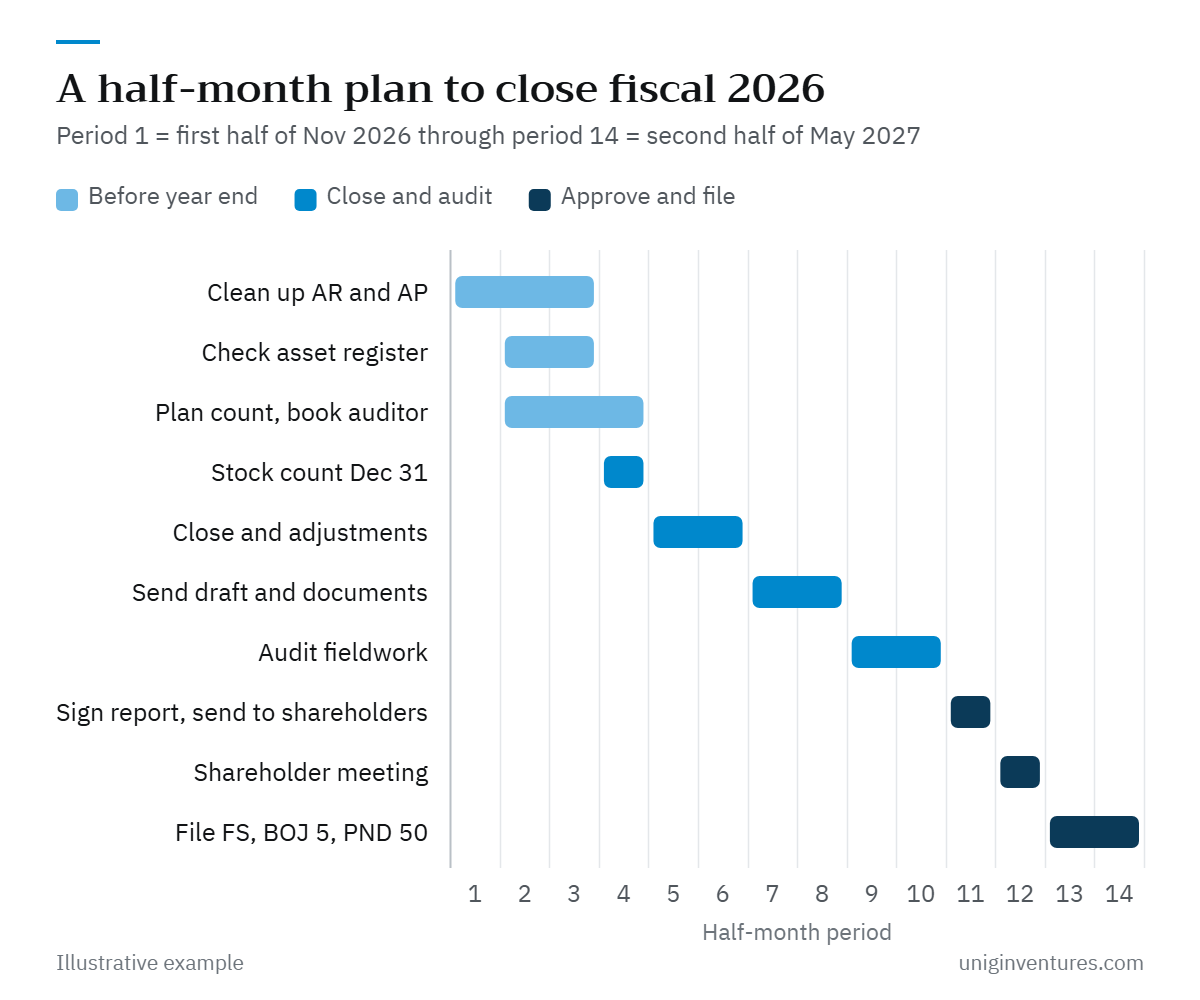
Counting back from April 30, the auditor needs a complete draft by about the end of February to leave time for fieldwork, questions and corrections before signing the report. The illustrative plan below splits the work into three phases, starting in the first week of November 2026.
Before year end (November–December)
- Clean up old receivables and payables. Work through the aging report, chase collections, send statements to major customers to confirm balances, and decide on uncollectible debts before the year closes. A tax-deductible write-off has to follow Revenue Department rules; see Aged Receivables and Bad Debts.
- Check the fixed asset register. Compare it with what physically exists. Remove assets that were sold or retired, and make sure new purchases have tax invoices and in-service dates so depreciation lands in the right period.
- Clear director accounts and suspense accounts. Director loans, cash advances and old suspense balances draw auditor questions almost every time. Every item needs documents and a balance the other party agrees with.
- Gather key contracts. Leases, loan agreements, sales contracts with unusual terms and potential lawsuits all affect the numbers and the notes.
- Book the auditor. Agree on the stock count date, the draft delivery date and the fieldwork dates, and ask for the document request list early.
The year-end stock count
When inventory is material, International Standard on Auditing 501 requires the auditor to attend the physical inventory count unless that is impracticable. The auditor evaluates the company's count instructions, observes the count, inspects the goods and performs test counts. The count needs a plan, not a quick walk through the warehouse.
- Write count instructions. Assign zones, use pre-numbered count sheets, count in pairs and collect every sheet back.
- Stop receiving and shipping during the count, or separate the areas clearly, and record the last delivery note and goods received note numbers before year end so sales and purchases fall in the right period (cut-off).
- Flag damaged and slow-moving stock during the count. It may need to be written down to net realizable value under the inventory section of TFRS for NPAEs.
- Cover stock held elsewhere, such as consignment stock or goods in a third-party warehouse, with a confirmation or a separate count.
VAT-registered businesses already keep a stock and raw materials report under Section 87 of the Revenue Code. The year-end count is the point where you check that report against reality. For costing methods, see Inventory Accounting for SMEs.
Closing after year end (January–February)
If the company closes its books every month, the year-end close is month 12 plus the annual adjustments. Before sending the draft, work through this checklist:
- Reconcile every bank account at December 31 against the bank statement.
- Accrue unpaid expenses such as utilities, adviser fees and approved bonuses, and release prepaid expenses for the period.
- Record unearned revenue and work done but not yet invoiced in the correct period.
- Run a full year of depreciation from the checked asset register.
- Set the allowance for doubtful accounts and adjust inventory for the count results.
- Reconcile output VAT in the ledger to all 12 PP 30 returns, and withholding tax balances to the returns filed.
- Calculate corporate income tax payable, net of tax already paid on PND 51 and tax withheld by customers.
- Review events after year end that may require an adjustment or a disclosure, such as a major customer's bankruptcy or a settled lawsuit.
Working with the auditor
The document request list
Most auditors send a list of what they need in advance, often called a PBC list (prepared by client). It usually covers the trial balance, a breakdown of every account with a balance, bank statements, the fixed asset register, receivable and payable aging, count results, key contracts, meeting minutes and the year's tax returns. Set up folders that follow the list, name files by account number, and make every schedule tie to the trial balance line by line.
Confirmations
The auditor will send confirmation requests to the company's banks and often to selected customers or suppliers. Under ISA 505 the auditor must keep control of the requests, and replies go straight to the auditor. The company's role is to sign the authorization and tell the other party to respond. Banks can take weeks to reply, so ask the auditor to send requests in early January.
The management representation letter
Before signing the report, the auditor will ask management to sign a representation letter confirming that it provided complete information. Read it carefully. If there is anything you have not mentioned, such as a guarantee or a dispute, raise it before you sign.
Where to start
- This week: meet your accounting firm and auditor, agree on the count date, the draft date and the shareholder meeting date, and put them in everyone's calendar.
- By the end of November: work through receivables, payables, director accounts and the asset register until only explainable items remain.
- By December 31: run the stock count to plan and record the cut-off document numbers.
- By the end of February: deliver the draft statements and the documents on the auditor's list.
- After the shareholder meeting: file Bor Or Jor 5 within 14 days, submit the statements to the Department of Business Development within 1 month, and file PND 50 by May 30, 2027.
Companies that close every month on time find the year end much lighter. See Investor-Ready Books: A 10-Day Monthly Close.
The weekly plan in this article is an illustrative example. Legal deadlines were checked as of October 2026. Companies with a non-calendar fiscal year should count from their own closing date, and should confirm details with their accountant and auditor.
Sources
- Civil and Commercial Code, Section 1197 — Thai Law Online
- Civil and Commercial Code, Section 1139 — Thai Law Online
- Accounting Act B.E. 2543 (Sections 11 and 30) — Department of Business Development
- PND 50 frequently asked questions — Revenue Department
- Ministry of Finance announcement on extended deadlines for online filing — Revenue Department
- Differences between TA and CPA — Revenue Department
- Revenue Code Sections 87–90 (stock and raw materials report) — Revenue Department
- TFRS for NPAEs (revised 2022), Chapter 8 Inventories — Federation of Accounting Professions
- ISA (UK) 501 Audit Evidence — Specific Considerations for Selected Items — Financial Reporting Council
- ISA (UK) 505 External Confirmations — Financial Reporting Council