Dividends Received by a Thai Company: When They Are Tax-Exempt
A Thai company's dividends from other Thai companies can be fully exempt, half taxed or fully taxed under Section 65 bis (10). See the 25% test, the three-month rule, 10% withholding and an example.
In this article
When your company holds shares in another company, whether a subsidiary, a joint investment with a partner, or shares bought with spare cash, the dividends it receives are company income. The Thai Revenue Code does not always tax all of that income, though. The same dividend can be fully exempt, half taxed, or fully taxed, depending on how large the stake is and how long the company has held it.
This article explains the rule in Section 65 bis (10) of the Revenue Code, the withholding tax the paying company deducts, a worked example that compares three cases, and what to check before you buy or sell shares close to a dividend date.
Why dividends between companies get relief
A paying company distributes dividends out of profit that has already borne corporate income tax. If the receiving company had to pay full tax on that money again, the same profit would be taxed once more at every level it passed through, and a group with several layers would stack tax on tax. Section 65 bis (10) reduces or removes that second layer for the receiving company.
The rule applies to a "limited company incorporated under Thai law" that receives dividends from a limited company incorporated under Thai law, or from a Thai specialized financial institution set up by its own law to lend for agriculture, commerce, or industry. It also covers profit shares from a joint venture. This article covers dividends from Thai companies only. Dividends from foreign companies fall outside this provision and follow their own rules.
Three levels of relief under Section 65 bis (10)
1. Fully exempt
The receiving company leaves the dividend out of its taxable income entirely in either of these cases:
- The receiving company is a listed company, meaning a company listed under the law on the Stock Exchange of Thailand (defined in Section 39).
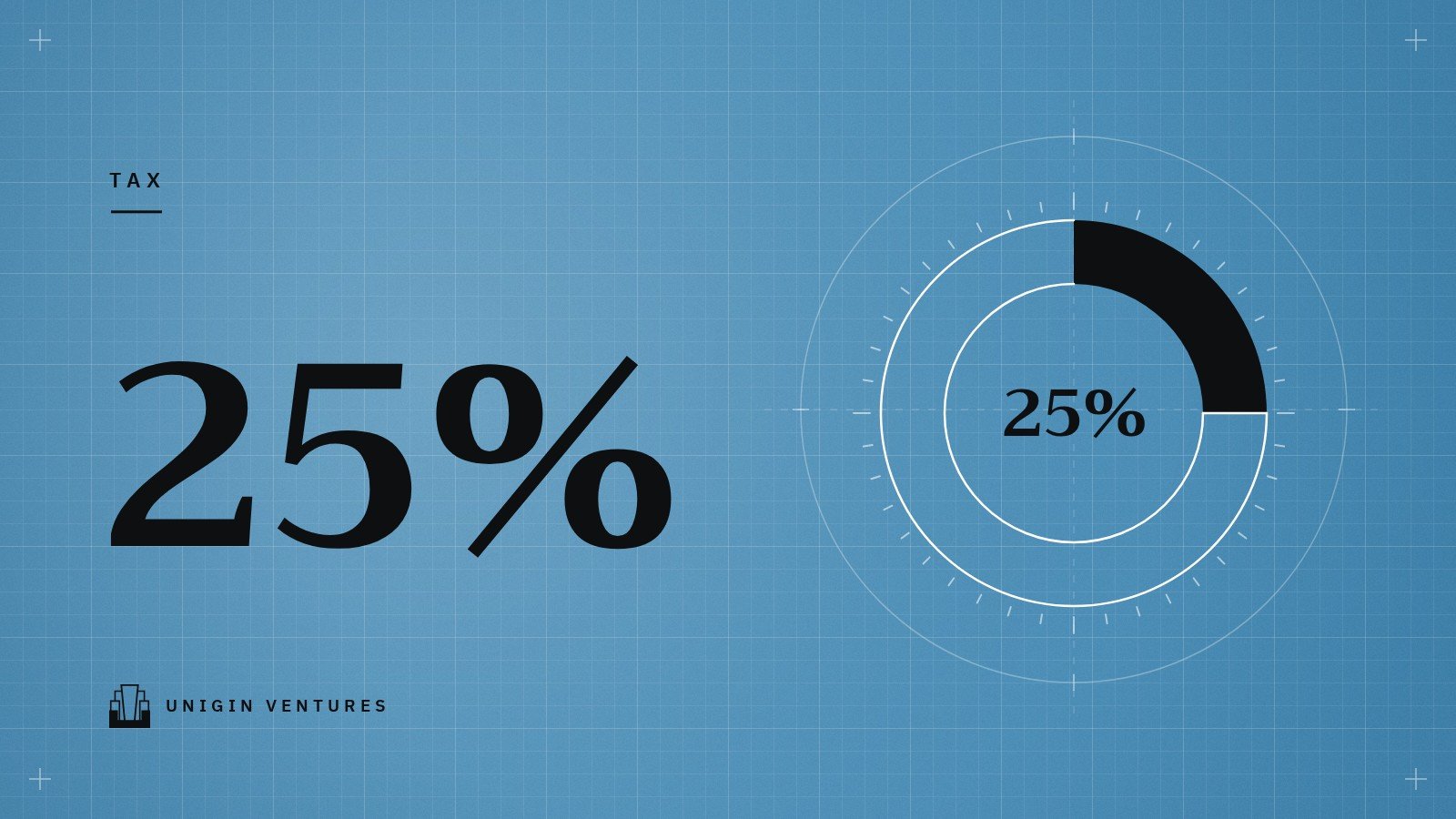
- The receiving company holds at least 25% of all voting shares of the paying company, and the paying company holds no shares in the receiving company, directly or indirectly.
The second case is the structure SMEs and startups meet most often: a parent that owns more than a quarter of a subsidiary, or a holding company that the founders set up to own the operating company.
2. Half exempt
A limited company that does not meet either case above, for example one that holds less than 25% or has a cross-holding, includes "only one half of the amount received" in its income. The other half is not taxed.
3. No exemption if the shares were held less than three months
Neither level of relief applies if the company held the shares that produced the dividend for less than three months from the date it acquired them to the date the income arose, or transferred those shares within three months after the date the income arose. In that case the full dividend goes into taxable income. The condition stops companies from buying shares just before a dividend, collecting it tax-free, and selling straight away.
| Receiving company | Share included in income |
|---|---|
| Listed company, three-month condition met | 0% |
| Limited company holding 25% or more of voting shares, no cross-holding, three-month condition met | 0% |
| Any other limited company, three-month condition met | 50% |
| Shares held less than three months before the income date, or transferred within three months after it | 100% |
Withholding tax on dividends
How much of the dividend counts as income is one question. Whether the paying company must withhold tax is a separate one. Revenue Department Order Tor.Por. 4/2528, clause 5, requires a company that pays dividends to a company or juristic partnership to withhold 10.0%. No withholding is required when the recipient is a listed company, or a limited company holding at least 25% of the payer's voting shares, under the conditions set out in that clause.
Tax withheld is not lost. The receiving company credits the amount shown on the withholding tax certificate (50 Tawi) against its tax for the year on the P.N.D. 50 return, and can claim a refund if too much was withheld (see reclaiming excess withholding tax on P.N.D. 50). The cost is cash: the withheld amount stays with the Revenue Department until the annual return is filed.
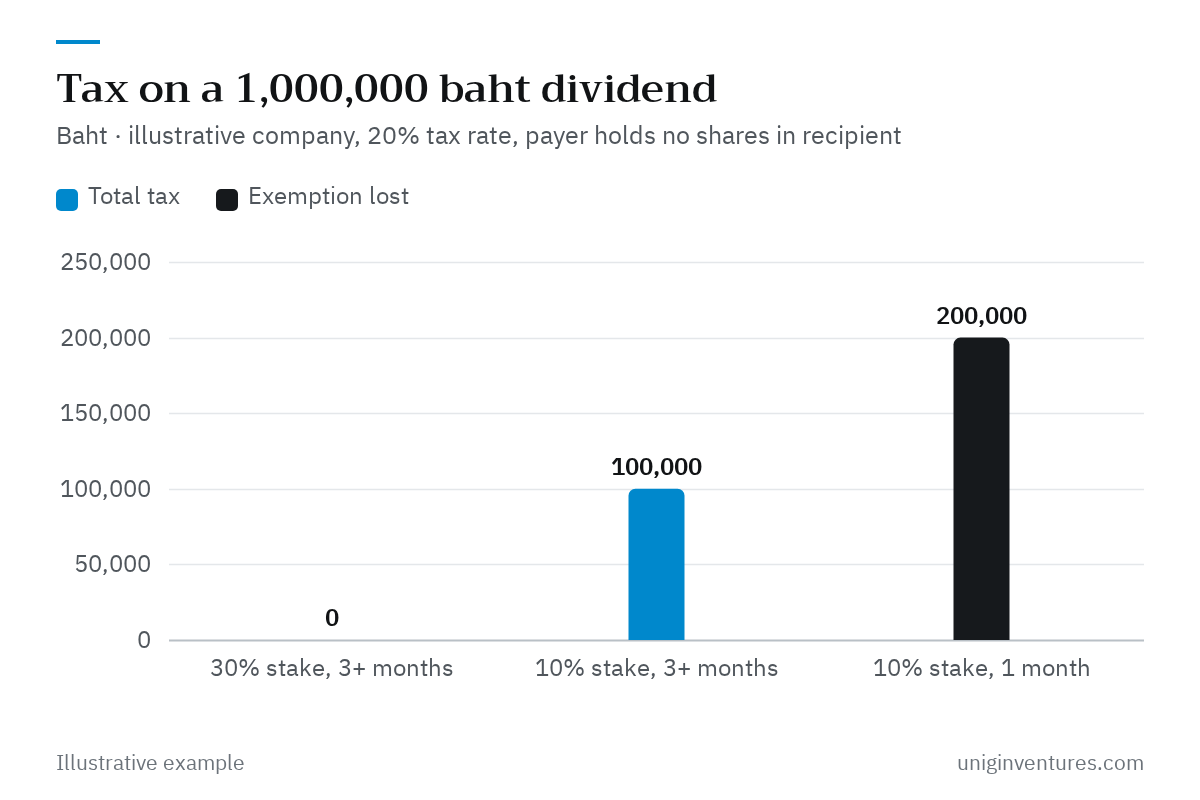
Worked example: one million baht of dividends, three cases
Illustrative example. Company A is a limited company that is not listed. Its core business earns enough that any extra profit is taxed at 20%. Company A receives a dividend of 1,000,000 baht from Company B, a Thai limited company that holds no shares in Company A.
| Item | 30% stake, held 3+ months | 10% stake, held 3+ months | 10% stake, bought one month earlier |
|---|---|---|---|
| Amount included in income | 0 | 500,000 | 1,000,000 |
| Tax on the dividend (20%) | 0 | 100,000 | 200,000 |
| 10% withheld by Company B | 0 | −100,000 | −100,000 |
| Extra tax due with P.N.D. 50 | 0 | 0 | 100,000 |
| Total tax | 0 | 100,000 | 200,000 |
The same dividend carries tax anywhere from 0 to 200,000 baht. With a 10% stake held for more than three months, the tax withheld exactly matches the tax due, so nothing more is payable. With shares bought only one month before the income date, the company loses the half exemption and pays another 100,000 baht at year end.
If Company A were an SME that qualifies for the stepped rates (paid-up capital of no more than 5 million baht and revenue from sales of goods and services of no more than 30 million baht) with profit between 300,000 and 3,000,000 baht, the extra profit would be taxed at 15%. The figures in the table would change, but the principle stays the same: the size of the stake and the holding period decide how much of the dividend counts as income.
How companies lose the exemption without meaning to
- Selling too soon after the dividend. The three-month condition runs both before and after the income date. If the company receives a dividend and transfers the shares within three months, the exemption is gone and the full dividend counts as income for that year. Plan any sale for after the three months.
- Falling below 25% after a capital increase. If a subsidiary takes money from a new investor and the parent's stake drops below the threshold, the next dividend is only half exempt. Work out the post-money stake before you agree to the round (see cap table basics).
- Counting non-voting shares. The 25% test is measured against "all voting shares," not the total share count or the share of money invested. If the paying company has more than one class of shares, check its articles of association for the voting rights of each class.
- Cross-holdings. If the paying company holds shares in the receiving company, even indirectly through another company, the full exemption under the 25% test does not apply. Keep the group's ownership chart running one way, from top to bottom.
- A recipient that is not a limited company. The provision refers to a "limited company incorporated under Thai law." If the shareholder is another kind of entity, such as a registered partnership, check with your accountant whether the relief applies.
Bookkeeping versus the tax return
In the financial statements, the company records the full dividend as income. The exemption happens when book profit is adjusted to taxable profit on the P.N.D. 50 return, by deducting the exempt portion (see adjusting book profit to taxable profit). Your accountant therefore needs evidence that the company meets the conditions, not just the amount received.
Keep these documents with every dividend received:
- The paying company's list of shareholders (Bor.Or.Jor. 5) showing your company's stake
- The share purchase agreement or other proof of the date the shares were acquired
- The resolution or notice declaring the dividend, and proof of the date it was received
- The withholding tax certificate, if the paying company withheld tax
- Evidence that the paying company holds no shares in your company, directly or indirectly
Where to start
- List every shareholding your company owns, with the share of voting rights, the date acquired, and whether the paying company is listed.
- Place each holding in one of the three levels: fully exempt, half exempt, or fully taxed.
- Before buying shares close to a dividend date, or selling shares after receiving one, count three full months on both sides.
- Before a subsidiary raises capital, check whether the parent will still hold more than 25%.
- Send the documents listed above to your accountant with each dividend received, so the P.N.D. 50 adjustment is right.
If you are deciding whether owners should take money from the company as salary or dividends, see salary or dividends. Before your own company declares a dividend, see dividend policy for small companies.
The companies and figures in the example are illustrative. The legal points were checked against the Revenue Department website in November 2026. Laws and orders can change, so confirm with the Revenue Department or your accountant before you act. This article is general information, not tax advice for any particular business.
Sources
- Revenue Code, Sections 65–76 (Section 65 bis (10), dividends received by limited companies) — Revenue Department (Thai)
- Revenue Code, Sections 38–64 (Section 39, definition of listed company) — Revenue Department (Thai)
- Revenue Department Order Tor.Por. 4/2528 (clause 5, withholding tax on dividends) — Revenue Department (Thai)
- Corporate income tax rates — Revenue Department (Thai)