Employee Benefits and Thai Tax: What Is Taxable and What Firms Can Deduct
Which benefits are exempt and which are income under Section 40 (1) and Ministerial Regulation 126: medical, group insurance, uniforms, housing and allowances, with a worked example.
In this article
Many SMEs add benefits to keep staff without raising salaries: group health insurance, a housing allowance, a monthly allowance, uniforms. Yet the accounts team is often unsure which items count as the employee's income for withholding and which the law exempts. The result is either too little tax withheld, leaving staff with a bill when they file, or tax withheld that never needed to be.
This article sorts common benefits into two groups under the Revenue Code and Ministerial Regulation No. 126, explains when the company can deduct what it spends, works through one employee's benefit package, and ends with a checklist for designing benefits correctly from the start.
The starting point: every benefit from employment is income
Section 40 (1) of the Revenue Code defines employment income broadly. It covers salary, wages, allowances and bonuses, and also house rent allowances, the value of rent-free housing provided by the employer, money the employer pays toward a debt the employee owes, and "money, property or any benefit received by reason of employment."
So the default is that every benefit is the employee's income unless the law clearly exempts it. The main exemptions sit in Section 42 and in Ministerial Regulation No. 126 (1966), issued under Section 42 (17). For items that are income, the company as payer must withhold tax under Section 50 (1) together with regular salary (see the monthly routine in PND 1 and social security contributions).
Benefits the law exempts for employees
Employees do not include the items in this table in taxable income, provided every condition is met. The conditions matter. Medical treatment abroad, for example, is exempt only when the employee falls ill while on an occasional work assignment overseas.
| Benefit | Key conditions | Legal basis |
|---|---|---|
| Medical expenses paid by the employer, to the employee or on their behalf | For the employee, spouse, parents or descendants supported by the employee, for treatment in Thailand only. Treatment abroad is exempt only for the employee when needed during an occasional work assignment overseas | Ministerial Regulation No. 126, clause 2 (4) |
| Group insurance premiums paid by the employer | Paid to an insurer operating in Thailand, for a group policy of no more than one year, and only the part that covers medical treatment for the same people as above | Ministerial Regulation No. 126, clause 2 (77) |
| Uniforms | No more than two sets per person per year, plus no more than one jacket per person per year | Ministerial Regulation No. 126, clause 2 (34) |
| Employer childcare center | A childcare center the employer is licensed to run as a welfare benefit for employees of that workplace, for the employee's legitimate children, excluding adopted children | Ministerial Regulation No. 126, clause 2 (83) |
| Allowances or travel costs for work | Only money the employee spends in good faith as necessary solely to perform their duties | Revenue Code, Section 42 (1) |
Benefits that are the employee's income
The following items have no exemption, or fall outside an exemption's conditions. Include them in income and withhold tax along with salary.
- Housing allowances and rent-free housing. Section 40 (1) names both the allowance and the value of living rent-free.
- Debts the company pays for the employee. If the company pays an employee's personal loan or their income tax, that is income under Section 40 (1).
- Welfare paid in cash. Revenue Department ruling 0706/9276 held that welfare money the company provided to employees was income under Section 40 (1), except the part spent on a customary celebration, which it treated separately. In ruling 0702/3651, a company that paid welfare contributions into employees' salary accounts itself treated the money as employee income and remitted the tax.
- Flat monthly allowances. Section 42 (1) exempts only money spent as necessary to perform duties. An allowance paid at the same amount every month, with no link to actual work travel, does not meet that condition.
- The non-medical part of group insurance. Clause 2 (77) exempts only the part covering medical treatment. Other cover in the same policy, such as life insurance, falls outside this exemption.
- Uniforms above the limit. A third set in the same year exceeds the cap in clause 2 (34).
The company side: what you can deduct
Whether the employee pays tax is a separate question from whether the company can deduct the cost. Both rulings above concluded that money a company spends on employee welfare is a business expense it may deduct in computing net profit. Ruling 0706/9276 states that it is not barred by Section 65 ter (3), which disallows personal expenses and gratuitous gifts, or Section 65 ter (13), which disallows expenses not incurred solely to earn profit or for the business. In both cases the employees still owed tax on what they received.
In ruling 0706/9276, the company had written welfare rules, set the same amount per person, and had the money overseen by a committee elected by employees under Section 96 of the Labour Protection Act of 1998. Facts like these make it easy to show the expense belongs to the business rather than benefiting one individual. Benefits given only to the owner or relatives invite questions more readily (see deductible and non-deductible expenses).
Worked example: one employee's benefit package
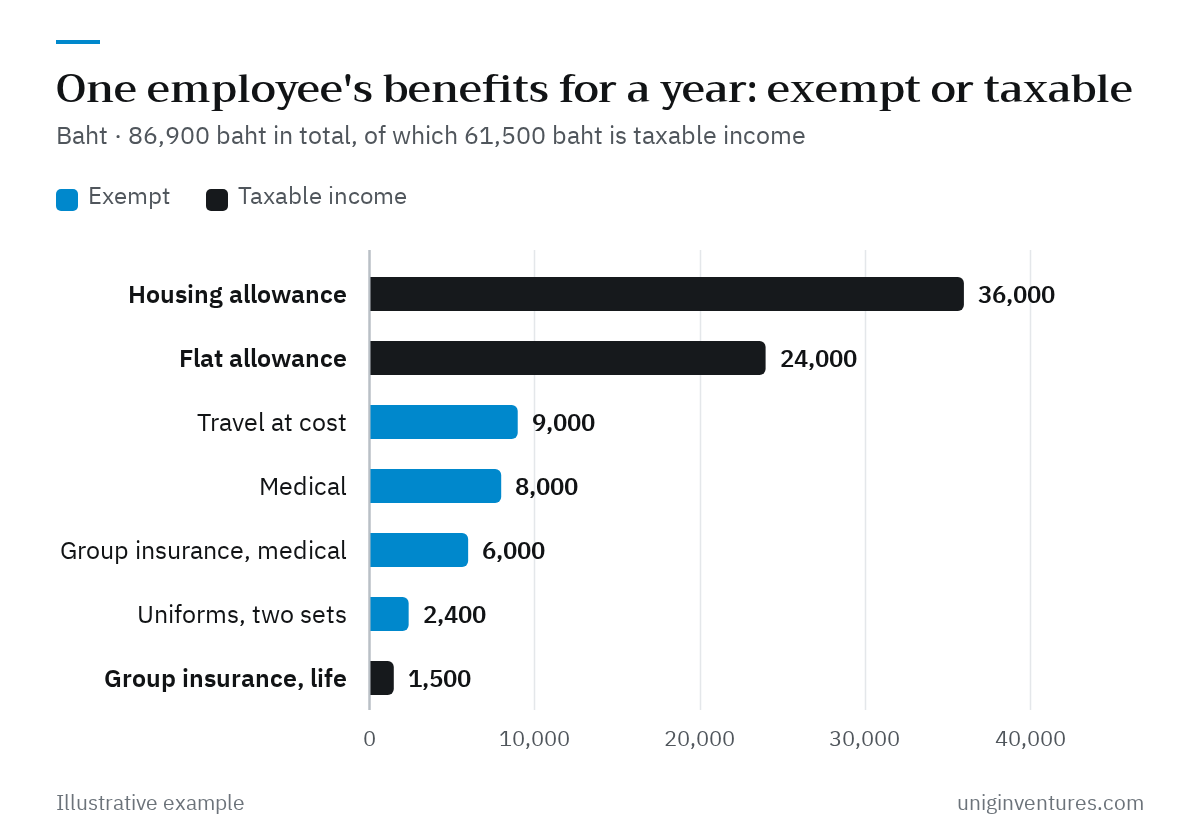
Illustrative example. A company gives one salesperson the benefits below over a year. The employee has already used the full standard deduction on salary income, and their net taxable income for the year, including taxable benefits, stays within the 300,001–500,000 baht band, taxed at 10% under the personal income tax rates in use since tax year 2017.
| Item | Amount | Tax treatment for the employee |
|---|---|---|
| Housing allowance, 3,000 baht × 12 months | 36,000 | Income |
| Flat allowance, 2,000 baht × 12 months | 24,000 | Income |
| Travel to customers, reimbursed at cost with receipts | 9,000 | Exempt |
| Medical treatment in Thailand, reimbursed at cost | 8,000 | Exempt |
| Group insurance, medical portion | 6,000 | Exempt |
| Uniforms, two sets | 2,400 | Exempt |
| Group insurance, life portion | 1,500 | Income |
| Total cost to the company | 86,900 | |
| Exempt portion | 25,400 | |
| Portion that is the employee's income | 61,500 |
Extra tax for the employee = 61,500 × 10% = 6,150 baht a year, or about 512.50 baht a month of additional PND 1 withholding
The company can deduct the full 86,900 baht as a business welfare expense. The tax that changes with the design falls on the employee. If the company turns the 24,000 baht flat allowance into reimbursement of actual travel with evidence of the work trips, the part genuinely spent on duties comes under Section 42 (1). But if the employee has been using the allowance as personal money, that change is effectively a pay cut, so agree on it first.
A checklist for designing benefits
- Put the welfare rules in writing, with entitlements, caps and claim procedures that apply to everyone in the same group.
- Pay medical costs directly to the hospital or reimburse against receipts, and keep evidence of who was treated and where.
- For group insurance, ask the insurer to split the premium by cover on the invoice so the medical portion is separate, and confirm the policy term is no more than one year.
- Tie travel costs and allowances to actual work, supported by travel approvals or customer visit reports.
- Count uniform sets per person per year, and treat any set above the cap as income.
- Set up taxable items in payroll from the first month, withhold every month, and include them in the year-end withholding certificate (50 tawi).
Where to start
- List every benefit the company provides today, with the amount per person per year, as in the example table.
- Sort each item as exempt or income using the legal bases above. For anything unclear, ask your accountant or request a ruling from the Revenue Department.
- Check payroll to confirm taxable items are already included in withholding. If not, correct it before the tax year closes so employees' 50 tawi certificates are right.
- Before adding a new benefit, calculate both the cost to the company and the extra tax for the employee, then choose the form that gives staff the larger net benefit for the same money. For the owner's own pay, see salary or dividends.
The employee and figures in this article are an illustrative example. Legal provisions checked as of November 2026. Revenue Department rulings answer the facts of each person who asked. This article is general information, not tax advice for any particular business.
Sources
- Revenue Code, Sections 38–64, including Section 40 (1), Section 42 and Section 50 — Revenue Department (Thai)
- Ministerial Regulation No. 126 (1966), clause 2 (4), (34), (77), (83) — Revenue Department (Thai)
- Ruling 0706/9276 (November 9, 2005): personal and corporate income tax on employee welfare money — Revenue Department (Thai)
- Ruling 0702/3651 (June 1, 2010): corporate income tax on employee welfare expenses — Revenue Department (Thai)
- Personal income tax rates from tax year 2017 — Revenue Department (Thai)