Zero-Rated VAT on Exported Services: Which Foreign Work Qualifies in Thailand
Services performed in Thailand and used abroad can carry 0% VAT. The conditions, real Revenue Department rulings on what qualifies, a monthly VAT calculation, and what to put in contracts and invoices.

In this article
More Thai companies work for overseas clients every year: software development, design, photo editing and back-office work delivered over the internet. This work may carry value added tax (VAT) at 0% instead of 7%, but not every job for a foreign client qualifies. The test is where the service is used, and whether the company has the evidence to prove it.
This article explains the conditions in the Revenue Code and the Revenue Department's notifications, real rulings on which services did and did not qualify for 0%, a monthly VAT calculation, and what to put in your contracts and invoices.
What 0% VAT is, and how it differs from an exemption
Section 80/1 (2) of the Revenue Code applies a 0% rate to services performed in Thailand and used abroad. The service provider remains a VAT-registered operator as usual and files the PP 30 every month, but the output tax on that work is zero.
The advantage is on the input side. Section 82/3 calculates VAT as output tax minus input tax. When input tax exceeds output tax, the operator may claim a refund or use the credit to pay VAT in later months. Input tax on costs used to serve foreign clients therefore remains creditable. That is different from businesses exempt from VAT under Section 81, such as certain education and healthcare services, which charge no output tax and cannot credit the input tax of that business.
The rate for domestic work is currently 7% (including local tax), a temporary reduction from the statutory 10%. The latest royal decree extends the reduction to September 30, 2027. Watch for announcements as that date approaches.
The conditions in the Revenue Department notification
Notification of the Director-General of the Revenue Department on VAT No. 105, with clause 2 (1) amended by No. 181, sets out three points:
- Performed in Thailand, for a recipient abroad, and used abroad. All three parts must hold. A foreign client that benefits from the work inside Thailand does not qualify.
- Partly used abroad. Only the portion used abroad gets 0%. The portion used in Thailand is taxed at 7%.
- Evidence of payment against an invoice issued in the name of the registered operator, such as a letter of credit, a T/T transfer record, a receipt, a bank statement, a bank deposit or transfer slip, or proof of payment by credit card or e-money. No payment evidence is needed for services provided free of charge.
The notification excludes tour services provided abroad from this 0% rule.
Where is it used? Learn from Revenue Department rulings
The deciding question is who benefits from the work, and where. These three rulings show where the line falls.
| Ruling | Work | Result |
|---|---|---|
| Kor Kor 0702/7386 (Sep 12, 2011) | Computer system planning and software testing for overseas clients through an online platform | 0% |
| Kor Kor 0702/Por.10961 (Dec 4, 2015) | Photo editing for a parent company in Sweden, files sent and returned online, images used only abroad | 0%, provided there is evidence of payment against invoices |
| Kor Kor 0702/Por./3267 (Apr 17, 2013) | Eight types of service for a Dutch company, such as inspecting and solving problems with factories in Thailand, training Thai manufacturers, and logistics | 7%, because the work was used with factories and manufacturers in Thailand |
The third ruling answers another important question. If the contract clearly separates the fee for the part used abroad from the part used in Thailand, the part used abroad gets 0%. If it does not, the whole fee is taxed at 7%.
The pattern is this: work delivered for the client to use in its own business abroad tends to qualify for 0%. Work tied to factories, goods, property or activities in Thailand is usually treated as used in Thailand, even when the payer is abroad. When in doubt, request a ruling from the Revenue Department before you invoice.
A monthly VAT calculation
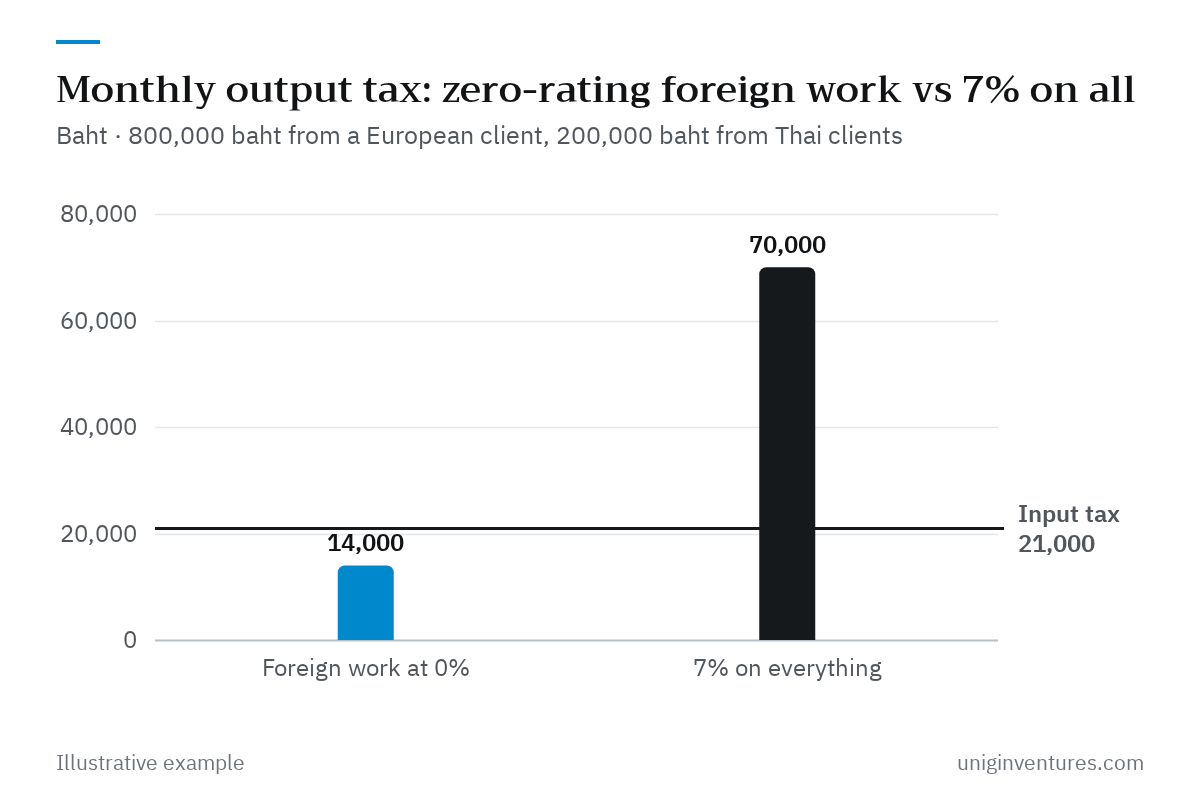
Illustrative example: a VAT-registered design studio earns 800,000 baht this month from a client in Europe, all used in the client's business abroad, and 200,000 baht from Thai clients. It buys 300,000 baht of goods and services subject to VAT, giving 21,000 baht of input tax.
Case 1, foreign work at 0%: output tax = 0 + (200,000 × 7%) = 14,000 baht
VAT payable = 14,000 − 21,000 = −7,000 baht, an excess input tax of 7,000 baht to refund or carry forward
Case 2, 7% on everything: output tax = (800,000 + 200,000) × 7% = 70,000 baht
VAT payable = 70,000 − 21,000 = 49,000 baht
In Case 2, the studio charges its European client an extra 56,000 baht of VAT. A client that is not VAT-registered in Thailand cannot credit that tax, so its cost rises by the full 7%, and the studio's price becomes harder to compete with providers in other countries.
The risk runs the other way too. If the company applies 0% to work that is in fact used in Thailand and is later assessed, it must pay the 7% it never collected from the client, 56,000 baht a month in this example, plus penalties and surcharges (see our article on late or wrong tax filings).
Contracts, invoices and evidence
- State the scope and where the work will be used in the contract, for example that deliverables go to the client for use in its business in a named country.
- Itemize separately in the contract and invoice when some work is used abroad and some in Thailand. Otherwise the whole fee may be taxed at 7%.
- Issue invoices in the name of the VAT-registered company and keep payment evidence that matches each invoice, such as bank statements or transfer records.
- Keep proof of delivery, such as emails, files sent or reports, showing the work reached the foreign client.
- Book 0% sales separately from domestic sales so that PP 30 figures trace back to invoices.
If your company also hires foreign service providers, that is a separate matter with its own tax to remit, covered in our article on the PP 36 and PND 54.
Where to start
- List every foreign client and note briefly where each one uses your work.
- Sort the work into three groups: clearly used abroad, used in Thailand, and unsure. Discuss the unsure group with your accountant or request a ruling.
- Update your contract and invoice templates to state where the work is used and to itemize by tax rate.
- Keep an evidence file per invoice: the invoice, the payment record and the delivery record together.
- Check excess input tax on the PP 30 each month. If it persists, decide whether to claim a cash refund or carry it forward.
The 0% rate is not a privilege you apply for. It applies when the work meets the conditions and the evidence is complete. A company that classifies its work clearly from the contract stage can price more competitively for foreign clients and avoid worrying about a back assessment.
Sources
- Revenue Code, Sections 80 to 82 (VAT), Revenue Department (in Thai)
- Notification of the Director-General on VAT No. 105, Revenue Department (in Thai)
- Notification of the Director-General on VAT No. 181, Revenue Department (in Thai)
- Ruling Kor Kor 0702/7386 on computer system planning and software testing for foreign clients, Revenue Department (in Thai)
- Ruling Kor Kor 0702/Por.10961 on photo editing used abroad, Revenue Department (in Thai)
- Ruling Kor Kor 0702/Por./3267 on services performed in Thailand and used abroad, Revenue Department (in Thai)
- Royal decrees under the Revenue Code, including the extension of the reduced VAT rate to September 30, 2027, Revenue Department (in Thai)