Reclaiming Excess Withholding Tax on P.N.D. 50: Amount, Deadline, Documents
Companies that suffer 3% withholding all year often pay more than the tax they owe. Calculate the refund on P.N.D. 50, know the three-year limit, refund interest, and the documents to prepare.

In this article
Many contractors and service companies in Thailand have tax withheld by their customers every time they are paid. Over a year, the total withheld can be several times the corporate income tax the company actually owes, especially in a year of thin profit. The difference is the company's money, held by the Revenue Department, and it does not come back on its own unless you claim it.
This article explains how excess withholding tax arises, how to calculate the refundable amount on the annual corporate income tax return (P.N.D. 50), the legal deadline, and the documents to prepare before filing so that the money returns to the company's account.
Why Withheld Tax Exceeds the Tax You Owe
Withholding tax is calculated on revenue, while corporate income tax is calculated on net profit. The two bases drift far apart when profit is a small share of revenue. Under Revenue Department Order Tor.Por. 4/2528, clause 12/1, anyone paying fees for hire of work, contracting or services to a company or juristic partnership operating in Thailand withholds tax at 3.0% of the payment. (Withholding through the e-Withholding Tax system carries reduced rates under measures announced period by period; see withholding tax rates and e-Withholding Tax.)
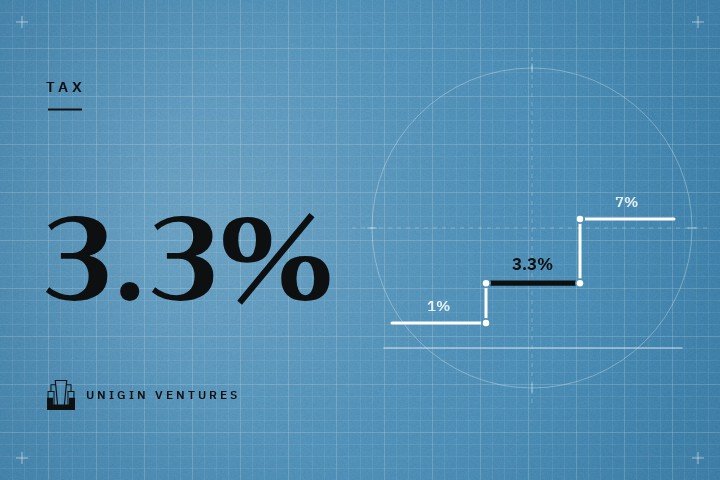
On the other side, the Revenue Department sets these corporate income tax rates for companies with paid-up capital of no more than 5 million baht and revenue from sales and services of no more than 30 million baht:
| Net profit | Tax rate |
|---|---|
| Up to 300,000 baht | Exempt |
| Over 300,000 to 3,000,000 baht | 15% |
| Over 3,000,000 baht | 20% |
Companies that do not qualify pay 20% of net profit. When all revenue suffers 3% withholding but net profit is only a small share of revenue, and the first 300,000 baht of profit is exempt, the tax withheld often exceeds the tax for the whole year. For a company that made a loss the gap is even clearer: no tax is due at all, yet tax was withheld all year.
Worked Example: How Much Can You Reclaim?
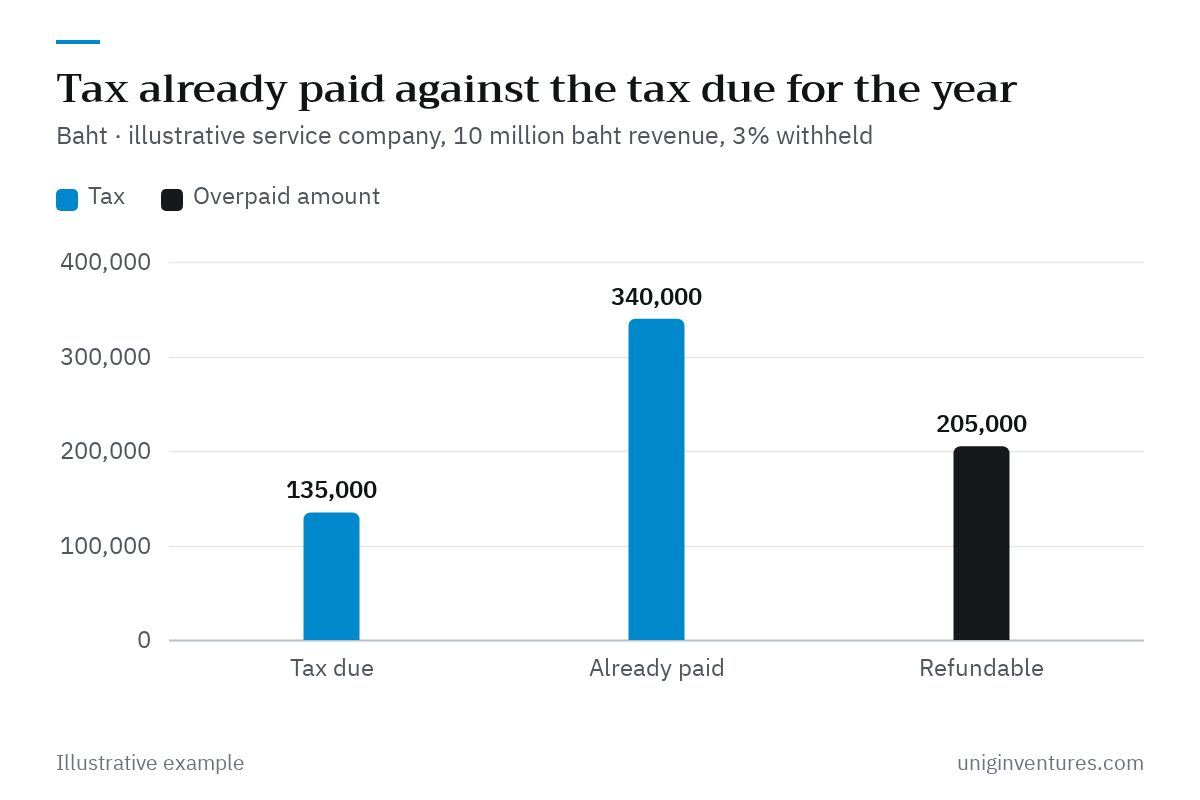
An illustrative example: an online marketing agency has paid-up capital of 2 million baht and service revenue of 10,000,000 baht for the year. Every customer is a company that withholds 3%. Mid-year, the agency filed its half-year return (P.N.D. 51) and paid 40,000 baht. At year-end its net taxable profit is 1,200,000 baht.
| Item | Amount |
|---|---|
| Net taxable profit | 1,200,000 |
| Tax on the first 300,000 baht (exempt) | 0 |
| Tax on the remaining 900,000 baht × 15% | 135,000 |
| Tax due for the year | 135,000 |
| Less tax withheld at source (10,000,000 × 3%) | −300,000 |
| Less half-year tax paid with P.N.D. 51 | −40,000 |
| Tax overpaid (refundable) | 205,000 |
This company has 205,000 baht waiting to be reclaimed, about 2% of its annual revenue. Repeat that every year without claiming and the lost money adds up to a large sum. As for the half-year payment, the Revenue Department explains that tax paid with P.N.D. 51 is a credit against the annual tax and can be refunded if overpaid (on estimating half-year profit, see P.N.D. 51).
How to Claim, and By When
1. File P.N.D. 50 on Time
The Revenue Department's P.N.D. 50 FAQ states that the return is due within 150 days of the last day of the accounting period. On the return you calculate the tax for the full year, then deduct the tax withheld at source and the half-year tax. A negative result is the tax overpaid.
2. State That You Want the Refund
The same FAQ answers that if you want a refund, you file a tax refund request on form Kor.10 (ค.10). A Revenue Department ruling (No. 0811/3075) held that the P.N.D. 50 return itself does not count as a refund request. The procedure can differ by filing channel and year, so confirm with your area revenue office or your accountant whether your year needs a separate Kor.10 or whether you can request the refund within the online return.
3. Do Not Miss the Three-Year Limit
Section 27 ter of the Revenue Code requires anyone entitled to a refund, including tax withheld and remitted in excess of the tax due, to file the refund request within three years of the last day of the deadline for filing the return. If the return was filed late, the three years run from the filing date. Tax withheld in past years that you have not yet reclaimed may therefore still be recoverable, as long as that window is open.
4. Receiving the Refund, and Interest
The Revenue Department offers tax refunds by PromptPay for juristic persons, and announced on July 2, 2026 that this round's Fast Track corporate income tax refunds apply only to P.N.D. 50 returns filed through e-Filing. Make sure the company's bank account is linked to PromptPay under its juristic person registration number.
If the refund is slow, Section 4 decies (มาตรา 4 ทศ) of the Revenue Code lets the Director-General pay interest to refund recipients at 1% per month or part of a month, not compounded and not exceeding the refund, under the prescribed rules. Ruling 0811/3075 explains that interest starts the day after three months from the filing deadline and is paid only when the return or claim was filed on time. In the example above, 1% a month on 205,000 baht is 2,050 baht.
Documents to Have Ready Before You File
How fast a refund moves depends on how easy your figures are to verify. Prepare these during the year:
- Every withholding tax certificate (50 Tawi): match one to each receipt where the customer withheld tax. Chase missing certificates in the month you are paid, not at year-end.
- A withholding tax register: a table of customer, payment date, income and tax withheld, whose total must equal the figure on P.N.D. 50.
- Revenue in the books that matches income on the certificates: if the certificates show more income than your financial statements, you must be able to explain why, such as revenue received in advance or items booked in a different period (see accruals and cut-off).
- Proof of the P.N.D. 51 payment and the working papers that adjust book profit to taxable profit (see P.N.D. 50 adjustments).
Tie Up Less Cash Next Year
- Estimate every quarter: compare cumulative tax withheld with the tax you expect for the year. If it will be well over, plan cash flow without counting the refund until it actually arrives.
- Estimate half-year profit realistically so you do not pay more P.N.D. 51 on top of withholding than you need to.
- Check customers withhold at the right rate: services (3.0%) and transport (1.0%) carry different rates under Order Tor.Por. 4/2528. A customer who withholds too much ties up more of your cash for no reason.
Where to Start
- Open your P.N.D. 50 returns for the last three years, look at the overpaid tax line, and check which years you have not reclaimed.
- For years still within the Section 27 ter three-year window, talk to your accountant or area revenue office about how to file the refund request.
- Link the company bank account to PromptPay under the juristic person registration number, and plan to file next year's P.N.D. 50 through e-Filing.
- Start a monthly withholding tax register this month, and chase any missing certificates.
The company and figures in the example are illustrative. Tax rates and refund procedures can change with the law and official announcements, so check with the Revenue Department before every filing. This article is general information, not tax advice for any particular business.
Sources
- Revenue Code, Sections 14–27 (Section 27 ter, tax refunds) — Revenue Department
- Revenue Code, Title 1 (Section 4 decies, interest on tax refunds) — Revenue Department
- Corporate income tax rates — Revenue Department
- Revenue Department Order Tor.Por. 4/2528 (clause 12/1, service fees) — Revenue Department
- P.N.D. 50 frequently asked questions — Revenue Department
- Ruling 0811/3075 on corporate income tax refunds and interest — Revenue Department
- July 2, 2026 notice: Fast Track corporate income tax refunds, P.N.D. 50 via e-Filing only — Chonburi 3 Area Revenue Office
- Other corporate income tax services (refunds by PromptPay) — Revenue Department