Flat Rate vs Effective Rate: Find the True Cost Before You Borrow
Hire purchase at 3% flat can cost more than a 5.5% reducing-balance loan. Convert with the BOT's 1.8 rule or RATE, compare two offers, and see why the consumer rate cap skips company cars.
In this article
- How the two kinds of interest differ
- Worked example: an 800,000 baht pickup at 3% flat
- Converting to a true rate: the shortcut and the exact method
- Comparing two offers on the same basis
- The consumer rate cap does not cover company vehicles
- Paying off early: flat interest is fixed in advance
- Where to start
A hire-purchase quote for a pickup truck says 3% a year. The bank offers a term loan at 5.5% a year. Most business owners pick the lower number on the spot. But the two figures are calculated in different ways, and 3% on a flat-rate basis can cost more than 5.5% on a reducing-balance (effective rate) basis.
This article explains how the two kinds of interest differ, how to convert a flat rate into a true rate with a shortcut and with a spreadsheet formula, and how to compare two offers on the same basis before you sign.
How the two kinds of interest differ
The Bank of Thailand (BOT) explains them as follows:
- Flat rate. Interest is charged on the full original amount for the whole term. The total interest is added to the principal and divided into equal installments. Even though you repay some principal every month, interest is still charged on the full amount, as on day one. Car and motorcycle hire purchase commonly uses this method.
- Reducing balance (effective rate). Interest is charged on the principal still outstanding in each period. As the principal falls, so does the interest. Home loans, credit cards and personal loans use this method.
The BOT states plainly that the two kinds of rate cannot be compared directly because they are calculated differently. You have to convert them to the same basis first.
Worked example: an 800,000 baht pickup at 3% flat
An illustrative example: a company takes a pickup truck on hire purchase. The amount financed is 800,000 baht at 3% a year flat, repaid over 48 monthly installments (4 years).
Total interest = amount financed × flat rate × number of years
Installment = (amount financed + total interest) ÷ number of installments
- Total interest = 800,000 × 3% × 4 = 96,000 baht
- Total repaid = 800,000 + 96,000 = 896,000 baht
- Monthly installment = 896,000 ÷ 48 = 18,666.67 baht
The problem is that the 96,000 baht of interest is calculated on the full 800,000 baht for all four years, even though the company repays principal every month. Near the end of the contract only a few tens of thousands of baht are still owed, yet the company still pays the same interest as when it owed 800,000 baht. On average the company uses far less money than the amount financed, so the true interest rate is close to double the number on the quote.
Converting to a true rate: the shortcut and the exact method
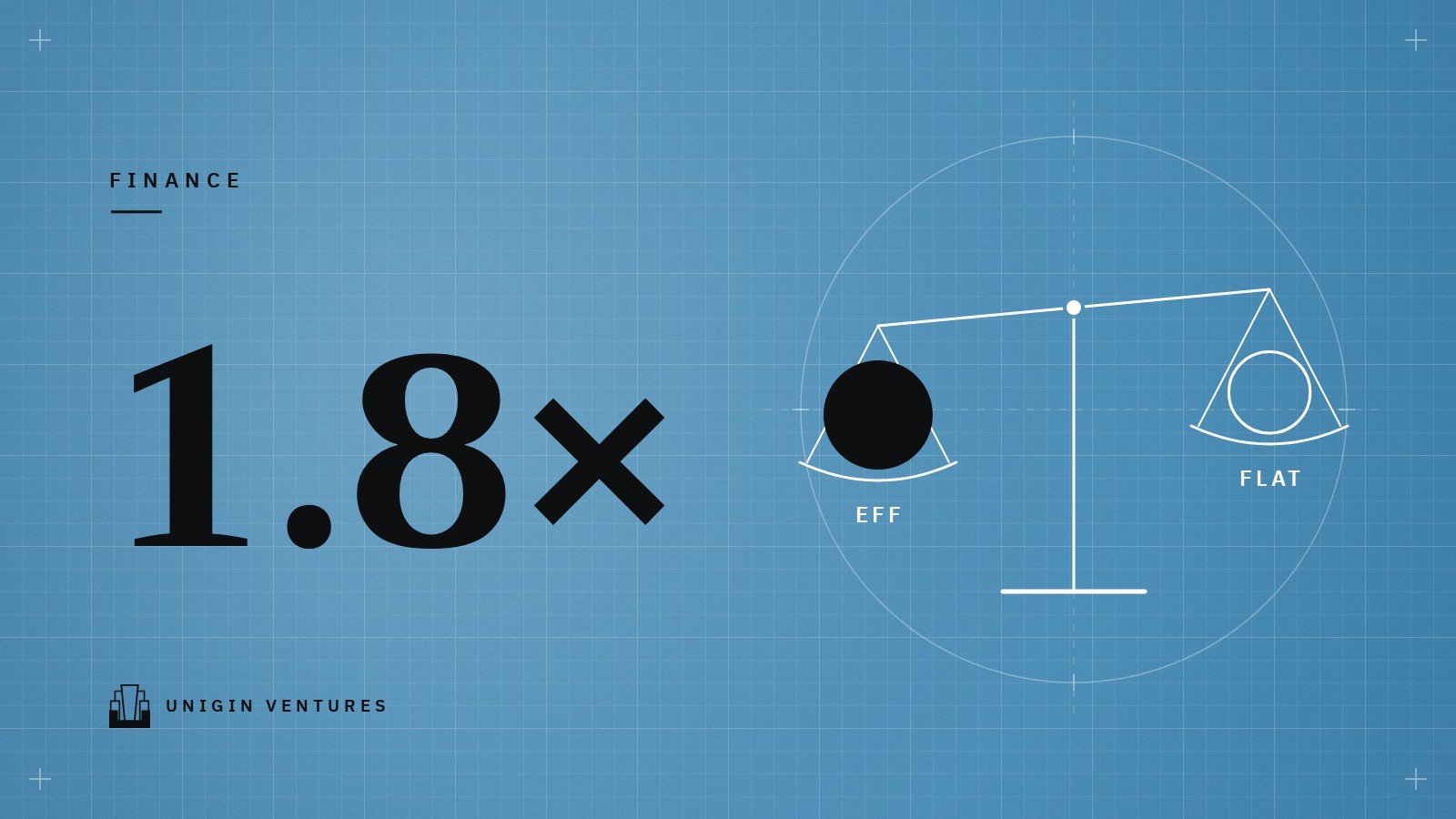
The BOT shortcut: multiply by 1.8
The BOT suggests a rough conversion: multiply the flat rate by 1.8. Here, 3% × 1.8 = 5.4% a year. This is a quick way to screen offers, but it is an approximation, and the real result depends on the number of installments.
The exact method: the RATE function
Excel and Google Sheets have a RATE function that finds the interest rate per period from the number of installments, the installment amount and the amount financed. Multiply by 12 to get the annual reducing-balance rate.
True annual rate = RATE(number of installments, −installment, amount financed) × 12
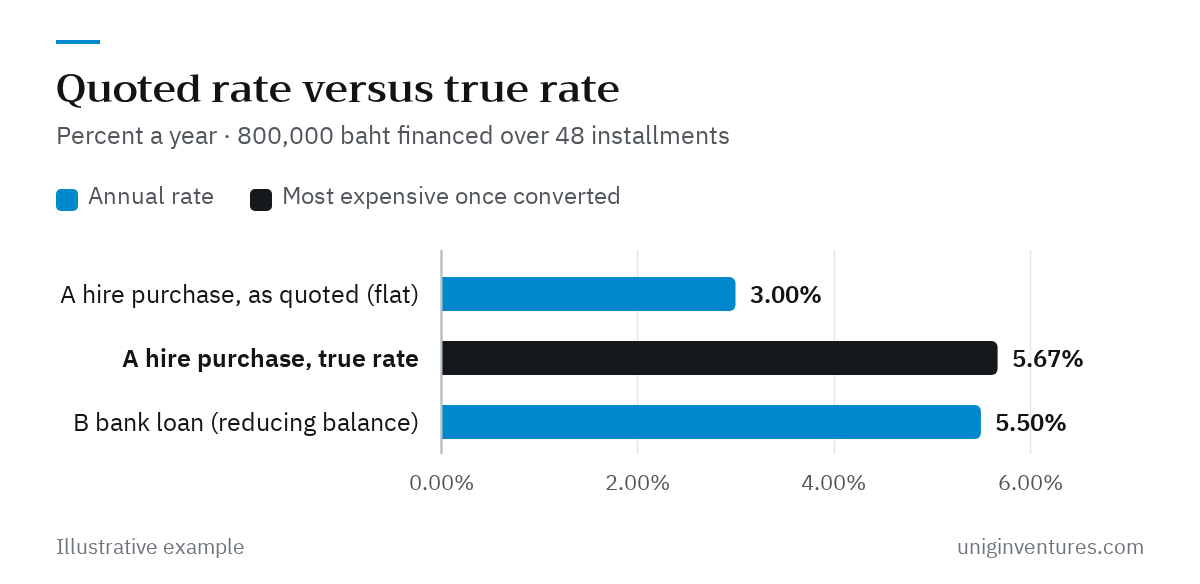
=RATE(48, -18666.67, 800000) * 12 gives about 5.67%
The true rate of this offer is therefore about 5.67% a year, higher than the 5.4% shortcut and almost twice the 3% on the quote. If there are fees paid at signing, subtract them from the amount financed before using the formula, and the result will reflect the real cost more closely.
Comparing two offers on the same basis
Continuing the illustrative example, a bank offers a term loan of 800,000 baht at 5.5% a year on a reducing balance, also over 48 installments. The PMT function gives the installment:
=PMT(5.5%/12, 48, -800000) gives about 18,605 baht a month
| Item | Offer A: hire purchase | Offer B: bank loan |
|---|---|---|
| Rate on the quote | 3.00% flat | 5.50% reducing balance |
| True annual rate | About 5.67% | 5.50% |
| Monthly installment (baht) | 18,667 | 18,605 |
| Total interest over the term (baht) | 96,000 | About 93,050 |
The offer quoted at 3% costs about 2,950 baht more over the term than the offer quoted at 5.5%. The gap in this example is small, but anyone comparing the quoted numbers would pick the wrong offer without realizing it, and the gap widens as the amount financed or the difference between the rates grows.
The interest rate is not the only thing to compare. Look at the down payment, fees, insurance the lender requires you to buy, and any collateral. Hire purchase may also leave your bank credit lines free, which has value for a business that needs them for working capital (see the wider decision in Lease or Buy: Compare the Real Cost of Equipment and Vehicles).
The consumer rate cap does not cover company vehicles
The Notification of the Contract Committee on car and motorcycle hire purchase as a contract-controlled business, B.E. 2565 (2022), in force since January 10, 2023, sets ceilings expressed as an effective interest rate per year:
- New cars: no more than 10% a year
- Used cars: no more than 15% a year
- Motorcycles: no more than 23% a year
The Office of the Consumer Protection Board (OCPB) explains that contracts still calculate interest on a flat basis: total interest is computed once for the whole term and divided equally across the installments. The ceiling only limits what that flat charge may amount to once converted to a true rate. The notification also applies only to hire purchase by individuals who use the vehicle personally.
A vehicle that a company takes on hire purchase for its business therefore falls outside this cap. The rate and terms depend on negotiation and the contract, so the company must convert the rate itself every time.
Paying off early: flat interest is fixed in advance
With a reducing-balance loan, interest is charged on the principal outstanding, so if you prepay or pay off early, the interest for the remaining periods never arises, although the contract may charge a prepayment fee. With a flat-rate contract, the interest for the whole term is calculated and built into the installments from day one, so any interest rebate on early payoff depends on the formula written into the contract.
If the business may sell the vehicle or machine before the contract ends, or expects a lump sum to clear the debt, ask for the early payoff formula in writing before you sign, then work out the payoff amount at installment 24 under both offers and compare.
Where to start
- List your current hire-purchase and loan contracts, noting the amount financed, installment and number of installments for each.
- Find the true rate of every contract with RATE(number of installments, −installment, amount financed) × 12 and sort from most to least expensive. The most expensive one is the first to consider paying off or refinancing when cash allows.
- For every new offer, ask for the installment, the number of installments, the amount financed and all fees, then convert to a true rate before comparing.
- Use the true rate as the cost of debt in investment decisions (see The Cost of Capital, Simply Explained), and if the loan has a floating rate, see what a rate change costs in Floating-Rate Loans.
The company, offers and figures in this article are illustrative examples. Results from the RATE and PMT functions are rounded. This article is general information, not financial or legal advice for any particular business.