Volume Discounts and Bundles: How Much to Give and Still Earn More
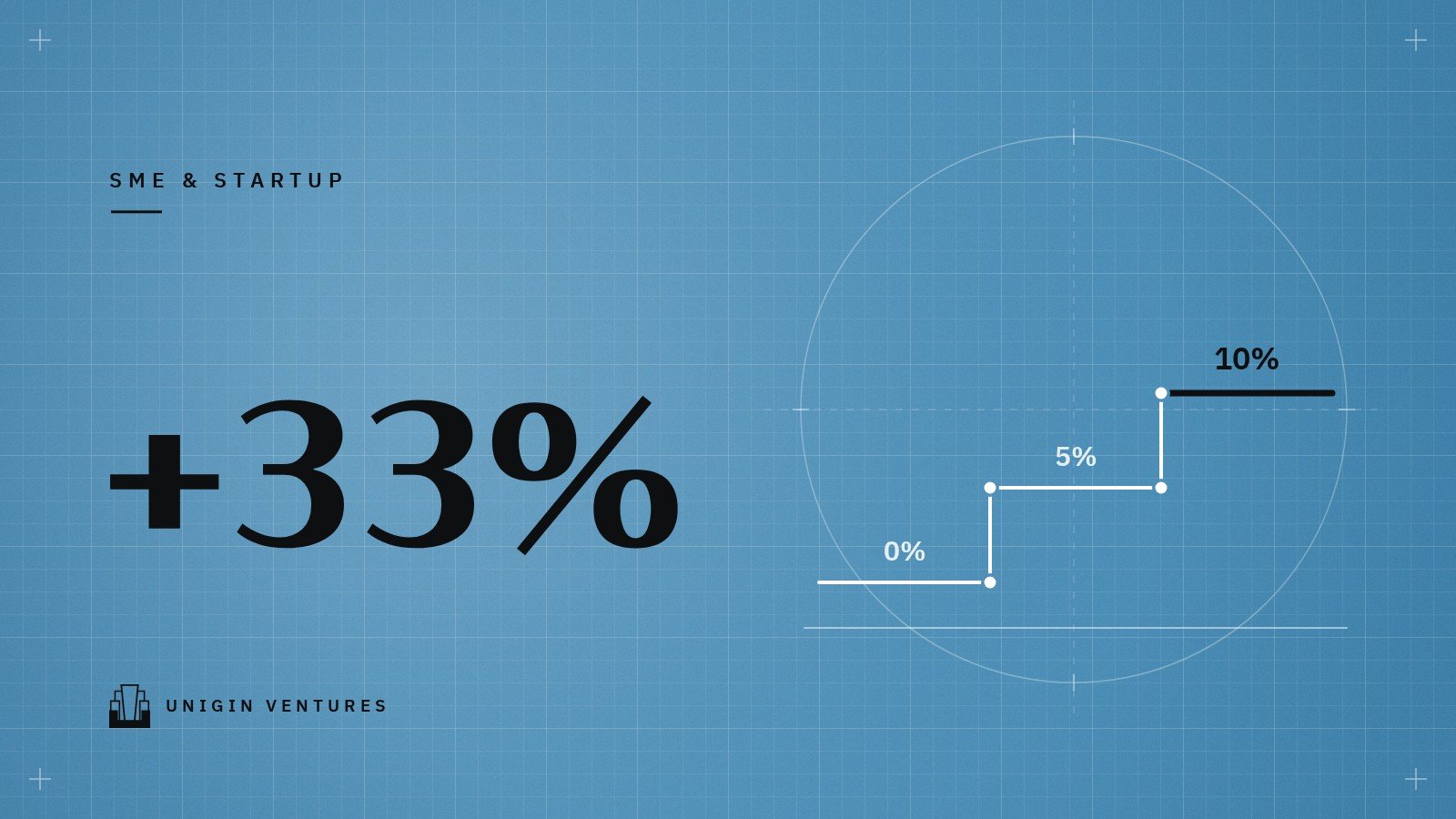
A 10% discount can need a third more volume just to stand still. The formula, every-unit vs. above-threshold discounts, and how to price a bundle from what customers would buy anyway.
In this article
A customer asks for a better price on a bigger order, or the sales team wants a discounted bundle to lift volume. It sounds like both sides win. But every baht of discount comes straight off profit, while the cost of the product stays the same. A 10% discount can take a quarter or more of the profit on each unit, and you then need to sell a lot more just to get total profit back to where it was.
This article gives you the formula for how much extra volume a discount has to bring in, compares two kinds of volume discount that produce very different results, and shows how to price a bundle by asking what each group of customers would have bought without it, with worked examples you can apply to your own products.
A discount comes out of contribution margin
OpenStax's Principles of Accounting, Volume 2: Managerial Accounting describes sensitivity analysis as a way to see what happens when the sales price, units sold, variable cost per unit or fixed costs change. When the sales price decreases, contribution margin is lower, so you need more sales to break even.
A discount bites harder than it looks because it is calculated on price but comes out of contribution margin, which is only part of the price. Take a product that sells for 100 baht with 60 baht of variable cost: contribution margin is 40 baht, or 40% of price. Cut the price 10% to 90 baht and contribution margin falls to 30 baht, down by a quarter. You need to sell a third more units to earn the same total contribution.
Required volume increase (%) = Discount (%) ÷ (Contribution margin ratio (%) − Discount (%))
Example: 10% discount, 40% contribution margin ratio → 10 ÷ (40 − 10) = 33.3%
The formula comes from setting total contribution before and after the discount equal. It holds when variable cost per unit does not change and fixed costs stay where they are. If the discount is equal to or larger than the contribution margin ratio, no amount of extra volume leaves any contribution at all.
| Discount | Contribution margin 30% | Contribution margin 40% | Contribution margin 50% |
|---|---|---|---|
| 5% | +20.0% | +14.3% | +11.1% |
| 10% | +50.0% | +33.3% | +25.0% |
| 15% | +100.0% | +60.0% | +42.9% |
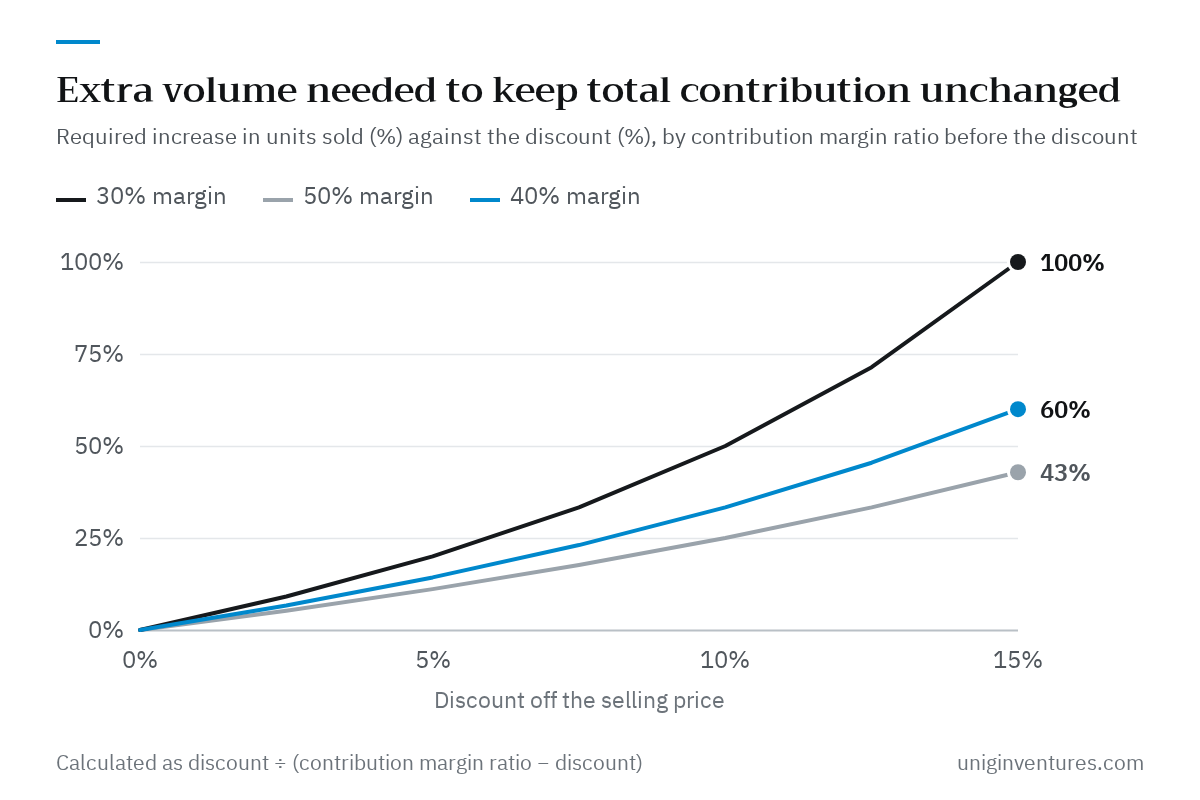
This table is the mirror image of a price increase, where raising prices without losing customers works out how much volume you can afford to lose. Before you use it, find the contribution margin ratio of each product (see contribution margin by product).
Volume discounts: on every unit, or only on units above the threshold
Volume discounts come in two common forms. One discounts every unit once an order reaches the threshold. The other discounts only the units above it. Illustrative example: a coffee roaster sells beans to cafés at 500 baht a kilogram. Variable cost is 300 baht a kilogram, so contribution margin is 200 baht a kilogram (40%). One customer orders 40 kilograms a month, earning 8,000 baht of contribution. The roaster offers 10% off (50 baht a kilogram) for orders of 60 kilograms a month or more, and the customer agrees to order 60.
| Discount method | Calculation | Contribution |
|---|---|---|
| No discount, 40 kg | 40 × 200 | 8,000 |
| Discount on every kg, 60 kg | 60 × 150 | 9,000 |
| Discount only above 40 kg, 60 kg total | 40 × 200 + 20 × 150 | 11,000 |
Discounting every kilogram adds only 1,000 baht, because the discount also goes to the 40 kilograms the customer was already buying (40 × 50 = 2,000 baht). Discounting only the units above the threshold adds 3,000 baht. The break-even order under the every-unit discount is 8,000 ÷ 150 = 53.3 kilograms; if the customer orders less than that, the roaster earns less than before.
Customers already above the threshold
The cost people forget is the discount handed to customers who already buy enough to qualify. If the roaster has another customer already ordering 70 kilograms a month, an every-unit discount costs 70 × 50 = 3,500 baht a month in contribution with no extra volume. Before announcing a new threshold, pull 6–12 months of purchases by customer, count how many already reach it, and subtract the discount they would receive from the profit you expect from customers who buy more.
A volume discount is easier to justify when large orders really do lower your costs, for example one delivery instead of several, or longer production runs. Those savings can be added back into the calculation (see cost to serve in customer profitability).
Bundle pricing: start from what each customer group would buy anyway
A bundle is another form of discount, and its effect depends on what bundle buyers would otherwise have bought. Illustrative example: a shop sells product A at 200 baht with 120 baht of variable cost (80 baht of contribution) and product B at 100 baht with 40 baht of variable cost (60 baht of contribution). It offers an A + B bundle at 270 baht, 30 baht or 10% off. The bundle's contribution is 270 − 160 = 110 baht.
| Without the bundle, the customer would have | Number | Change per bundle | Total |
|---|---|---|---|
| Bought both A and B anyway | 100 | 110 − 140 = −30 | −3,000 |
| Bought only A | 200 | 110 − 80 = +30 | +6,000 |
| Bought only B | 50 | 110 − 60 = +50 | +2,500 |
| Bought nothing (new customer) | 50 | +110 | +5,500 |
| Total | 400 | +11,000 |
This bundle adds 11,000 baht of contribution a month because most buyers would otherwise have bought a single item. If all 400 buyers had been customers who already bought both, the shop would lose 12,000 baht. The same prices can produce opposite results depending on who buys.
OpenStax explains that if customers purchase more low-margin products, the break-even point rises, and if they purchase more high-margin products, it falls. A bundle can shift the sales mix either way. The table gives a simple rule: for a customer who would have bought only A, the bundle adds profit when the discount is smaller than B's contribution (30 baht against 60 baht). Good bundles therefore tend to pair a core product with a high-margin add-on, with a discount smaller than the contribution of the item being added.
Checklist before you discount
- Work out the contribution margin ratio of the product you plan to discount, then use the formula above to find the extra volume required. Ask honestly whether sales can rise that much.
- Prefer discounts only on units above the threshold. If your market expects every-unit discounts, set the threshold above what most customers already buy.
- Count the customers who already qualify and the discount you would give them for no extra volume.
- For bundles, estimate the share of the four customer groups in the table from past purchase data. If you have no data, test the bundle for a short period or in a few branches first.
- Set an end date or a review condition from the start. A discount is harder to take back than never to give.
Where to start
- Pick one discount or bundle you run today and find the contribution margin ratio before and after the discount.
- Pull actual sales for the discount period and a comparable earlier period (adjusting for seasonality if you can), and check whether volume rose to the level in the table.
- Calculate total contribution for both periods. If the discount period earned less, change the threshold, shrink the discount, or switch to discounting only units above the threshold.
- Apply the same thinking to discounts given through distributors or as rebates on cumulative purchases (see distributor pricing and rebates), and agree with your accountant on the documents to issue when you reduce a price after the tax invoice has gone out (see credit and debit notes).
The businesses, products and figures in this article are illustrative examples. This article is general information, not financial advice for any particular business.
Sources
- 3.3 Perform Break-Even Sensitivity Analysis for a Single Product Under Changing Business Situations, Principles of Accounting, Volume 2: Managerial Accounting — OpenStax (Rice University)
- 3.4 Perform Break-Even Sensitivity Analysis for a Multi-Product Environment Under Changing Business Situations, Principles of Accounting, Volume 2: Managerial Accounting — OpenStax (Rice University)