Delivery Apps and Marketplaces: Pricing That Survives Commission and Ads
Split platform costs per order, set the app price from the contribution you need, find the break-even ROAS for ads, and see how promotions and VAT on the commission eat into profit.
In this article
- Platform costs come in two kinds
- Step 1: What is left if you sell at the counter price
- Step 2: A formula for the app price
- In-app ads: the ROAS you need to break even
- Promotions: first ask which price the commission is charged on
- VAT on the commission: registered and unregistered shops pay different costs
- Choosing menus and bundles for the app
- Where to start
Many shops start selling on a food delivery app or an online marketplace at the same price they charge over the counter. Orders go up, but the bank balance at the end of the month does not follow. The platform's commission is a percentage of the selling price, the discounts the shop funds are a percentage of the selling price, and there are ad and packaging costs that the counter never had. Once every item is deducted, a dish that leaves 50 baht at the counter can leave less than 10 baht on the app.
This article breaks the cost of a platform order into its parts, gives a formula that sets the app price from the contribution you want per order, and uses the same numbers to test whether ads and promotions pay. It also covers VAT on the commission and ends with a checklist for your next price review.
Platform costs come in two kinds
Before any calculation, split the cost of an app order into two groups, because they behave differently when you raise the price.
- Costs charged as a percentage of the price, such as the commission (often called GP in Thailand) that the platform takes from the menu price, payment fees, and discounts the shop funds itself. These rise with the price: add 10 baht to the price and these costs rise too.
- Costs in baht per order or per item, such as ingredients, boxes and bags, average ad spend per order, and any delivery subsidy the shop pays. These do not change with the price.
Real commission and fee rates differ by platform, type of shop and the package you sign up for. Use the figures in your own contract and invoices, not numbers passed around by word of mouth. Every figure in this article is an illustrative example.
Step 1: What is left if you sell at the counter price
A hypothetical made-to-order restaurant sells chicken basil rice for 80 baht at the counter. Ingredients cost 30 baht a plate. The shop is not VAT-registered, and the platform charges a commission of 30% of the menu price, VAT included. The shop co-funds discounts that average about 10% of the price and spends 3,000 baht a month on in-app ads for about 600 orders, or 5 baht an order on average.
| Item | Counter | App at 80 baht |
|---|---|---|
| Selling price | 80.00 | 80.00 |
| Commission 30% | − | −24.00 |
| Shop-funded discount, 10% average | − | −8.00 |
| Average ad cost per order | − | −5.00 |
| Box, bag and cutlery | − | −6.00 |
| Ingredients | −30.00 | −30.00 |
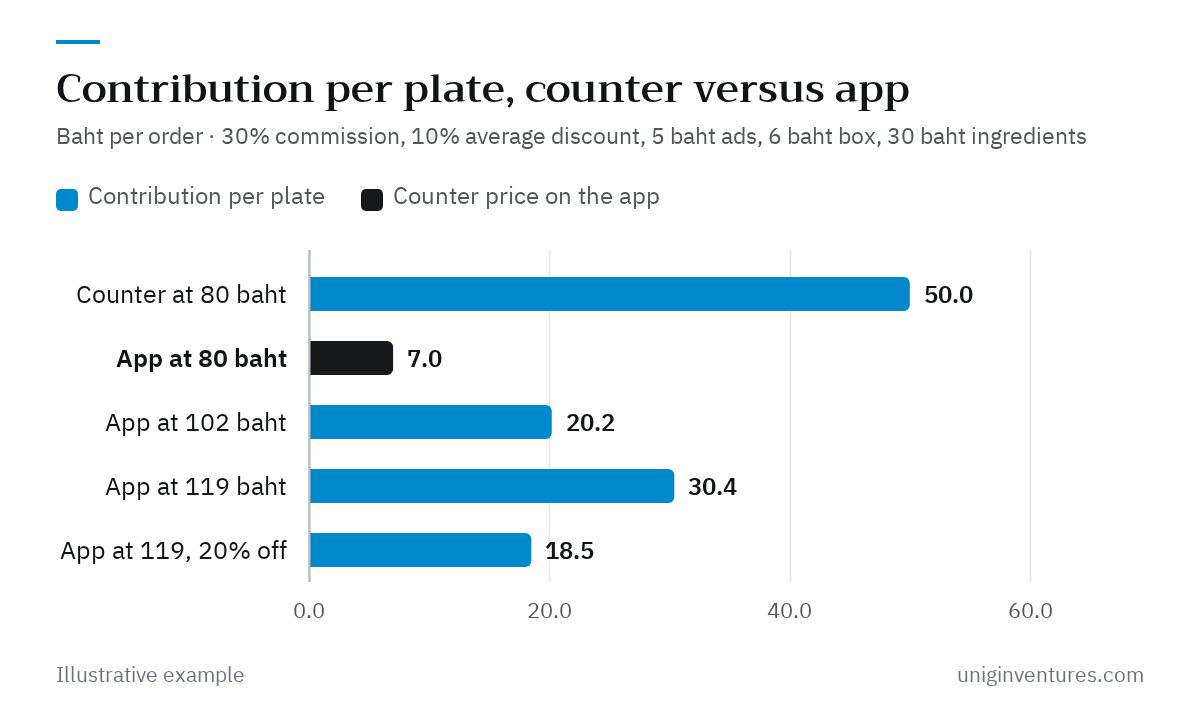
| Contribution per plate | 50.00 | 7.00 |
Contribution margin is the money each plate leaves to pay rent, wages and the owner's profit. The same plate leaves 50 baht at the counter and 7 baht on the app. If app orders need one extra person to pack them, the shop can lose money on the channel while sales look healthy. Our article on finding which products really make money with contribution margin explains the method item by item.
Step 2: A formula for the app price
The common mistake is to add the commission on top of the price: 80 baht plus 30% is 104 baht. That falls short, because the commission is then charged on the higher price as well. The right way is to divide by what is left after the percentage costs.
App price = (baht costs per order + target contribution per order) ÷ (1 − all percentage costs)
The hypothetical shop has 41 baht of baht costs per order (ingredients 30, packaging 6, ads 5) and 40% of percentage costs (commission 30%, discount 10%). The divisor is 1 − 0.40 = 0.60, which means every extra baht on the price brings the shop only 0.60 baht. As a check, a target of 7 baht gives (41 + 7) ÷ 0.60 = 80 baht, matching the table above.
| Target contribution (baht) | Price from formula (baht) | Rounded (baht) | Above counter price |
|---|---|---|---|
| 20 | (41 + 20) ÷ 0.60 = 101.67 | 102 | 27.5% |
| 30 | (41 + 30) ÷ 0.60 = 118.33 | 119 | 48.8% |
| 50 (same as counter) | (41 + 50) ÷ 0.60 = 151.67 | 152 | 90.0% |
Earning the counter contribution on the app would take almost double the price, which most customers will not pay. So the real question is what app orders have to pay for. If the kitchen has spare capacity and the counter already covers the rent, app orders only need to cover the costs this channel adds, such as a packer.
Suppose the shop hires a packing assistant for 12,000 baht a month and expects 600 app orders a month. At 102 baht it earns 600 × 20.20 = 12,120 baht of contribution, barely enough for the wage. At 119 baht it earns 600 × 30.40 = 18,240 baht, leaving 6,240 baht after the wage. The 20.20 and 30.40 are the actual contributions after rounding the price up. A higher price may cost some orders, so test prices one menu group at a time and watch real order numbers for two to four weeks.
Marketplaces work the same way
A shop selling goods on a marketplace has the same cost structure. Commission, transaction fees and payment fees are percentages, while the product cost, packing and any shipping subsidy are baht per item. As a hypothetical example, take a product costing 250 baht, 15 baht of packing, a 20 baht shipping subsidy, 30 baht of ads per item on average and 15% of percentage fees. For a contribution of 100 baht an item, the price is (250 + 15 + 20 + 30 + 100) ÷ 0.85 = 488.24 baht, rounded to 489 baht.
In-app ads: the ROAS you need to break even
Most apps report ad results as ROAS (return on ad spend): sales attributed to ads divided by ad spend. It is easy for this number to look high, because it measures sales, not profit. Work out your own break-even first.
Break-even ROAS = selling price ÷ contribution per order before ad costs
At 119 baht, the hypothetical shop's contribution before ads is 119 − 35.70 − 11.90 − 6 − 30 = 35.40 baht. Break-even ROAS is 119 ÷ 35.40 = 3.36.
- At a ROAS of 3, 100 baht of ads brings 300 baht of sales, about 2.52 orders, and 2.52 × 35.40 = 89.24 baht of contribution. The shop loses 10.76 baht for every 100 baht of ads.
- At a ROAS of 5, 100 baht of ads brings 500 baht of sales, about 4.20 orders, and 148.74 baht of contribution, leaving 48.74 baht.
The app's ROAS also counts orders that regular customers would have placed anyway, so the true effect is usually lower than the dashboard shows. A simple test is to pause ads for one or two weeks outside a holiday period and compare total orders with the weeks before. The orders that disappear are the ones the ads actually created.
Promotions: first ask which price the commission is charged on
Suppose the app invites the shop into a campaign of 20% off every order, with the shop funding the whole discount. At 119 baht the discount is 23.80 baht. The effect on the shop depends on one question to ask the platform before joining: is the commission charged on the price before or after the discount the shop funds?
| Item | Normal (10% average discount) | 20% off, commission on full price | 20% off, commission on discounted price |
|---|---|---|---|
| Selling price | 119.00 | 119.00 | 119.00 |
| Shop-funded discount | −11.90 | −23.80 | −23.80 |
| Commission 30% | −35.70 | −35.70 | −28.56 |
| Ads, packaging and ingredients | −41.00 | −41.00 | −41.00 |
| Contribution per order | 30.40 | 18.50 | 25.64 |
| Orders needed to keep total contribution | − | 30.40 ÷ 18.50 = 1.64× (+64%) | 30.40 ÷ 25.64 = 1.19× (+19%) |
If the commission is charged on the full price, the campaign must lift orders by about 64% just to hold total contribution. If it is charged on the discounted price, the lift needed is about 19%. Also ask what share of the discount the platform funds, and whether customers won in the campaign come back at the normal price. If they do not, the discount only sold the same plates for less.
VAT on the commission: registered and unregistered shops pay different costs
If the platform is a VAT-registered business in Thailand and charges VAT on its commission, the cost to the shop depends on the shop's own status. The VAT rate is currently 7% including local tax, a temporary reduction from 10% that Royal Decree No. 807 (2026) extended to September 30, 2027.
- Shops that are not VAT-registered carry the VAT on the commission as a full cost. If the contract states a 28% commission before VAT, the real cost is 28% × 1.07 = 29.96% of the price. Use the VAT-inclusive figure in the formula.
- VAT-registered shops compute the tax they owe as output tax minus input tax under Section 82/3 of the Revenue Code, and Section 82/4 treats VAT charged by another registered business as input tax, so the VAT on the commission can be deducted. Section 82/5 (1), however, disallows input tax without a tax invoice. Set the shop's registered name and tax ID correctly in the seller account and download the tax invoices every month.
- Registered shops must take VAT out of the selling price before using the formula, because 7 of every 107 baht is output tax to pass on, not revenue. Work in pre-VAT figures, then multiply by 1.07 for the app price. A pre-VAT price of 118.33 baht, for example, is about 126.62 baht with VAT. Check your invoices to see whether the platform charges the commission on the price with or without VAT, because a different base changes the divisor in the formula.
For recording full sales, reconciling with the platform's reports and the other taxes an online shop faces, see our article on tax for online sellers that trade as a company.
Choosing menus and bundles for the app
You do not have to put every menu item on the app, and you do not have to raise every price by the same amount.
- List the items with enough contribution. Run the formula from Step 2 for every item. Items that would need a price customers will not pay should come off the app or be sold only as part of a set.
- Bundle to raise the order value. Boxes, bags and ad cost per order hardly grow with the number of plates, so an order with food and a drink spreads these costs better than a single plate.
- Read the contract before pricing differently from the counter. Some platforms have terms on pricing or how prices are shown, so check them before you change anything.
- Review whenever the platform changes its fees. A few points more in percentage costs change the divisor at once. From 0.60 to 0.55, the price for a 30 baht contribution rises from 118.33 to 129.09 baht.
Where to start
- Pull last month's platform invoices and sales report. Split the costs into percentage costs and baht-per-order costs, including shop-funded discounts and ad spend.
- Work out the contribution per order of your five best sellers at their current app prices.
- Set a target contribution per order from the costs this channel adds, such as a packer's wage divided by expected orders, plus the profit you want on top.
- Find the price with the formula: (baht costs per order + target contribution) ÷ (1 − percentage costs).
- Find your break-even ROAS and compare it with the ad report, and ask the platform whether the commission is charged before or after discounts before the next campaign.
- Change prices one menu group at a time and watch order numbers and total contribution for two to four weeks before the next change.
This article is general information, not business, tax or legal advice for any particular business. The shop, prices, commission rates and all figures are illustrative examples and do not come from any particular platform. Tax information was checked against the Revenue Department's website in November 2026.