Early-Payment Discounts: Are They Cheaper Than Borrowing?
A 2% discount for paying within 10 days sounds small, yet as an annual rate it can cost more than an overdraft. The break-even formula, a full-year example and how to write the terms.
In this article
- A Cash Discount Is a Price Paid for Faster Cash
- Count From When Customers Actually Pay, Not the Invoice Terms
- The Largest Discount That Still Pays
- Illustrative Full-Year Example: Counting the Customers Who Already Pay Early
- When a Cash Discount Still Makes Sense
- Write the Terms and the Paperwork Clearly
- Where to Start
Many customers pay later than the terms they agreed to. Money that should arrive on day 30 turns up on day 60 or 70, and in the meantime the business draws on its overdraft (O/D) to pay suppliers and salaries. The fix many owners reach for is a cash discount: "pay within 10 days and take 2% off." Two percent looks small next to a loan rate of several percent a year, but the two numbers are in different units. The discount is paid once to bring cash in a few weeks early, while interest is quoted per year.
This article converts a discount into an annual cost so you can compare it with borrowing, works out the largest discount that still pays, runs a full-year example that includes customers who already pay early, and sets out how to write the terms and the paperwork. Do the math before you print new terms on your invoices.
A Cash Discount Is a Price Paid for Faster Cash
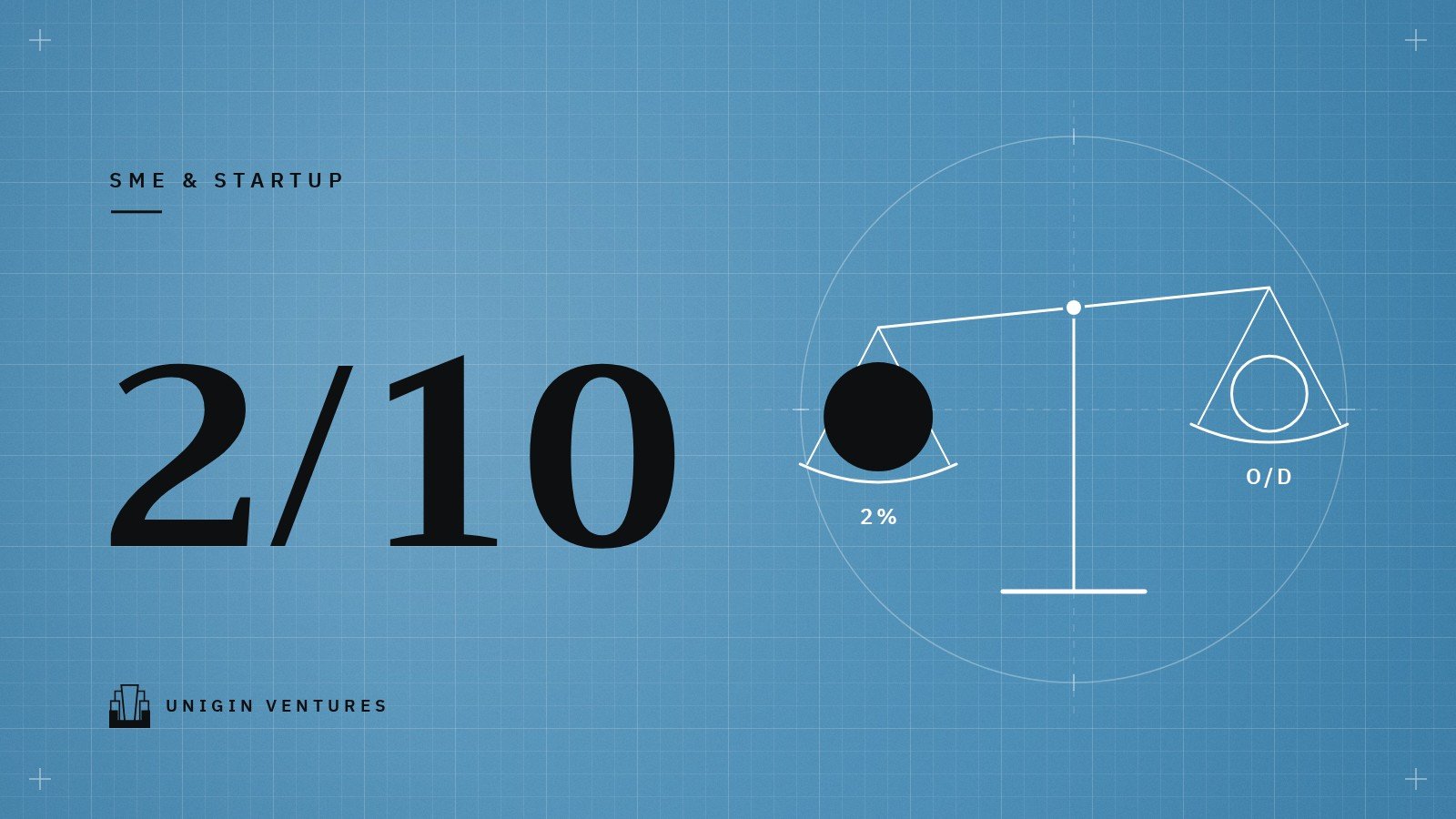
Terms written as "2/10 net 30" give the customer 2% off if they pay within 10 days of the invoice date; otherwise the full amount is due within 30 days. From the seller's side, the discount is what you give up to receive the money 20 days sooner. That is no different from borrowing the same amount for 20 days, so you can express the cost as an annual rate, just like interest:
Annual cost of the discount = discount % ÷ (100% − discount %) × 365 ÷ days the cash arrives sooner
The divisor is 100% minus the discount because a 100-baht invoice brings in only 98 baht. For 2/10 net 30 that gives 2 ÷ 98 × 365 ÷ 20 = 37.2% a year. (Some textbooks use a 360-day year, which gives 36.7%.) If your overdraft costs far less than that, drawing on it is cheaper than offering the discount.
This is the same formula a buyer uses to price skipping the discount, because it is one deal seen from two sides. If you are the buyer receiving such an offer, see the buyer's view in negotiating payment terms with suppliers.
Count From When Customers Actually Pay, Not the Invoice Terms
The 37.2% assumes every customer pays exactly on day 30. In practice, if customers who usually pay on day 60 switch to paying within 10 days, the cash arrives 50 days sooner, not 20. The annual cost of a 2% discount then falls to 2 ÷ 98 × 365 ÷ 50 = 14.9%, and a 1% discount falls to 7.4%.
The opposite also holds. Customers who already pay within 10 days take the discount without bringing the cash in a single day earlier. Every baht of discount they receive is pure cost, and it is the part most often left out of the calculation.
So before you calculate, find out when each customer really pays. Pull the last 6 to 12 months of invoices with the dates the money arrived, and work out the average number of days from invoice date to receipt for each customer. The aged receivables report from your accounting software is a good starting point.
The Largest Discount That Still Pays
Turn the first formula around and you get the discount at which its annual cost exactly equals your cost of borrowing. Anything larger costs more than borrowing.
Break-even discount = k ÷ (1 + k), where k = annual borrowing cost × days the cash arrives sooner ÷ 365
For a quick estimate, k on its own is close enough; it comes out slightly higher than the exact figure. The borrowing cost you put into the formula should be the cost of the money you would actually use if you did not offer the discount:
- If you are drawing on an overdraft: use the rate in your own facility agreement. If the agreement sets it as MOR plus a margin, use the MOR your bank announces on the day you calculate. The Bank of Thailand describes MOR as the rate commercial banks charge their prime large customers on overdraft facilities.
- If you already have spare cash: use what that cash earns now, such as deposit interest, which is generally lower than loan interest. The discount worth offering shrinks accordingly.
- If the alternative is factoring: use the total fees and interest of that service, converted to an annual rate (see factoring and invoice financing).
| Cash arrives sooner by | 6% a year | 8% a year | 12% a year |
|---|---|---|---|
| 20 days | 0.33% | 0.44% | 0.65% |
| 30 days | 0.49% | 0.65% | 0.98% |
| 45 days | 0.73% | 0.98% | 1.46% |
| 60 days | 0.98% | 1.30% | 1.93% |
Read it like this: with an 8% borrowing cost and customers paying 30 days sooner, any discount above 0.65% already costs more than the overdraft. No cell in the table reaches 2%: even at a 12% borrowing cost with customers paying 60 days sooner, the break-even discount is 1.93%.
Illustrative Full-Year Example: Counting the Customers Who Already Pay Early
An illustrative company sells 36 million baht a year on credit (all figures exclude VAT), gives 30-day terms, and draws on an overdraft all year at 8%. Its customers fall into three groups by when they actually pay:
- Group A: 20% of sales, or 7.2 million baht, already paid within 10 days.
- Group B: 40% of sales, or 14.4 million baht, paid on day 60 on average, and would switch to paying within 10 days for a 1% discount.
- Group C: 40% of sales, or 14.4 million baht, paid on day 70 on average. A 1% discount would not change their behavior; a 2% discount would.
Days sales outstanding (DSO) is currently 54 days. Offer 1/10 net 30 and Group B's money arrives 50 days sooner. Average cash on hand rises by 14,400,000 × 99% ÷ 365 × 50 = 1,952,877 baht, which cuts overdraft interest by 156,230 baht a year. Against the 144,000 baht of discounts Group B takes, that looks like a net gain of 12,230 baht, and the annual cost of the faster cash is 7.4%, below the overdraft rate.
But Group A takes the discount too, another 72,000 baht a year. Total discounts come to 216,000 baht, the net result becomes a loss of 59,770 baht a year, and the annual cost of the faster cash rises to 216,000 ÷ 1,952,877 = 11.1%, above the overdraft rate.
| Item | 1/10 net 30 | 2/10 net 30 |
|---|---|---|
| Customers who take the discount | Groups A and B | All groups |
| DSO after the discount (was 54 days) | 34 days | 10 days |
| Average increase in cash on hand | 1,952,877 | 4,252,932 |
| Overdraft interest saved (8%) | 156,230 | 340,235 |
| Discounts given | 216,000 | 720,000 |
| Net result | −59,770 | −379,765 |
| Annual cost of the faster cash | 11.1% | 16.9% |
Raise the discount to 2% so that Group C switches as well, and DSO falls from 54 days to 10. That looks excellent in a management report, yet the discounts total 720,000 baht a year, more than twice the 340,235 baht of interest saved. The net result is a loss of 379,765 baht a year.
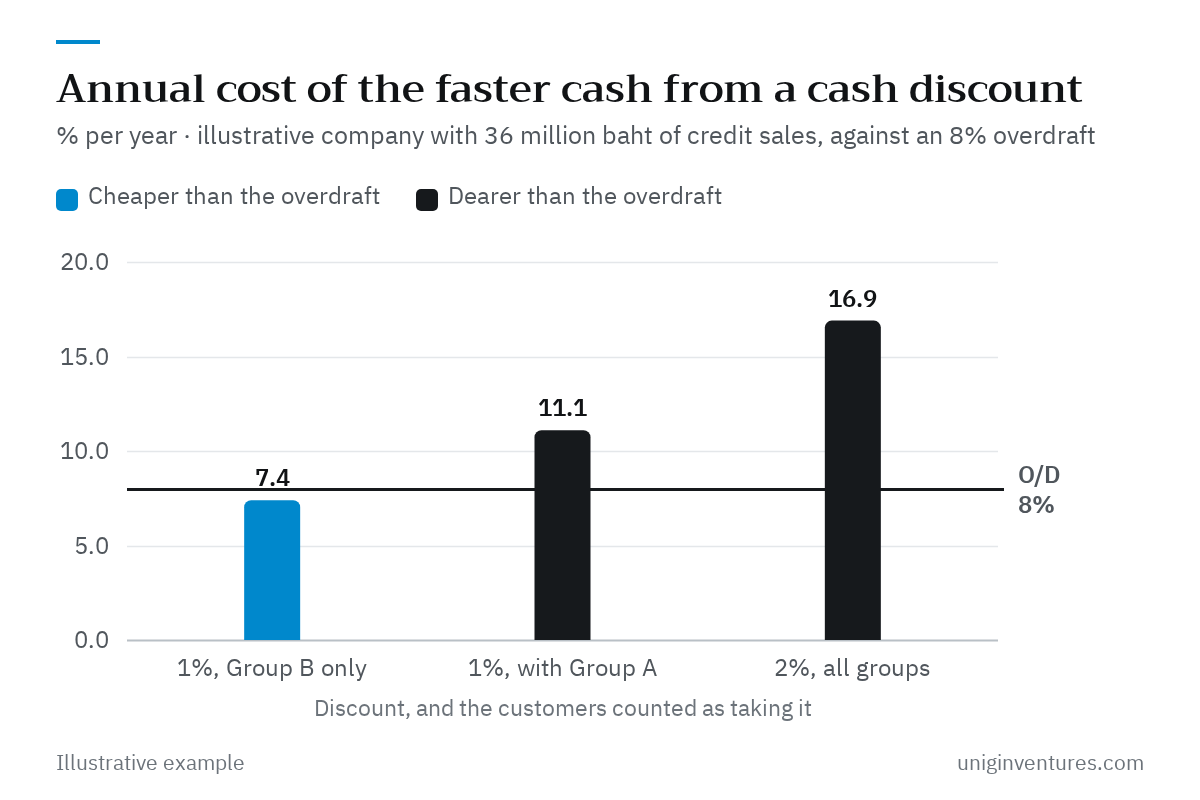
The lesson from this example: a lower DSO does not mean the discount pays. Judge it on the net result, and remember that every baht of discount comes straight off profit. On a product with a 20% gross margin, a 1% discount wipes out 5% of the gross profit on those sales.
When a Cash Discount Still Makes Sense
The figures above compare the discount with interest alone. A discount can be worth more in these cases:
- Funding is genuinely scarce or expensive: the overdraft is fully drawn and the next source of money costs much more. Use the cost of that next source in the formula, not the overdraft rate.
- The customer may not pay at all: faster cash lowers the chance of a bad debt. For a truly risky customer, though, a deposit or staged payments usually work better (see deposits and milestone payments in B2B contracts).
- Collection is costly: if your team spends a lot of time chasing the same customers every month, the time saved has value. Put a number on it first rather than using it to justify an oversized discount.
If you do offer a discount, you can limit the leak to customers who already pay early. Offer it when signing or renewing contracts with customers who habitually pay late, use a smaller discount of 0.5% to 1% instead of 2%, or trial it with a small group for three months and measure the net result. Customers who already pay on time may ask for the same terms, so prepare your answer in advance.
Write the Terms and the Paperwork Clearly
- What the discount is calculated on: state clearly whether it applies to the price before VAT or to the total.
- When the window starts and ends: count from the invoice date, and say by which date the money must be in your account, not the date the customer sends the transfer.
- Late payment with the discount deducted: state that the discount is forfeited, and bill the difference as soon as you spot it. Let it pass once and it tends to happen again.
- Full payment of that invoice only: the discount does not apply to partial payments.
On VAT, the Revenue Department answered a ruling request (No. กค 0811(กม.06)/พ.1647, dated 2 November 2000) from a company that agreed to give cash discounts afterward to customers who paid before the due date and wanted to show the discount on its tax invoices. In the ruling's example, the price is 4,400 baht less a 400-baht trade discount, leaving 4,000 baht, with VAT of 280 baht; the 40-baht cash discount is shown after that, and the customer pays 4,240 baht. The Department said the company may do this as long as the tax invoice contains all the essential items required by Section 86/4, and that a cash discount given afterward is not an event that requires a credit note under Section 82/10 of the Revenue Code.
A ruling answers the facts of the company that asked. Before you start, have your bookkeeper or auditor confirm the tax invoice format and how to record the discount, and keep discounts in a separate sales-discount account so you can compare each month's discounts with the interest saved.
Where to Start
- Find out when customers really pay: use invoices and receipt dates from the past 6 to 12 months, customer by customer.
- Set your own cost of money: the overdraft rate in your agreement, or what your spare cash earns.
- Work out the break-even discount for each customer group with the formula or the table above.
- Measure the leak: the sales of customers who already pay within the discount window. Then calculate the full-year net result as in the example.
- Trial it first: with a small group of customers for three months. Track discounts given, receipt dates and the net result every month before deciding to continue or stop.
- Compare the alternatives: systematic collection, deposits or factoring may bring cash in sooner at a lower cost.
This article is general information, not tax or financial advice for a specific business. The company, the figures and the 6%, 8% and 12% interest rates are illustrative. The Revenue Department ruling was checked in November 2026.