Slow-Moving Stock: Discount, Clear or Keep? Let the Cash Decide
Find slow-moving stock, compare keeping, discounting and clearing it by the cash each returns, find the sales a discount needs, and handle accounting and tax when selling below cost.
In this article
Stock that has sat in the warehouse for months with hardly a buyer is cash locked away, and every month it also costs storage, insurance and the risk of damage. Many owners refuse to cut the price because "selling below cost means a loss," so they hold on until the product is outdated and finally sell it as leftovers for far less than they could have gotten earlier.
This article shows how to find slow-moving stock, compare three options (keep it at full price, discount it, or clear it now) by the cash each one actually brings back, and handle the accounting and tax correctly when you sell below cost or have to destroy goods.
Find your slow-moving stock
Start with an item-level inventory report, then calculate how many months the stock on hand would last if sales continue at the recent pace.
Months of stock on hand = units on hand ÷ average units sold per month
Illustrative example: a kitchenware store has 1,000 units of one air fryer model. Each cost 400 baht, and the normal price is 700 baht. Over the past six months it sold an average of 20 units a month, so the stock would take 1,000 ÷ 20 = 50 months to sell out. Meanwhile, the manufacturer will launch a new model in about 12 months.
There is no official threshold for when stock counts as slow-moving. Each business sets its own based on product life. Fashion and electronics need a shorter limit than building materials. If you have not grouped your products yet, see ABC Inventory and Reorder Points.
What you already paid is not a decision factor
The OpenStax textbook Principles of Managerial Accounting explains that a sunk cost cannot be avoided because it has already occurred, and that sunk costs are not relevant in decision-making because they have no bearing on future events.
The 400,000 baht paid for the air fryers is gone whichever option you choose. The only things that differ between options are the cash you will receive from today on and the costs you will pay while waiting to sell. The same textbook calls this comparison of only the differences a differential analysis. So the right question is not "Will I lose money?" but "Which option brings back the most cash?"
The cost of holding on
The OpenStax textbook Principles of Finance defines carrying costs as all costs of having inventory in stock, including storage space, insurance, obsolescence and spoilage, and the opportunity cost of the money invested in inventory.
None of these costs shows up on a single invoice, so they are easy to overlook. Estimate them in baht per unit per month: warehouse rent allocated by the space the product takes, interest on the credit line you use in place of the cash tied up, and the share you expect to be damaged. In this example, assume they add up to 8 baht per unit per month, or 2% of cost a month.
Compare three options by the cash they return
Continuing the illustrative example, the owner has three options for the next 12 months. Assume that once the new model launches, bulk buyers will pay only 80 baht a unit. Prices are net of selling fees, and carrying cost is based on the average of opening and closing units for the year, assuming stock falls evenly each month.
- Keep it at full price. Sell at 700 baht, 20 units a month, then sell the rest in bulk after the new model arrives.
- Discount 30%. Sell at 490 baht and expect to sell 80 units a month.
- Clear it now. Sell all units to a bulk buyer today at 250 baht each.
| Item | Keep at full price | Discount 30% | Clear now |
|---|---|---|---|
| Sales over 12 months | 240 × 700 = 168,000 | 960 × 490 = 470,400 | 1,000 × 250 = 250,000 |
| Bulk sale of the remainder | 760 × 80 = 60,800 | 40 × 80 = 3,200 | 0 |
| Carrying cost (average units × 8 × 12) | −84,480 | −49,920 | 0 |
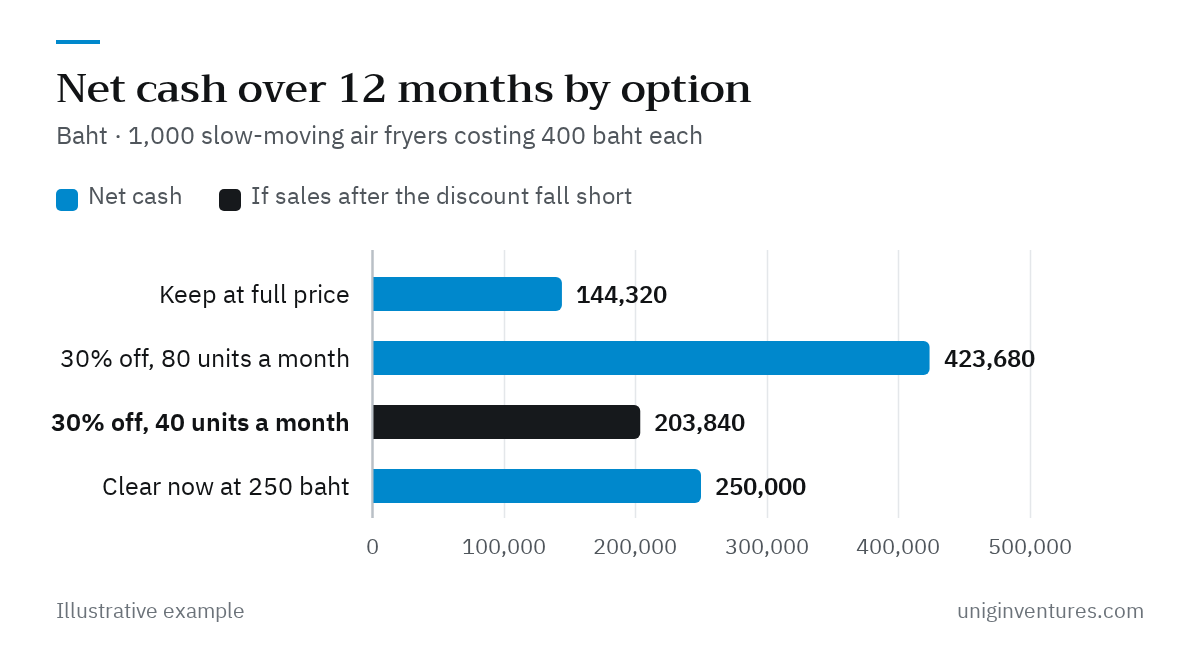
| Net cash | 144,320 | 423,680 | 250,000 |
Average units held are (1,000 + 760) ÷ 2 = 880 when keeping at full price, and (1,000 + 40) ÷ 2 = 520 when discounting. Every option returns less than the 400,000 baht cost. Yet keeping the stock at full price, which looks like no loss because each sale is above cost, returns the least cash: it sells few units, pays to store them for a long time, and ends up selling most of them at the bulk price after the product is outdated.
The best option depends on sales after the discount
The 80 units a month is only a forecast. If the discount lifts sales to just 40 units a month, sales bring in 480 × 490 = 235,200 baht, the bulk sale of the remaining units brings in 520 × 80 = 41,600 baht, and carrying costs are 760 × 8 × 12 = 72,960 baht. Net cash is 203,840 baht, less than clearing the stock now.
You can find the point where the two options return the same cash. Let q be the units sold per month after the discount.
Net cash from discounting = 490 × 12q + 80 × (1,000 − 12q) − 8 × 12 × (2,000 − 12q) ÷ 2 = 5,496q − 16,000
Setting this equal to the 250,000 baht from clearing gives q of about 48.4 units. The discount beats clearing only if it sells at least 49 units a month, about 2.5 times the old sales rate. Before deciding, test the discount for one to two weeks and compare actual sales with this point instead of guessing.
One thing the table leaves out is timing. Clearing brings in 250,000 baht today, while the discount brings cash in over the year. If the business is short of cash or carries expensive debt, money that arrives sooner is worth more than the table shows. For the effect on working capital, see The Cash Conversion Cycle.
Other options worth comparing
- Bundle it with best-sellers. You get a better price per unit than a bulk sale, provided the best-seller's contribution margin can absorb the discount. See Contribution Margin by Product.
- Return or exchange it with the supplier. If the purchase contract allows returns, or the supplier will swap it for a model that sells, you may come out ahead even after a fee.
- Sell through another channel. Corporate buyers or markets that still want this model can be compared in the same table.
Accounting and tax when you sell below cost or destroy goods
Accounting: write the stock down when it will sell below cost
The Thai Financial Reporting Standard for Non-Publicly Accountable Entities (TFRS for NPAEs), issued by the Federation of Accounting Professions, requires inventory to be measured at the lower of cost and net realizable value. Net realizable value is the estimated selling price in the ordinary course of business less the estimated costs to complete and sell. If goods are damaged or obsolete, or selling prices fall, the cost may not be recoverable in full.
In the example, if the owner decides to clear the stock at 250 baht a unit, net realizable value is 150 baht a unit below cost, so the financial statements must recognize a 150,000 baht write-down loss in that period. The entry does not touch cash. It makes the statements reflect what the stock is really worth. For more on the calculation, see Inventory Accounting: FIFO, Weighted Average and Stock Counts.
Tax: market price and reasonable cause
- Valuing closing inventory. Section 65 bis (6) of the Revenue Code requires closing inventory on the last day of the accounting period to be valued at cost or market price, whichever is lower.
- Selling below market price. If goods are sold below market price without reasonable cause, the assessment officer may assess income at market price under Section 65 bis (4), and the VAT base becomes the market price under Section 79/3 (1).
- Evidence of reasonable cause. In ruling Kor Kor 0811(Kor Mor)/134, dated January 29, 1999, the Revenue Department answered a manufacturer that planned to sell near-expiry, expired and substandard goods below cost. It said that if the goods are inspected under the company's own criteria, approved by an authorized person, and the sale is observed and signed off by witnesses from the warehouse and accounting departments, the sale counts as below market price with reasonable cause. A ruling answers one specific case, but it shows what evidence to keep.
- Destroying goods. Revenue Department Order Por. 79/2541, as amended by Por. 84/2542, sets out the practice: approval by an authorized person; witnesses from the warehouse, accounting, sales or audit departments who observe and sign; the auditor invited as a witness; and, for goods that can be stored and destroyed together, notice to the area or provincial revenue office 30 days before the destruction date.
In short, when you decide to sell below cost, document the reason, the condition of the goods, the price received and who approved it before the sale takes place. Tax positions differ by business, so talk to your auditor or tax adviser before writing down or destroying a large amount of stock.
Where to start
- Pull an item-level inventory report, calculate months of stock on hand, and sort from highest to lowest.
- Estimate the carrying cost in baht per unit per month and the date each product will become outdated or expire.
- Get quotes from at least two bulk buyers so you know what clearing the stock today is worth.
- Build a table comparing the net cash of each option, leaving out what you already paid, and find the minimum sales that make a discount worthwhile.
- Test the discount for a short period, check actual sales, and pick the option that brings back the most cash.
- Record the write-down, keep the approval and witness records the Revenue Department guidance describes, and adjust reorder points so the same product does not pile up again.
The store, products and figures in this article are illustrative examples to explain the reasoning.
Sources
- 10.1 Identify Relevant Information for Decision-Making — OpenStax, Principles of Managerial Accounting
- 19.5 Inventory Management — OpenStax, Principles of Finance
- TFRS for NPAEs (revised 2022), in Thai — Federation of Accounting Professions
- Revenue Code, Sections 65–76 (Section 65 bis (4) and (6)), in Thai — Revenue Department
- Revenue Code, Sections 77–79 (Section 79/3 (1)), in Thai — Revenue Department
- Ruling Kor Kor 0811(Kor Mor)/134 on selling goods below cost, in Thai — Revenue Department
- Revenue Department Order Por. 79/2541 on destroying waste and deteriorated goods, in Thai — Revenue Department
- Revenue Department Order Por. 84/2542 amending Order Por. 79/2541, in Thai — Revenue Department