
Capacity and Bottlenecks: How Much More Work Can You Take On
Measure the capacity of each step, find the bottleneck, calculate the extra work you can accept, rank jobs by profit per bottleneck hour, and expand capacity with the five focusing steps.

In this article
Sales has landed a new customer who will order another 800 units a day. The first question for the owner is not price but whether the plant can make them. Many companies answer from gut feel, or by looking at their biggest machine, and only later find work piling up at one step, deliveries slipping, overtime bills rising and existing customers complaining.
This article shows how to measure the capacity of each step, find the bottleneck, calculate how much more work you can take, choose the most profitable work when capacity is tight, and expand the bottleneck in an order that does not waste money. The example is a factory, but the same method works for services, such as the hours of an engineer who must review every job.
What a bottleneck is
The OpenStax textbook Principles of Managerial Accounting defines a constraint as a scarce resource that limits the output or productive capacity of the organization, and says that when the constraint slows production, it is called a bottleneck. The book compares it to a chain that is only as strong as its weakest link.
The Theory of Constraints Institute adds that the output of the constraint governs the output of the organization as a whole, and that strengthening any link other than the weakest is a waste of time and energy. In other words, a faster printer does nothing if work is stuck at the cutter.
Measure the capacity of each step
The capacity you can plan with is what a step actually produces, not the number on the machine's nameplate.
Daily capacity = (hours open − setup and changeover time) × actual output per hour
Illustrative example: a carton plant has four steps and runs 8 hours a day. Customers currently order an average of 3,000 units a day. The die-cutter (the machine that cuts and creases each carton) runs at 500 units an hour, but loses a total of 1.6 hours a day to setup and die changes, leaving 6.4 hours of cutting. Its capacity is 6.4 × 500 = 3,200 units a day.
| Step | Capacity (units a day) | Current load (units a day) | Utilization |
|---|---|---|---|
| Prepress and dies | 6,000 | 3,000 | 50% |
| Printing | 5,000 | 3,000 | 60% |
| Die-cutting | 3,200 | 3,000 | 94% |
| Folding, gluing and packing | 4,500 | 3,000 | 67% |
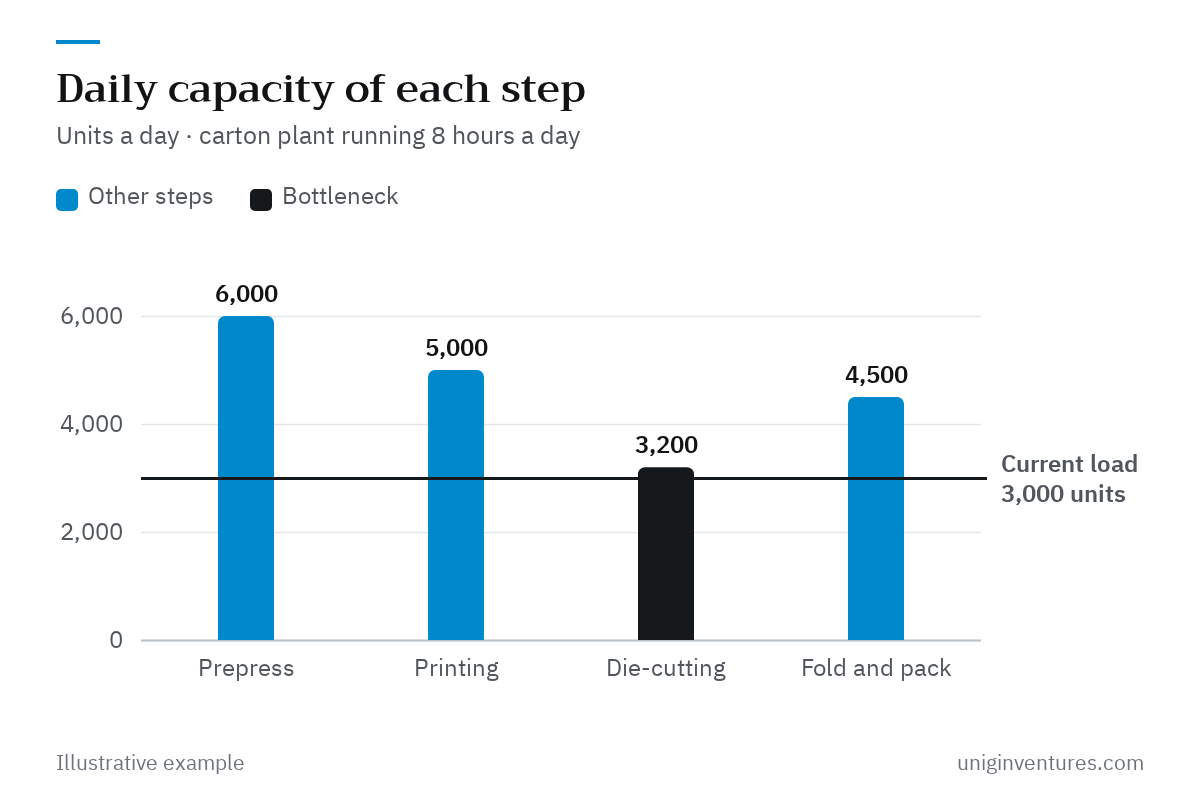
There are two ways to find the bottleneck in a real plant, and they work well together. One is the calculation in the table. The other is walking the floor to see where work piles up waiting. If the two point to different places, recheck the setup times and actual speeds.
How much more work can you take
Extra work you can take = bottleneck capacity − current load = 3,200 − 3,000 = 200 units a day
The printer has 2,000 units a day to spare, but that figure means nothing, because every unit must pass through the die-cutter. Without changes, a new order of 800 units a day cannot be accepted. Also note that a bottleneck running near 100% has no room for variation. On a day when the machine breaks down or a rush job arrives, work starts piling up at once.
When capacity is tight, choose work by profit per bottleneck hour
OpenStax says that when resources are constrained, products or services should be ranked by unit contribution margin divided by the use of the constrained resource, not by unit contribution margin alone. For how to calculate contribution margin, see Contribution Margin by Product.
| Product | Contribution margin per unit (baht) | Die-cutting speed (units an hour) | Contribution per die-cutting hour (baht) |
|---|---|---|---|
| Carton A, standard shape | 4 | 500 | 2,000 |
| Carton B, special shape | 6 | 250 | 1,500 |
Carton B earns more per unit but takes twice as long on the die-cutter, so each bottleneck hour earns less than with Carton A. If you have to choose how to fill the remaining die-cutting hours, Carton A produces more total profit. To keep taking Carton B, the price must yield at least 2,000 baht an hour, which means a contribution margin of 8 baht a unit. This rule applies only when the bottleneck is truly full. While there is spare capacity, any work with a positive contribution margin adds to profit.
Expand the bottleneck in order: the five focusing steps
The Theory of Constraints Institute sets out a process of ongoing improvement in five steps: identify the constraint, exploit it, subordinate everything else to it, elevate it, and prevent inertia from becoming the constraint by returning to step one each time an expansion is done. The order matters, because the first two steps need almost no investment.
- Exploit the bottleneck. Cut setup time, sequence jobs to reduce die changes, and stagger lunch breaks so the machine keeps running.
- Subordinate the other steps. Inspect quality before the bottleneck so its time is not wasted on units that will be scrapped anyway. OpenStax also notes that minimizing defects and rework keeps production from slowing. Do not release work into the plant faster than the bottleneck can take it.
- Elevate the bottleneck. OpenStax lists options such as extending operating hours, which may cost overtime, moving workers to the bottleneck, hiring more staff, outsourcing some of the work, or redesigning the process. Buying a new machine belongs in this step and should go through the analysis in Payback, NPV and IRR first.
Continuing the example, taking the new 800-unit order brings the load to 3,800 units a day.
| Step | Action | Die-cutting capacity (units a day) | Still short (units a day) |
|---|---|---|---|
| Today | 1.6 hours of setup a day | 3,200 | 600 |
| Exploit | Cut setup to 0.8 hours, 7.2 hours of cutting | 3,600 | 200 |
| Elevate | 0.4 hours of overtime a day | 3,800 | 0 |
Once die-cutting can handle 3,800 units, go back to step one. Folding, gluing and packing, with a capacity of 4,500 units, will now run at 84%. If sales keep growing past 4,500 units a day, the bottleneck moves there. Build overtime and other added costs into the price you quote the new customer. If the expansion plan needs new hires, see When to Hire.
Where to start
- List the main steps every job goes through, then record actual times for one to two weeks, including run time, setup time and downtime.
- Calculate the daily capacity of each step, compare it with the current load, find the step with the highest utilization, and walk the floor to see where work waits.
- Before accepting a large order, calculate the extra work you can take from the bottleneck's capacity, not from your biggest machine.
- Calculate the contribution per bottleneck hour of your main products, and use it for pricing and job sequencing when the bottleneck is full.
- Expand the bottleneck in order: exploit it first, adjust the other steps, then invest, and look for the new bottleneck after every expansion.
The plant, products and figures in this article are illustrative examples to explain the reasoning.