Selling Through Distributors: Dealer Margins, Discounts and Target Rebates
A 30% plus 15% discount is not 45%. Work back from the shelf price, keep margin and markup apart, design rebates that do not invite year-end stock loading, and track real sell-through.
In this article
Distributors take your product to stores and provinces your own sales team cannot reach. Every layer of the channel needs its own gross margin, though. If you set your wholesale price without working back from the shelf price, you can sell more units and keep less profit than you planned, or end up with dealers who have no reason to push your product.
This article covers the difference between distributors, sales agents and consignment, how to work out dealer prices from the retail price, how to design discounts and target rebates that do not invite year-end stock loading, how to track what dealers actually sell, and which contract terms to spell out.
Distributor, sales agent or consignment
People say "agent" for several different arrangements, and each one changes pricing, risk and how you record revenue. Agree on which one you are entering before you negotiate numbers.
| Question | Distributor / dealer | Sales agent | Consignment |
|---|---|---|---|
| Who owns the goods | The distributor, after buying them | You; the agent finds buyers | You, until the goods sell |
| Who sets the resale price | The distributor; you can only recommend | You | As agreed |
| Who carries end-customer bad debt | The distributor | You | As agreed |
| What the intermediary earns | The spread between buy and sell price | A commission | A share or fee per unit sold |
| Your main risk | The distributor's own debt, and unsold stock it asks to return | End-customer debt | Stock that sits, gets damaged or fails to count out |
This article focuses on the first model: a distributor that buys outright and resells. If you use consignment or a sales agent, ask your accountant when to record revenue and issue tax documents, because the goods have not left your company on the day you ship them.
Work back from the shelf price
Start with the price the final buyer pays, then take off the gross margin each layer needs, one layer at a time.
Channel buy price = channel sell price × (1 − the gross margin that layer needs)
Illustrative example: a maker of cleaning liquid sets a recommended retail price of 200 baht per bottle (all figures before VAT). Retailers want a 30% gross margin on their selling price, the distributor wants 15% of the price it charges retailers, and each bottle costs 70 baht to make.
| Layer | Sell price | Gross margin | Buy price | Profit per bottle |
|---|---|---|---|---|
| Retailer | 200 | 30% | 140 | 60 |
| Distributor | 140 | 15% | 119 | 21 |
| Manufacturer | 119 | 41.2% | 70 (production cost) | 49 |
The manufacturer receives 119 baht of the 200 baht shelf price, or 59.5%. The two channel layers keep 81 baht between them. Note that "30% plus 15%" is not a 45% discount, because the second discount applies to the already reduced price: 200 × 0.70 × 0.85 = 119 baht, which is 40.5% off retail.
Margin and markup are different numbers
A retailer that asks for 30% usually means 30% of its selling price. If the manufacturer reads that as a 30% markup on the 140 baht wholesale price, it will print a recommended price of 182 baht, and the retailer will earn only 42 ÷ 182 = 23.1%. The retailer will then ignore the recommended price or decline to stock the product.
Markup on cost = gross margin ÷ (1 − gross margin) · a 30% margin = a 42.9% markup · a 15% margin = a 17.6% markup
If 49 baht per bottle does not cover marketing, freight and dealer support, the fix is a higher retail price, a lower cost or one fewer layer in the channel. Squeezing channel margins until nobody wants to sell your product is not a fix. For pricing from customer value, see Value-Based Pricing for SMEs.
Three kinds of dealer discount
Give each discount its own purpose. If everything is lumped into one "special discount," you cannot tell what you are paying for.
- Trade discount is the spread in the table above. It pays the dealer to hold stock, deliver and extend credit to stores. Keep it equal for every dealer at the same level.
- Cash discount pays for faster collection.
- Target rebate pays when a dealer reaches an agreed volume within a set period.
Cash discounts cost more than they look. "2% off if paid within 10 days, otherwise full payment in 30 days" means you give up 2% to get your money 20 days sooner.
Annual cost of a cash discount = discount ÷ (1 − discount) × 365 ÷ days paid early = 2 ÷ 98 × 365 ÷ 20 = 37.2% a year
Compare that with your own cost of borrowing before you offer it. If the real problem is dealers paying late, tighter credit limits and collection follow-up may work better. See Aged Receivables and Bad Debts.
On VAT, Section 79 (1) of the Revenue Code excludes from the tax base a discount that a VAT-registered business grants at the time of sale and deducts from the price, shown clearly on the tax invoice. Discounts granted later, such as a year-end rebate or sales support payments, are handled differently depending on how the agreement and documents are set up. Have your accounting firm review the draft terms before you sign.
Tiered rebates: watch for the cliff at each target
A common design pays a percentage of the whole year's purchases once a tier is reached. Illustrative example: the same manufacturer pays its distributor 2% of all purchases once it buys 1,000,000 baht in the year, and 3% of all purchases once it reaches 2,000,000 baht.
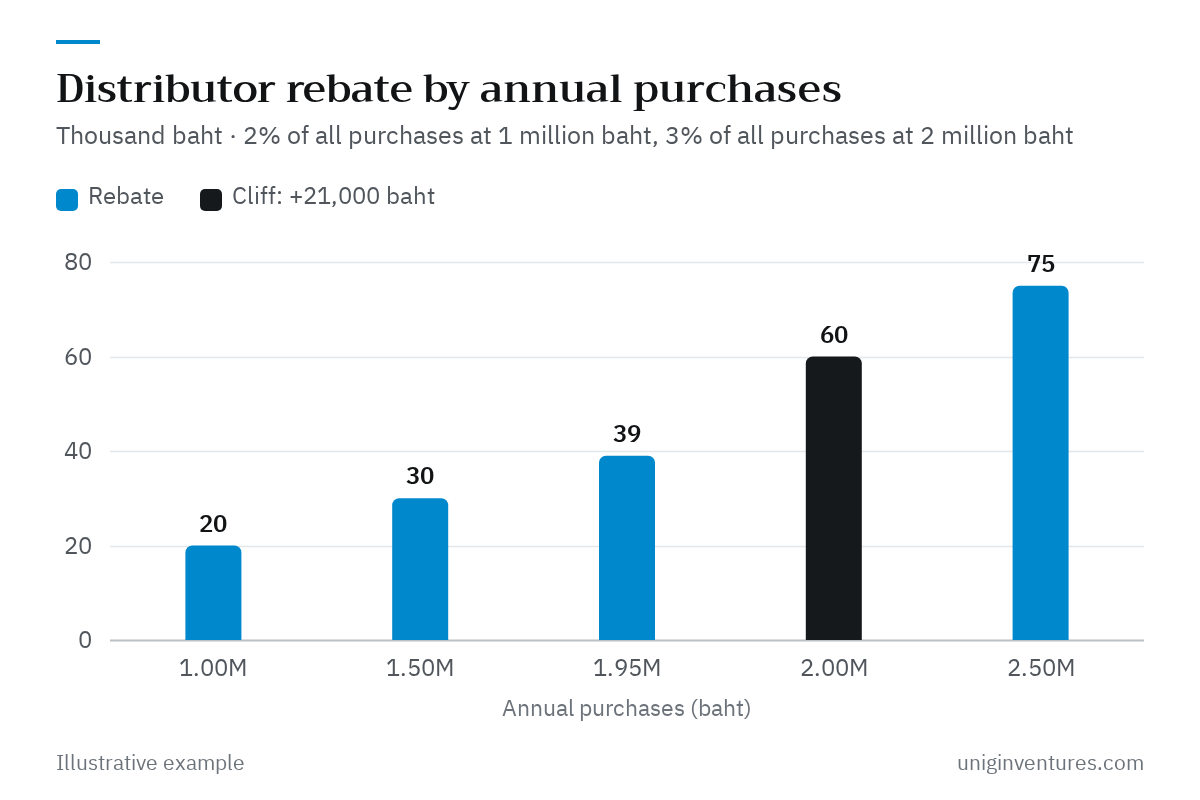
An extra 21,000 baht of rebate on 50,000 baht of purchases is a 42% discount on that lot. A distributor close to the line in the last month will order more even if it cannot sell it. The manufacturer fares worse. Its gross margin is 41.2% of sales, so the 50,000 baht order brings about 20,588 baht of gross profit, less than the 21,000 baht of extra rebate. The company loses money on that lot, and the stock then sits in the distributor's warehouse and depresses orders early the next year.
The fix is to pay the rebate only on purchases above each tier (incremental tiers). Illustrative example: 4% on the portion of purchases between 1,000,000 and 2,000,000 baht, and 6% on the portion above 2,000,000 baht.
| Annual purchases | On all purchases (2% / 3%) | On the portion above each tier (4% / 6%) |
|---|---|---|
| 1,000,000 | 20,000 | 0 |
| 1,500,000 | 30,000 | 20,000 |
| 1,950,000 | 39,000 | 38,000 |
| 2,000,000 | 60,000 | 40,000 |
| 2,500,000 | 75,000 | 70,000 |
The second design pays only 2,000 baht more, or 4%, between 1,950,000 and 2,000,000 baht, so there is no point where loading stock pays off, and it still rewards real growth. At 2,500,000 baht it pays 2.8% of purchases in total, close to the 3.0% of the first design.
Pair any rebate with conditions: count only purchases paid on time, net of returns, and pay after the period closes. If you can get sell-out data from dealers, tie part of the rebate to that instead of to orders.
Track what dealers sell out, not only what you sell in
What you sell to dealers (sell-in) is your revenue. Real market demand is what dealers sell on to stores or users (sell-through). If sell-in grows and sell-through does not, stock is piling up in the channel and orders will drop soon.
Ask dealers for a monthly report of sell-out and stock on hand, in exchange for something such as the part of the rebate tied to reporting. Then watch this number.
Channel stock (weeks) = units the dealer holds ÷ average weekly sell-out
Illustrative example: a distributor holds 3,000 bottles and sells an average of 250 a week, which is 12 weeks of stock. The right level depends on your delivery time and order cycle. If you can deliver within a week, 12 weeks is far more than the dealer needs and a sign not to push more sell-in that month. For reorder points, see ABC Inventory and Reorder Points.
Contract terms to spell out
- Territory and customer groups: which area the dealer covers, and who handles key accounts and online channels.
- Exclusivity: if you grant it, attach a minimum target and say how exclusivity ends if the dealer misses it.
- Prices and price changes: how many days' notice, and whether new prices apply to orders already placed.
- Credit terms and limits: the limit per dealer, and what happens when a dealer exceeds it or pays late.
- Returns: damaged goods only, or slow stock too, and at what fee.
- Dealer reporting: sell-out, stock on hand and due dates.
- Termination: notice period and how remaining stock is handled.
If you plan to dictate dealers' resale prices, bar sales outside a territory or bar competing products, have a lawyer review it first. Section 57 of Thailand's Trade Competition Act B.E. 2560 (2017) prohibits a business with market power or superior bargaining power from unfair trade practices that cause damage to other businesses, including unfairly restrictive or exclusionary trade conditions. The Trade Competition Commission has also issued guidelines on unfair trade practices between wholesalers and retailers and manufacturers or distributors (2019). A price printed as a "recommended price" can guide the market, but have a qualified advisor check how binding your contract wording is.
Where to start
- Write down your target retail price, then work back through the margin each layer needs until you reach your own selling price.
- Compare what is left with production cost, freight and sales support. If it is not enough, fix price or cost before opening the channel.
- Split discounts into three parts: trade discount, cash discount and rebate. Work out the annual cost of the cash discount.
- Design rebates on the portion above each tier, then check purchase levels just below and just above every target.
- Ask for monthly sell-out and stock reports, and track channel stock in weeks.
- Draft a contract that covers territory, exclusivity, credit, returns and termination, and have a lawyer and your accounting firm review it before signing.
If your own sales team earns commission on sales to dealers, see how to link commission to profit in Sales Commission on Gross Profit, Not Revenue.
The companies, prices and figures in this article are illustrative examples to show the calculations.
Sources
- Revenue Code Sections 77–79 (Section 79 (1), discounts granted at the time of sale and shown on the tax invoice) — Revenue Department of Thailand
- Section 57 unfair trade practices and related guidelines (including the 2019 guideline on wholesalers and retailers and manufacturers or distributors) — Office of the Trade Competition Commission