Customer Profitability: Find Out Which Customers Really Make You Money
Your biggest customer may not be your most profitable. How to measure cost to serve with the time your team actually spends, three customers whose results differ from their sales, and what to fix first.
In this article
Your biggest customer is not necessarily your most profitable one. A report of sales and gross profit by customer tells only half the story. The other half is what it costs to look after each customer: frequent deliveries, small orders, returns, year-end rebates, slow payment. None of these sit in cost of goods sold, so they stay invisible on the income statement.
This article shows how to calculate customer profitability in a way a small team can manage in a spreadsheet, using only the time your team spends on each task and what the team costs. It ends with three customers whose results look very different from what their sales suggest.
Gross profit is not customer profit
Gross profit is sales minus the cost of the goods sold. Two customers buying the same products can earn the same gross profit and still have very different costs to serve. Count these items:
- Discounts and rebates outside the price, such as year-end volume rebates, listing fees or free goods.
- Taking and entering orders. A customer who orders several times a week uses more sales and accounting time than one who orders monthly.
- Picking and delivery, both warehouse time and the cost of each trip.
- Invoicing and collection. More invoices mean more reconciling and more follow-up calls.
- Returns and rework: inspecting goods, issuing credit notes and shipping again.
- The cost of credit terms. A receivable that sits unpaid is capital the company must fund from elsewhere, at the cost of interest or the return its owners expect.
Most of these costs sit inside selling and administrative expenses, which the financial statements show as a single block. You have to work out yourself which customer used which part of that block.
Assign costs by time: a short version of time-driven ABC
Traditional activity-based costing asks employees what percentage of their time goes to each activity, which is slow to do and hard to update. In the November 2004 issue of Harvard Business Review, Robert S. Kaplan and Steven R. Anderson proposed a simpler method called time-driven ABC. It needs only two numbers:
- The cost per minute of a team: the team's expenses divided by the working time it can actually use.
- The time one task takes: how many minutes it takes to enter one order, for example. Ask supervisors to estimate it, or time the work for a week.
Cost per minute = team expenses per month ÷ usable working minutes per month
Cost of an activity = cost per minute × minutes per task × number of times for that customer
Usable time is not the full working day. Take out meetings, training and breaks. If you use the full day, the cost per minute will come out too low.
Illustrative example: cost per minute and per task
A distribution company has five people across sales support, the warehouse and receivables. The team costs 288,000 baht a month and works 20 days a month, with 6 usable hours a day.
Usable minutes = 5 people × 20 days × 6 hours × 60 minutes = 36,000 minutes
Cost per minute = 288,000 ÷ 36,000 = 8 baht
| Task | Minutes per task | Outside cost | Cost per task |
|---|---|---|---|
| Take and enter an order | 15 | — | 120 baht |
| Pick and deliver | 30 | Freight 600 baht per trip | 840 baht |
| Invoice and collect | 20 | — | 160 baht |
| Handle a return | 60 | — | 480 baht |
The cost of credit terms is based on the average receivable balance. This example uses a cost of capital of 6% a year, or 0.5% a month (how to arrive at that figure is covered in our article on the cost of capital).
Worked example: three customers in one month
Illustrative example: three customers of the same company over one month.
- Customer A, a large retailer: sales 1,200,000 baht at a 20% gross margin, a 3% volume rebate, 40 orders and deliveries, 10 returns, 90-day credit.
- Customer B, a wholesaler: sales 600,000 baht at a 25% gross margin, no extra rebate, 8 orders and deliveries, 1 return, 30-day credit.
- Customer C, a small online shop: sales 150,000 baht at a 30% gross margin, 40 orders and deliveries, 2 returns, 30-day credit.
| Item | Customer A | Customer B | Customer C |
|---|---|---|---|
| Sales | 1,200,000 | 600,000 | 150,000 |
| Gross profit | 240,000 | 150,000 | 45,000 |
| Volume rebate | −36,000 | 0 | 0 |
| Order entry | −4,800 | −960 | −4,800 |
| Picking and delivery | −33,600 | −6,720 | −33,600 |
| Invoicing and collection | −6,400 | −1,280 | −6,400 |
| Returns | −4,800 | −480 | −960 |
| Cost of credit terms | −18,000 | −3,000 | −750 |
| Total cost to serve | −103,600 | −12,440 | −46,510 |
| Customer profit | 136,400 | 137,560 | −1,510 |
| Profit as % of sales | 11.4% | 22.9% | −1.0% |
The credit cost follows the receivable balance. Customer A, on 90-day terms, owes about three months of sales at any time: 3,600,000 baht × 0.5% = 18,000 baht. Customers B and C owe about one month.
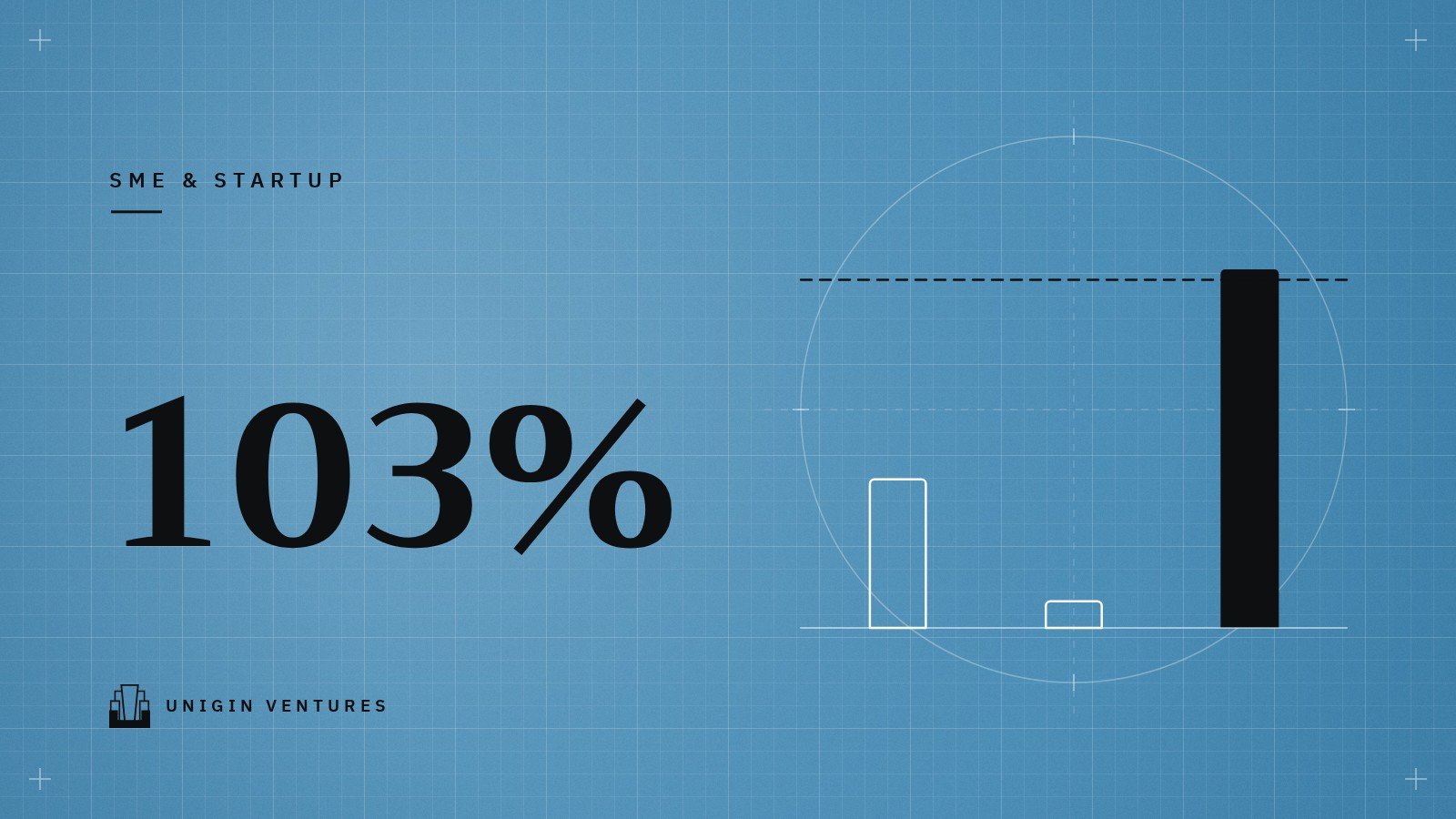
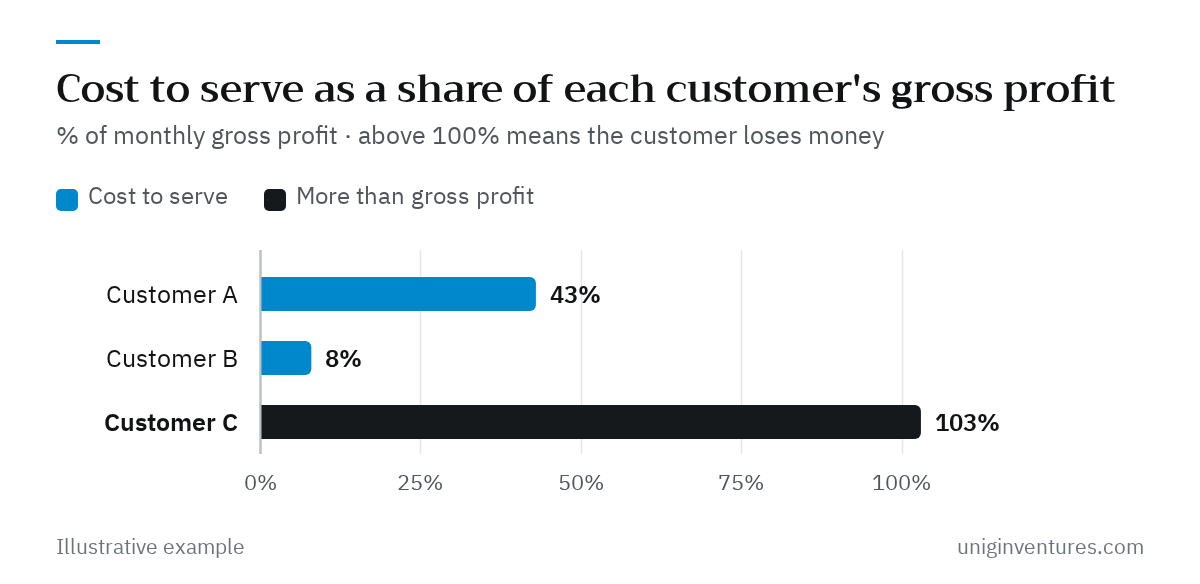
Three results differ from what sales alone suggest. Customer A buys twice as much as Customer B but earns about the same profit. Customer B earns the highest profit per baht of sales because it orders rarely and pays quickly. Customer C has the highest gross margin of the three, yet its cost to serve consumes all of its gross profit. As a share of gross profit, the cost to serve is about 43% for Customer A, 8% for Customer B and 103% for Customer C.
What the numbers let you decide
The point is not to drop loss-making customers. It is to see what needs fixing. Most of the cost to serve comes from ordering habits and trading terms, and both can be negotiated.
- Set a minimum order or charge for delivery below a threshold. If Customer C combined its orders into 10 a month, the cost of order entry, delivery and invoicing would fall from 44,800 baht to 11,200 baht, and Customer C's profit would rise to 32,090 baht.
- Tie discounts to behavior that lowers cost, such as full-truck orders or early payment, instead of sales volume alone.
- Review credit terms. Customer A's 90-day terms cost 18,000 baht a month; at 60 days the cost would drop to 12,000 baht (see our article on aged receivables).
- Move small customers to a cheaper channel, such as online ordering or a distributor (see our article on selling through distributors).
- Raise prices when nothing else works. Customers who want special service should pay a price that reflects its cost (see our article on raising prices).
One caution: most team costs are fixed in the short run. If you stopped selling to Customer C tomorrow, salaries would stay the same. You would lose 45,000 baht of gross profit and save only the freight, 40 trips × 600 baht = 24,000 baht, so company profit would fall by about 21,000 baht a month. Freed-up time turns into money only when you use it for more profitable customers or actually reduce the team.
Where to start
- Pick your top 10 to 20 customers by sales, plus one group of small customers. You do not need every customer at first.
- Pull the last three months of data: sales, gross profit, number of orders, delivery trips, invoices, returns, off-invoice discounts and receivable ageing. If one customer has several codes in your system, its figures are split and look smaller than they are; the Chawinnix team explains how to merge duplicate customer codes in an ERP without losing the history.
- Calculate the cost per minute of each team, then ask supervisors how many minutes each task takes.
- Build a table like the one above, sort customers from most to least profitable, and look for any with unusually low profit per baht of sales.
- Pick two or three of the largest cost items, such as delivery trips or credit terms, and discuss them with the customer, numbers in hand.
- Repeat every quarter to see whether the changes worked.
If a few large customers account for most of your sales, these numbers also help you judge the risk of depending on one of them (see our article on customer concentration).