Buying a Franchise: Work Out Payback and Minimum Sales First
The entry fee is only part of the investment. Add up the full cash outlay, deduct royalties and the owner's pay, compare payback with the contract term, and find the daily sales you need.
In this article
- A franchisee pays in three layers
- Step 1: Add up everything you spend before opening
- Step 2: Monthly cash profit, after paying the owner
- Step 3: Payback, measured against the contract term
- Step 4: The minimum sales the outlet must reach
- What to request before you sign
- Accounting and tax: the entry fee is not a first-year expense
- Where to start
The first two numbers most prospective franchise buyers look for are the entry fee and the payback period. Both sound precise, yet neither answers the question a buyer actually needs answered. The cash needed before opening day is several times the entry fee, the monthly fees are charged on sales rather than profit, and the payback period you were told may not yet deduct the pay of the person behind the counter, who is often the owner.
This article walks through four sets of numbers to have on paper before you transfer the entry fee: total investment, monthly cash profit, payback measured against the contract term, and the minimum sales the outlet must reach. It ends with the information to request from the franchisor, so the math rests on figures from real outlets rather than a brochure.
A franchisee pays in three layers
Thailand's Department of Business Development (DBD) groups the money a franchise investor pays the franchisor in a way that makes a useful frame for the calculation.
- Franchise fee, paid once for the right to use the brand's name, system and know-how.
- Royalty fee, a revenue share paid as a percentage of sales of goods or services.
- Marketing fee, usually a percentage of revenue that funds the brand's collective marketing.
- Other charges, such as training and services billed case by case.
On top of what goes to the franchisor, the buyer pays for things before the first sale: the fit-out the brand requires, equipment, the rental deposit and the first batch of stock. All of it together is the investment that has to pay back, not the entry fee alone.
Step 1: Add up everything you spend before opening
The numbers in this article are an illustrative example of a single beverage franchise outlet on a five-year (60-month) contract, renting space for 30,000 baht a month. All figures exclude VAT.
| Item | Amount |
|---|---|
| Franchise fee | 300,000 |
| Fit-out and equipment to brand standard | 650,000 |
| Rental deposit, 3 months | 90,000 |
| First stock of ingredients and packaging | 60,000 |
| Opening reserve (pre-opening costs and the first months before sales reach target) | 150,000 |
| Total investment | 1,250,000 |
Here the entry fee is only 24% of the cash required. The item most often left out of the math is the opening reserve, which covers the period when customers do not yet know the outlet and sales are below target, while rent, wages and royalties run from day one. The rental deposit comes back when the lease ends, but until then the money is locked up and cannot be used in the business.
Step 2: Monthly cash profit, after paying the owner
Split monthly costs into two groups: those that move with sales (variable costs) and those you pay regardless of sales (fixed costs). The illustrative outlet sells 300,000 baht a month.
| Item | Share of sales | Baht per month |
|---|---|---|
| Sales | 100% | 300,000 |
| Ingredients and packaging bought from the brand | 38% | −114,000 |
| Royalty fee | 5% | −15,000 |
| Marketing fee | 2% | −6,000 |
| Rent | Fixed | −30,000 |
| Three staff, including social security contributions | Fixed | −50,000 |
| Water, electricity and common fees | Fixed | −15,000 |
| Other (maintenance, payment fees) | Fixed | −10,000 |
| Pay for the owner working in the outlet | Fixed | −25,000 |
| Monthly cash profit | 35,000 |
Always ask whether a quoted payback figure includes the last cost line. If the owner stands behind the counter every day, that time has a price. Leave it out and profit looks like 60,000 baht, cutting the payback period almost in half, when in fact the owner is paying their own salary out of what they think is profit. Use the salary you would pay a store manager to do the same job.
Notice too that the royalty and marketing fees, 7% combined, are charged on sales, not profit. At 300,000 baht of sales the outlet pays 21,000 baht for these two items, equal to 60% of the cash profit that remains, and it still pays them in full in a month when it loses money.
Step 3: Payback, measured against the contract term
Payback (months) = total investment ÷ monthly cash profit
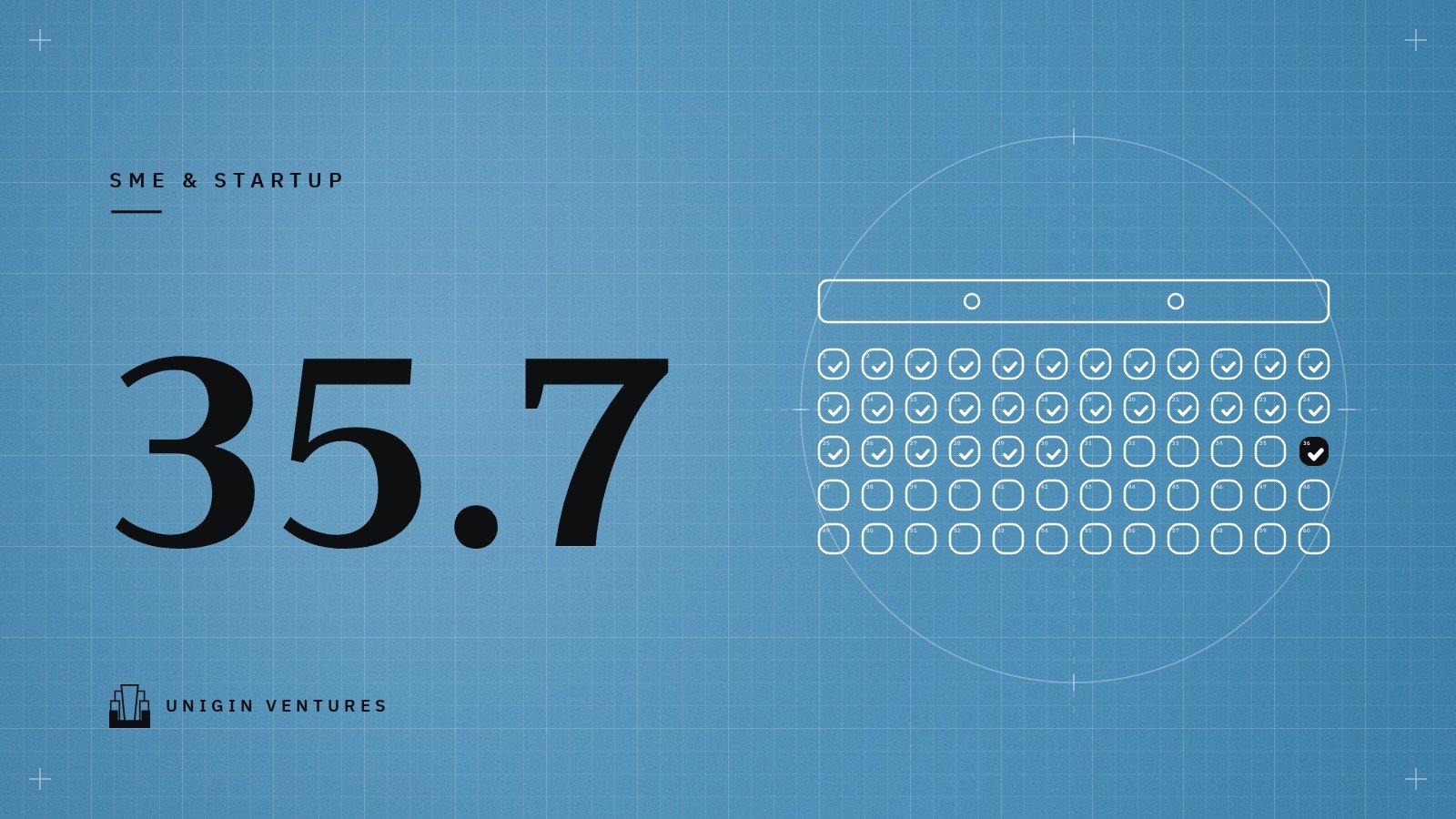
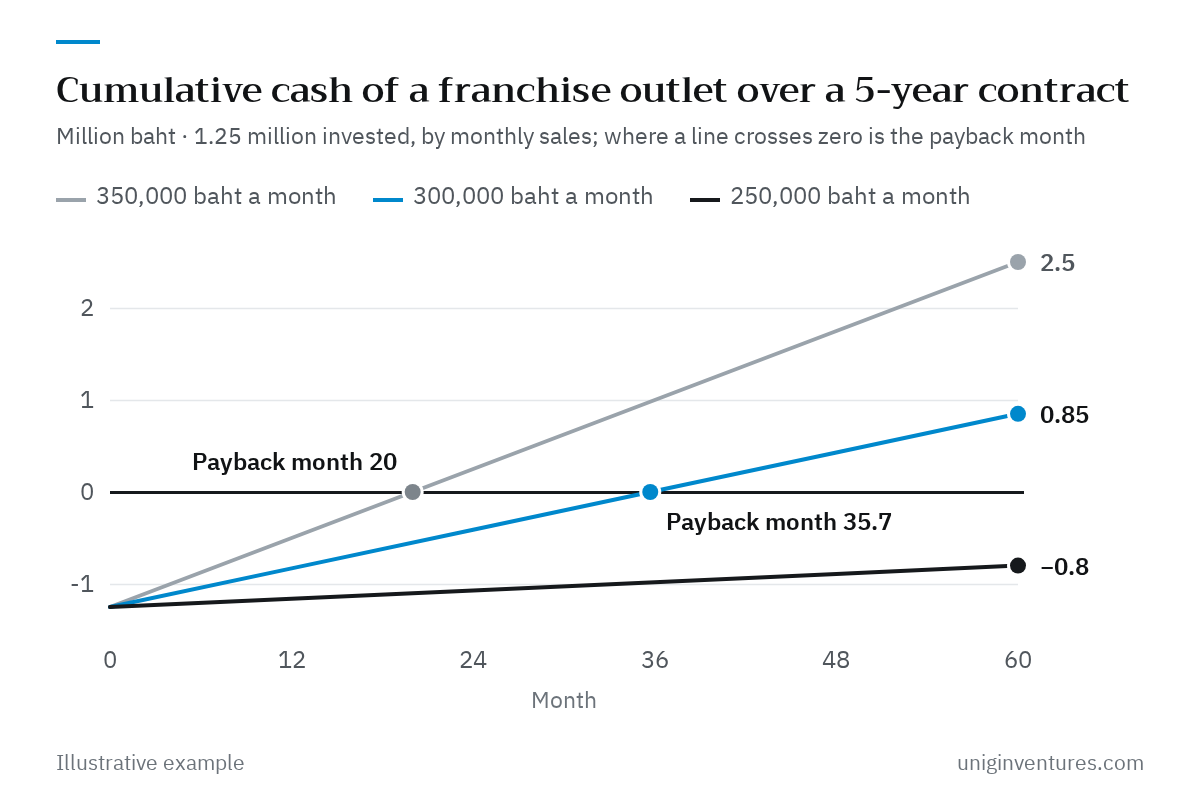
The illustrative outlet pays back in 1,250,000 ÷ 35,000 = 35.7 months, about three years of a five-year contract. Without the owner's pay it would be 1,250,000 ÷ 60,000 = 20.8 months: two very different answers for the same outlet.
The DBD's guidance on choosing a franchise suggests looking for a payback period no longer than half the contract term. The second half of the contract is when the buyer actually earns a return, and at renewal there may be a renewal fee or a refit to the brand's new design. The illustrative outlet would need to pay back within 30 months; at 35.7 months it does not meet this test.
The result is also very sensitive to sales, because fixed costs do not fall when sales do.
| Monthly sales | Monthly cash profit | Payback | Cumulative cash at contract end |
|---|---|---|---|
| 250,000 | 7,500 | 166.7 months (beyond the term) | −800,000 |
| 270,000 | 18,500 | 67.6 months (beyond the term) | −140,000 |
| 300,000 | 35,000 | 35.7 months | 850,000 |
| 350,000 | 62,500 | 20.0 months | 2,500,000 |
A 10% drop in sales, from 300,000 to 270,000 baht, cuts cash profit almost in half, from 35,000 to 18,500 baht, and the outlet no longer pays back within the contract. Cumulative cash in the table is 60 months of cash profit minus the investment; it does not count the returned rental deposit or whatever the equipment is still worth.
Step 4: The minimum sales the outlet must reach
Instead of asking how much the outlet will sell, turn the question around: what is the lowest level of sales at which the numbers work? Then check that against outlets already trading. The illustrative outlet's variable costs are 45% of sales (ingredients 38%, royalty 5%, marketing 2%), leaving a contribution margin of 55%. Fixed costs, including the owner's pay, are 130,000 baht a month.
Break-even sales = monthly fixed costs ÷ contribution margin
Sales to pay back on target = (monthly fixed costs + investment ÷ target months) ÷ contribution margin
- Break-even sales: 130,000 ÷ 55% = about 236,400 baht a month, or about 7,900 baht a day over 30 trading days.
- Sales to pay back in 30 months: (130,000 + 1,250,000 ÷ 30) ÷ 55% = (130,000 + 41,667) ÷ 55% = about 312,100 baht a month, or about 10,400 baht a day.
Converting this into cups or receipts per day makes it concrete. With an average receipt of 80 baht, 10,400 baht a day is about 130 receipts. Then stand outside an outlet in a similar location for one weekday and one weekend day and count customers. A number you counted yourself is more reliable than an average sales figure you were told.
What to request before you sign
The formulas are only as good as the numbers you put into them. The DBD advises visiting the outlets you are interested in, negotiating with the franchisor and studying the contract in detail before deciding. Ask for the following in writing.
- Every fee and how it is calculated. Are royalty and marketing fees charged on sales before or after discounts and delivery-app commissions? Is there a monthly minimum?
- Goods and equipment you must buy from the brand, with unit prices and the terms for changing them. In the example this is the largest single cost.
- Contract term, renewal fee and refit obligations. Must the outlet be refitted at renewal, and who pays?
- Territory protection. Can the brand open another outlet near yours, and within what radius?
- Termination. If you want to close because of losses, or the franchisor terminates, who owns the equipment and fit-out, and what penalties apply?
- Figures from real outlets. Ask for a list of existing franchisees and call them about the sales, costs and payback they actually experienced. Ask how many outlets have closed and why.
A franchise agreement binds you for years and is usually drafted by the franchisor. Have a lawyer read it before you sign, especially the termination and penalty clauses.
Accounting and tax: the entry fee is not a first-year expense
If you buy the franchise through a company, the entry fee is the cost of a right you can use for the term of the contract. The Royal Decree on depreciation and wear and tear of assets (No. 145) sets the rate for the cost of acquiring other rights with a limited period of use at 100% divided by the number of years of use. A 300,000-baht entry fee on a five-year contract is therefore deducted at 60,000 baht a year, and the fit-out and equipment are depreciated over their useful lives.
As a result, profit in the financial statements will be lower than the cash profit in the tables above, because amortization and depreciation are not cash payments. Measure payback with cash profit and plan tax with accounting profit. Have your accountant confirm the treatment against the actual contract before the first year-end close.
Where to start
- Get every cost line, both what you pay the brand and what you pay yourself before opening, then add an opening reserve.
- Build a monthly cash-profit table that deducts the owner's pay and charges royalty and marketing fees on sales.
- Calculate payback and compare it with half the contract term.
- Find the minimum daily sales, both break-even and on-target payback, and convert them into receipts.
- Check against real outlets. Count customers outside and speak to at least three existing franchisees.
- Cut sales by 10–20%. Only if the outlet still pays back before the contract ends is it worth moving on to the contract terms.
This article is general information, not investment, tax or legal advice for any particular business. The outlet, figures and fee rates are an illustrative example and do not come from any actual franchise. Government sources were checked in November 2026.