Building a Cash Flow Statement With the Indirect Method
A step-by-step guide to the indirect method using two balance sheets, a worked example where 1.2 million baht of profit added only 120,000 baht of cash, and how to read the result.
In this article
- What the cash flow statement shows that profit does not
- What you need before you start
- Illustrative example: profit grew, cash barely moved
- Step 1: Cash from operating activities
- Steps 2 and 3: Investing and financing activities
- Reading the result: how much profit turned into cash
- Common mistakes
- Where to start
Many owners look at an income statement that shows more than a million baht of profit, then at a bank balance that grew by a few hundred thousand, and nobody can say clearly where the rest went. The answer sits in the cash flow statement, which most Thai SMEs never prepare because the law does not require it.
This article shows how to build one with the indirect method, using only the two year-end balance sheets and the income statement you already have. It walks through a worked example step by step, shows how to reconcile the result to actual cash, and explains two measures you can read from it.
What the cash flow statement shows that profit does not
The income statement works on the accrual basis. Revenue counts when you deliver, even if the customer has not paid. Depreciation is an expense with no cash leaving. Cash spent on machinery or on repaying a loan does not appear in it at all (see accrual vs cash basis for the basics). The cash flow statement sorts the cash that actually moved into three groups, following the international standard IAS 7.
- Operating activities: cash from normal trading, such as collections from customers and payments to suppliers, staff and the tax office.
- Investing activities: buying and selling long-term assets such as machinery, vehicles and buildings.
- Financing activities: cash that changes borrowings or equity, such as new loans, repayments, capital increases and dividends.
There are two ways to present operating activities. The direct method lists each type of cash receipt and payment, which means extracting a full year of cash transactions. The indirect method starts from net profit and adjusts for non-cash items and changes in working capital. It needs nothing beyond statements you already have, which makes it the practical choice for an SME doing it in-house.
On the legal side, under the Department of Business Development notification on the abbreviated components of financial statements, a cash flow statement is optional for limited companies and registered partnerships, and required for public limited companies. Banks reviewing a loan and investors doing due diligence usually ask for these numbers anyway.
What you need before you start
- The statements of financial position (balance sheets) at two consecutive year-ends
- The income statement for the latest year
- The fixed asset register: additions, disposals, sale proceeds and book value of what was sold, and depreciation for the year
- Loan statements: new borrowing and principal repaid
- Dividend resolutions and any capital increase during the year
The last three matter because net balances hide the gross flows. A loan balance that rose by 600,000 baht might reflect 1,000,000 baht of new borrowing and 400,000 baht of repayments.
Illustrative example: profit grew, cash barely moved
A distributor had sales of 12 million baht in 2025 and 15 million baht in 2026. Net profit for 2026 was 1,200,000 baht. During the year it sold an old delivery truck with a book value of 150,000 baht for 200,000 baht, bought new machinery and vehicles, recorded 500,000 baht of depreciation, and paid a 300,000 baht dividend.
| Item | 2025 | 2026 | Change |
|---|---|---|---|
| Cash and bank deposits | 500,000 | 620,000 | 120,000 |
| Trade receivables | 1,800,000 | 2,600,000 | 800,000 |
| Inventory | 1,500,000 | 1,900,000 | 400,000 |
| Prepaid expenses | 100,000 | 120,000 | 20,000 |
| Property, plant and equipment (net) | 3,000,000 | 3,550,000 | 550,000 |
| Total assets | 6,900,000 | 8,790,000 | |
| Trade payables | 1,200,000 | 1,500,000 | 300,000 |
| Accrued expenses | 200,000 | 260,000 | 60,000 |
| Income tax payable | 150,000 | 180,000 | 30,000 |
| Long-term bank loan | 1,000,000 | 1,600,000 | 600,000 |
| Paid-up share capital | 2,000,000 | 2,000,000 | 0 |
| Retained earnings | 2,350,000 | 3,250,000 | 900,000 |
| Total liabilities and equity | 6,900,000 | 8,790,000 |
Retained earnings rose by 900,000 baht: net profit of 1,200,000 baht less the 300,000 baht dividend. Check this first every time. If it does not tie, some other item went through equity and you need to find it.
Step 1: Cash from operating activities
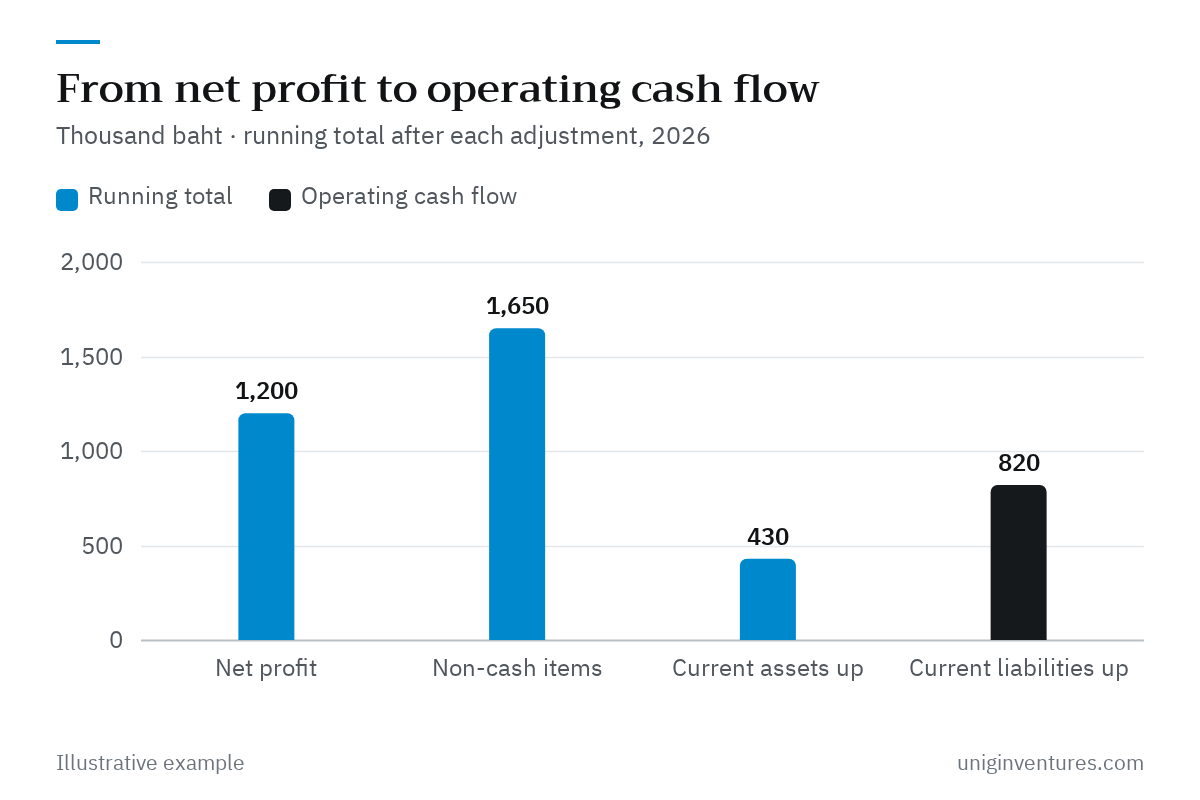
Start with net profit and make two sets of adjustments. The first removes items that sit in profit but involve no cash. The second captures changes in trading assets and liabilities. One rule covers them all.
A current asset that rises uses cash (subtract). A current liability that rises provides cash (add). Reverse the sign when either falls.
The logic: higher receivables are sales already counted in profit but not yet collected, and higher payables are costs already used but not yet paid.
| Item | Why | Amount |
|---|---|---|
| Net profit | From the income statement | 1,200,000 |
| Add depreciation | Expense with no cash out | 500,000 |
| Less gain on sale of truck | The full proceeds go to investing | −50,000 |
| Increase in trade receivables | Sold but not collected | −800,000 |
| Increase in inventory | Cash tied up in stock | −400,000 |
| Increase in prepaid expenses | Paid before use | −20,000 |
| Increase in trade payables | Bought but not paid | 300,000 |
| Increase in accrued expenses | Used but not paid | 60,000 |
| Increase in income tax payable | Tax expensed but not yet paid | 30,000 |
| Net cash from operating activities | 820,000 |
Steps 2 and 3: Investing and financing activities
Net fixed assets rose by 550,000 baht, but that is not what the company spent. Roll the opening balance forward to the closing balance first.
Opening 3,000,000 − depreciation 500,000 − book value of truck sold 150,000 + additions = closing 3,550,000
Additions = 1,200,000 baht
| Item | Amount |
|---|---|
| Purchase of machinery and vehicles | −1,200,000 |
| Proceeds from sale of old truck | 200,000 |
| Net cash used in investing activities | −1,000,000 |
| New long-term borrowing | 1,000,000 |
| Principal repaid | −400,000 |
| Dividend paid | −300,000 |
| Net cash from financing activities | 300,000 |
| Net increase in cash (820,000 − 1,000,000 + 300,000) | 120,000 |
| Cash at start of year | 500,000 |
| Cash at end of year | 620,000 |
The closing cash you calculate must match the balance sheet exactly. If it does not, something is missing or in the wrong group. Go through the balance sheet line by line and confirm every change has been used once.
Reading the result: how much profit turned into cash
Two measures are ready to use.
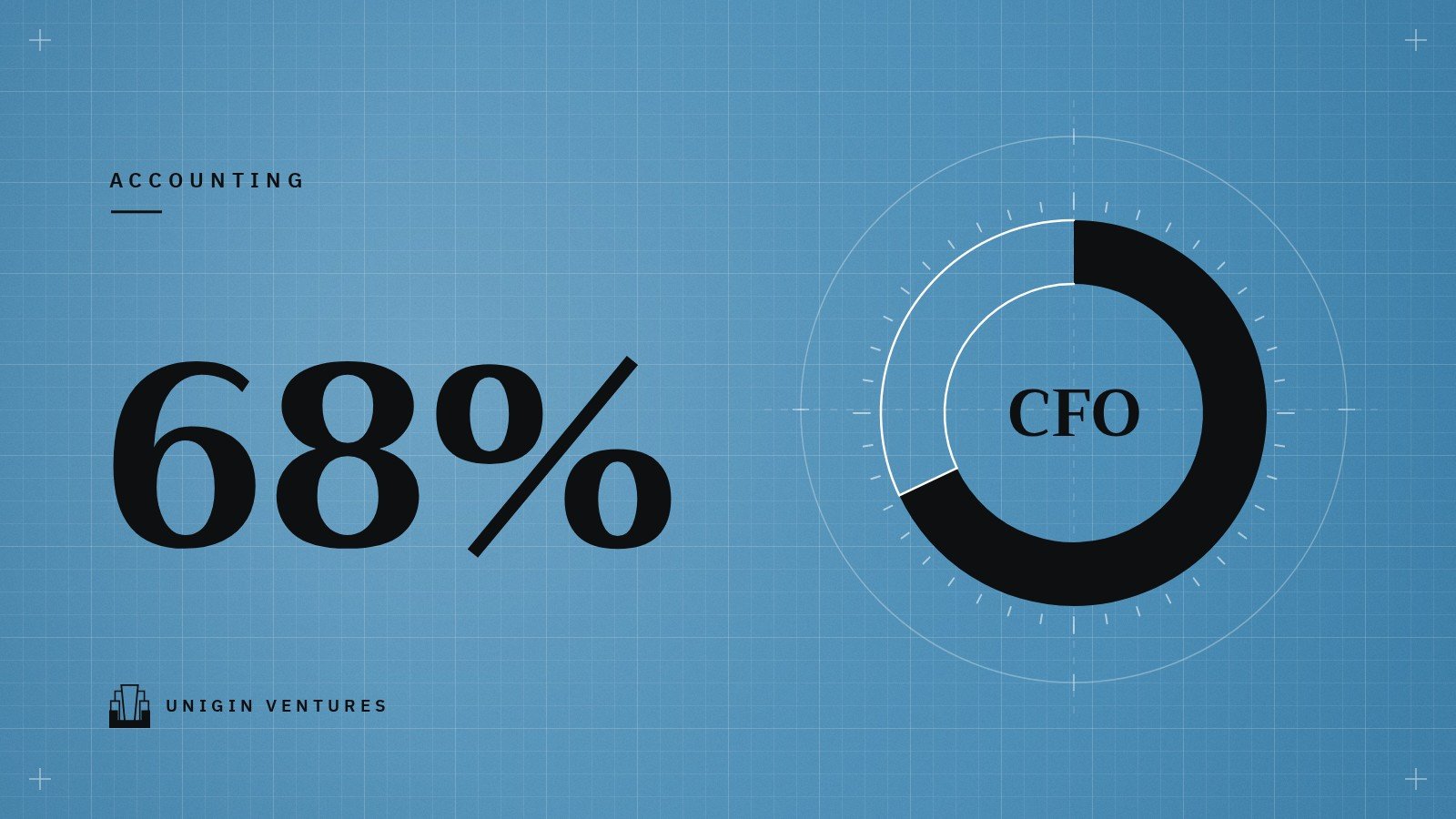
- Operating cash flow to net profit: 820,000 ÷ 1,200,000 = 68%. Every 100 baht of profit produced about 68 baht of cash. If this stays below 100% year after year, profit is piling up in receivables and stock.
- Free cash flow: in its simple form, operating cash flow less purchases of fixed assets: 820,000 − 1,200,000 = −380,000 baht. The company invested more than the business generated this year, and new borrowing covered the gap.
The numbers point at receivables first. Sales grew 25%, but receivables grew 44%. Days sales outstanding, measured on year-end balances, rose from about 55 days (1,800,000 ÷ 12,000,000 × 365) to about 63 days (2,600,000 ÷ 15,000,000 × 365). Had the company collected as fast as the year before, year-end receivables would have been 2,250,000 baht (15,000,000 × 1,800,000 ÷ 12,000,000) and cash 350,000 baht higher. To estimate the working capital that growth consumes, see working capital needed for sales growth, and for the full cycle, the cash conversion cycle.
Common mistakes
- Treating the net change in fixed assets as capital spending. In the example the net balance rose 550,000 baht, while the cash spent was 1,200,000 baht. Always roll forward through depreciation and disposals.
- Netting new loans against repayments. Show them on two lines so readers can see how much the company relies on borrowing.
- Forgetting to remove the gain on an asset sale. The full proceeds already sit in investing. Leave the gain in operating cash and you count it twice.
- Putting director loans in operating activities. Money a director lends to the company, or the company repays, is financing (see separating personal and company money).
- Skipping the cash reconciliation. A statement that does not land on the actual closing cash is not ready to support any decision.
Where to start
- Ask your bookkeeper for the fixed asset register, loan statements and dividend resolutions for the latest year.
- Lay out the two balance sheets as in the example, add a change column, and check the movement in retained earnings first.
- Build operating activities with the rule "assets up, subtract; liabilities up, add," then build investing and financing from the supporting documents.
- Reconcile to closing cash, then calculate operating cash flow to net profit and free cash flow.
- Repeat for the previous two or three years to see the trend, and use the results to set assumptions for a 13-week cash flow forecast.
The company and figures in this article are an illustrative example. Information checked as of November 2026. This article is general information, not accounting advice for any particular business.
Sources
- IAS 7 Statement of Cash Flows — IFRS Foundation
- FAQ for 2023 year-end Financial Statements under Revised TFRS for NPAEs (2022) and DBD Notification on Abbreviated Components — Forvis Mazars Thailand
- Key changes in financial statements and notes according to the TFRS for NPAEs (Revised 2022) and new DBD notification — Forvis Mazars Thailand