Accruals and Cut-Off: Getting Monthly Profit Right
A month-end checklist, how to estimate accrued expenses from documents you have, an example where profit was overstated by 30%, cut-off checks at month-end, and the tax risk at year-end.
In this article
Many SMEs record expenses in the month the bill arrives, not the month the cost was incurred. This month's electricity shows up next month. Commission on this month's sales lands when it is paid in the middle of the following month. The whole year's bonus piles into December. Monthly profit then rises and falls with the timing of paperwork, and owners make decisions on numbers that look better than reality.
This article gives you a month-end checklist, ways to estimate accrued expenses from evidence you already have, a cut-off routine that keeps sales and receipts of goods in the right month, and the tax consequences of getting it wrong at year-end.
What accruals and cut-off mean
Thai companies must keep their books on an accrual basis: record income and expenses in the period they occur, whether or not cash has moved (the basics are in Accrual vs. Cash Basis). At month-end, that comes down to four main adjustments:
- Accrued expenses. You have used the service or incurred the obligation, but have not received the bill or paid it yet: electricity, commission, interest.
- Prepaid expenses. You have paid, but the benefit covers several months, such as an annual insurance premium. Spread it as an expense month by month.
- Accrued income. The work is done, but you have not invoiced yet.
- Deferred revenue. The customer has paid, but you have not delivered. It is not this month's revenue yet.
Cut-off is the check that transactions near the end of the month, such as goods shipped on the 31st or received into the warehouse on the last day, are recorded in the month they actually happened, not the month printed on the document.
The month-end checklist
You do not need to wait for invoices. Most accrued expenses can be estimated from documents the company already has. Build this table once and reuse it every month.
| Item | Evidence for the estimate |
|---|---|
| Electricity, water, telephone | Average of the last three months, or the month-end meter reading |
| Sales commission | The month's sales times the rate in your commission policy |
| Year-end bonus | Full-year bonus budget divided by 12, adjusted when performance changes |
| Consulting, bookkeeping and other quarterly fees | Contract fee averaged per month |
| Loan interest the bank debits early next month | Outstanding principal times the interest rate times the number of days |
| Goods or services received but not yet invoiced | Purchase order (PO) matched to the receiving report |
| Insurance premiums, annual software subscriptions, prepaid rent | Amount paid divided by the months of benefit |
| Work completed but not yet invoiced | Delivery acceptance or project progress report |
Set a materiality threshold as well. Items below it can be booked when the bill arrives, so the close is not held up chasing a few hundred baht of drinking water. The right threshold depends on the size of the business. Agree on it with your accountant and keep it consistent.
Worked example: October profit before and after adjustments
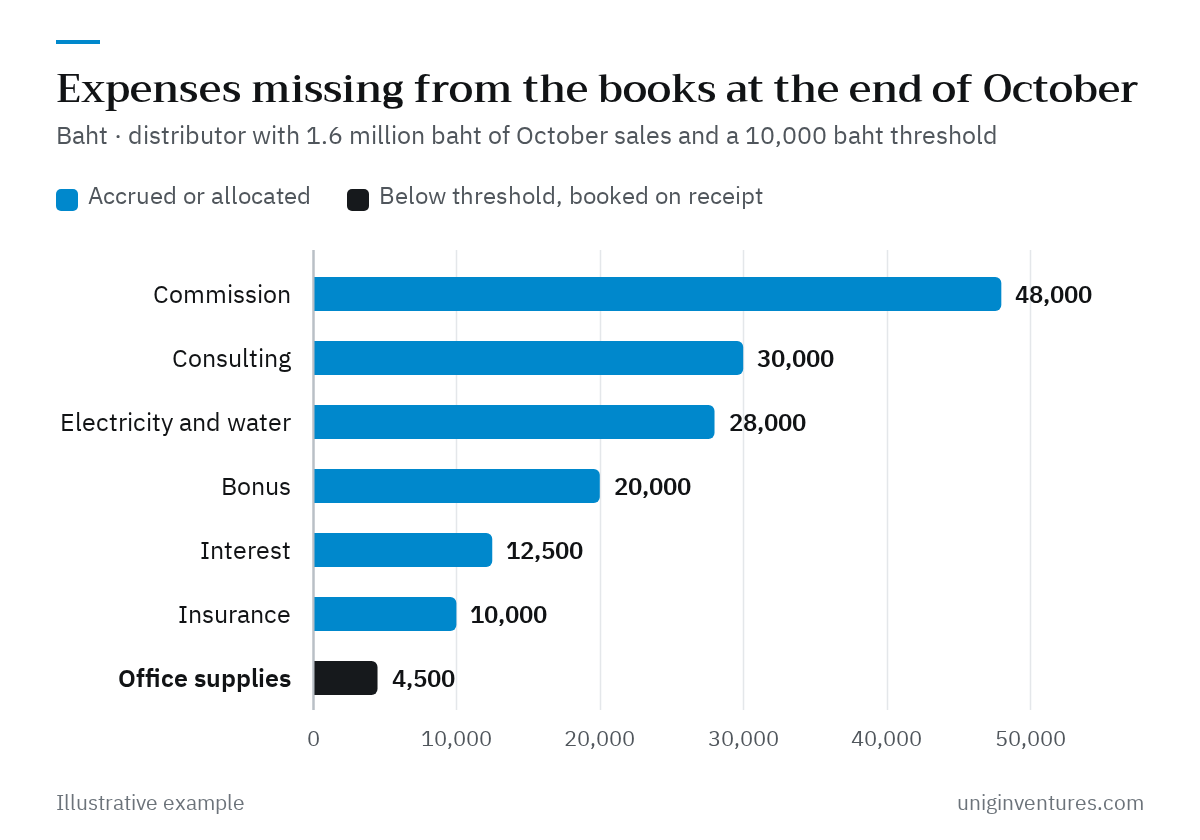
Illustrative example: a distribution company invoiced 1,600,000 baht in October and has booked 1,300,000 baht of expenses, so the unadjusted accounts show a 300,000 baht profit. The company uses a 10,000 baht materiality threshold. It paid a 120,000 baht annual insurance premium in January and expensed the whole amount that month.
| Item | Basis | Effect on profit |
|---|---|---|
| Unadjusted profit | Invoices 1,600,000 − expenses booked 1,300,000 | 300,000 |
| Accrued income | Installation delivered, not yet invoiced | 80,000 |
| Accrued commission | 3% × sales of 1,600,000 | −48,000 |
| Accrued consulting fee | 90,000 a quarter ÷ 3 | −30,000 |
| Accrued electricity and water | Three-month average | −28,000 |
| Accrued bonus | Bonus budget 240,000 ÷ 12 | −20,000 |
| Accrued interest | Bank debits on November 5 | −12,500 |
| October share of insurance | 120,000 ÷ 12 | −10,000 |
| Adjusted profit | 231,500 |
The insurance needs fixing for the whole year, not just October. The 120,000 baht booked in January should be moved to prepaid expenses and released at 10,000 baht a month. The table shows only October's share.
The unadjusted accounts overstated profit by 68,500 baht, about 30% of the correct figure. Net margin falls from 18.8% to 13.8% of revenue. A 4,500 baht office supplies bill arriving next month is below the threshold, so it is booked when it comes, an error the company accepts.
Cut-off for sales and goods received
Most errors sit in the last few days of one month and the first few days of the next. Run these checks every month:
- Sales. Pull the last five delivery notes of the month and the first five of the next, and compare them with invoices. Goods delivered on October 31 are October revenue if the sales terms transfer ownership on delivery, even if the invoice is dated November 1. See the principles in Revenue Recognition.
- Purchases. Goods received into the warehouse without an invoice yet should be recorded as inventory with a matching payable. Otherwise the stock count will exceed the books and cost of sales will be wrong.
- Advance receipts. Deposits or service fees paid before delivery go to deferred revenue, then become revenue when you deliver.
Reverse at the start of the month and track the error
The way to avoid remembering every accrual is a reversing entry: on the first day of the next month, reverse all of them. When the real bill arrives, book it as usual. The difference between estimate and actual falls into the new month automatically.
Log that difference every month. If an item misses by more than 10–20% for several months in a row, change the evidence you use, for example by reading the meter instead of using an average. The 10–20% range is a working guide for your team to agree on, not a threshold from any standard.
Year-end: mistakes have tax consequences
During the year, a misplaced accrual distorts management numbers. At the end of the fiscal year it also affects tax. Section 65 of the Revenue Code requires companies to compute income and expenses on an accrual basis: income belongs to the period in which it arises even if not yet received, and expenses relating to that period count in the same period even if not yet paid. Revenue Department Order Tor.Por. 1/2528 sets out the same rule, with exceptions for certain types of business.
Section 65 ter (9) disallows expenses that should have been charged to another accounting period, unless they could not be charged in that period, in which case they may be charged in the next one. December commission or service fees that were never accrued and then booked the following year therefore risk being deductible in neither year. Before the year-end close, have your accountant work through the full accrual schedule, and see the other steps in Year-End Close and Audit Preparation.
Where to start
- Build an accrual and allocation schedule from the items in this article, with the evidence and the person responsible for each line.
- Agree on a materiality threshold with your accountant and apply it every month.
- Add the delivery-note and receiving-report cut-off check to your close routine. See Close the Month in 10 Working Days.
- Reverse accruals at the start of each month and log the gap between estimate and actual so you can improve the estimates.
- Compare monthly profit before and after adjustments for three months to see how far your management numbers have been off.
The company and figures in this article are an illustrative example. Legal provisions were checked as of November 2026. This article is general information, not accounting or tax advice for any particular business.
Sources
- Revenue Code Sections 65–76, including Section 65 (accrual basis) and Section 65 ter (9) (Thai) — Revenue Department
- Conditions for computing net profit under Section 65 ter (non-deductible expenses) (Thai) — Revenue Department
- Revenue Department Order Tor.Por. 1/2528 on the accrual basis for company income and expenses (Thai) — Revenue Department
- TFRS for Non-Publicly Accountable Entities (revised 2022), TFAC Notification 48/2565 (Thai) — Federation of Accounting Professions