
Retirement Severance Provisions: A Step-by-Step Calculation for SMEs
Thai labor law treats retirement as termination, so severance of up to 400 days' pay is coming. How to estimate the provision under TFRS for NPAEs, record it each year and handle the tax.

In this article
An employee who stays with your company until retirement is owed severance under Thai labor law. Someone with 20 years of service receives 400 days of final wages, a little over 13 months of salary. That amount builds up every year the employee works, yet many companies never record it. When the first employee retires, the whole cost lands in a single year, and that year's profit takes a hit for an obligation that grew over decades.
This article explains why retirement triggers severance, how the accounting standard most Thai SMEs use requires you to estimate the liability, a step-by-step worked example, the entries in later years, and why the expense is added back on the PND 50.
Why retirement means severance
Section 118/1 of the Labor Protection Act treats retirement under an agreement between employer and employee, or under rules the employer sets, as termination of employment. The employer must therefore pay severance at the Section 118 rates, the same as any other termination. If the company has not set a retirement age, an employee aged 60 or over may declare retirement, which takes effect 30 days after the declaration.
| Continuous service | Severance (final wage rate) |
|---|---|
| 120 days to under 1 year | 30 days |
| 1 year to under 3 years | 90 days |
| 3 years to under 6 years | 180 days |
| 6 years to under 10 years | 240 days |
| 10 years to under 20 years | 300 days |
| 20 years or more | 400 days |
The 400-day tier for 20 or more years of service was added to the law in 2019. For a monthly-paid employee, 400 days of wages equals about 13.33 months of salary.
One point matters for the calculation: severance is paid when the employer terminates the employee or when the employee retires. An employee who resigns voluntarily receives none. So you do not set aside the full amount for everyone. You estimate how likely each person is to stay until retirement.
What the accounting standard requires
The Thai Financial Reporting Standard for Non-Publicly Accountable Entities (TFRS for NPAEs) has a chapter on employee benefits. It requires an entity to recognize post-employment benefit obligations, such as retirement severance, at the best estimate of the obligation at the reporting date. Where the time value of money is material, the amount is discounted to present value, and the nature and amount of the obligation are disclosed in the notes to the financial statements.
The standard does not require an actuary. An SME can do the calculation itself. The Federation of Accounting Professions issued a calculation guideline in 2020 that comes down to six steps:
- Collect data for each employee: salary, age and length of service.
- Calculate severance at the statutory labor-law rates.
- Discount at a risk-free rate, such as the yield on long-term Thai government bonds.
- Estimate the probability that the employee stays until retirement. The guideline suggests rates by age group, which companies may adjust using their own data.
- Recognize the obligation pro rata to the service already rendered.
- Review and update the assumptions every year.
The common mistakes are not recording the liability at all, using the same assumptions for years, skipping the discount, and not updating the balance annually. An employee benefit obligation is a type of provision, built on the same idea of a present obligation from past events covered in our article on provisions and contingent liabilities.
A step-by-step worked example
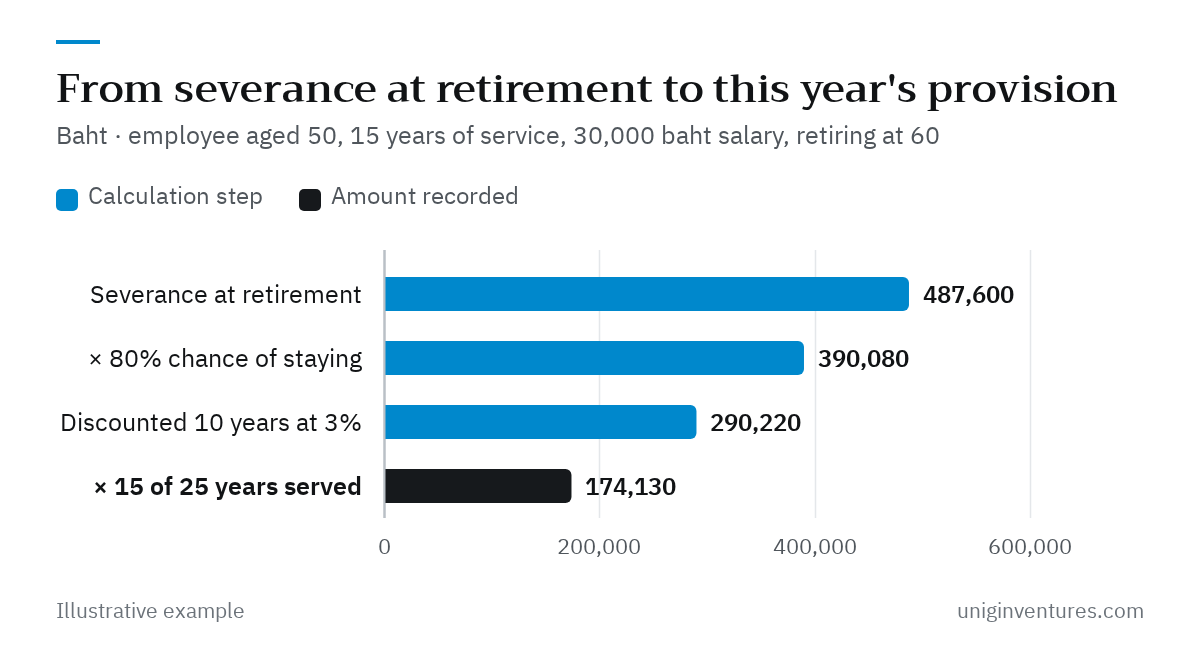
Illustrative example: Khun A is 50 years old, has worked for the company for 15 years and earns 30,000 baht a month. The company's work rules set retirement at 60. The company assumes salaries rise 2% a year, a discount rate of 3% a year, and an 80% chance that Khun A stays until retirement. These three numbers are assumptions for this example only. For a real discount rate, use the government bond yield curve at your reporting date, at a maturity close to the years remaining until retirement.
1) Service at retirement = 15 + 10 = 25 years, so 20+ years earns 400 days of severance
2) Salary at retirement = 30,000 × (1.02 to the power of 10) ≈ 30,000 × 1.219 = 36,570 baht
3) Severance at retirement = 36,570 × 400 ÷ 30 = 487,600 baht
4) Times the probability of staying = 487,600 × 80% = 390,080 baht
5) Discount 10 years at 3% (factor ≈ 0.744) = 390,080 × 0.744 ≈ 290,220 baht
6) Recognize 15 of 25 years of service = 290,220 × 15 ÷ 25 ≈ 174,130 baht
The employee benefit obligation for Khun A at this year end is therefore about 174,130 baht, not 487,600 baht. It is not certain Khun A will stay, money paid ten years from now is worth less today, and Khun A still has 10 years of work to earn the full entitlement. Repeat the same steps for every employee and add them up for the company total.
Later years: entries and annual review
At the end of the first year you set up the provision, record: debit employee benefit expense 174,130, credit employee benefit obligation 174,130. If the company has never recorded this liability before, most of the balance relates to prior years. Ask your auditor how that portion should be presented.
At the end of the next year, Khun A is 51, has 16 years of service and 9 years to go. If the assumptions do not change, severance at retirement is still 487,600 baht, or 390,080 baht at 80%. Discounting 9 years (factor ≈ 0.766) gives about 298,800 baht, and recognizing 16 of 25 years gives about 191,230 baht. The company records the increase of about 17,100 baht as that year's expense. The increase comes from one more year of service and from the payment date moving one year closer.
Other events that change the balance:
- The employee resigns. No severance is due, so reverse that employee's balance to profit or loss.
- Salaries rise faster than assumed, or the discount rate falls. The obligation increases, and the difference is an expense in the year of the change.
- Severance is paid on retirement. Record: debit employee benefit obligation, credit cash. Any difference between the payment and the balance is recognized in that year.
- Termination before retirement. Severance is also due at the rates in the table above. If the company has decided on a layoff plan, assess that separately.
Tax: add it back until you pay
In ruling No. Kor Kor 0702/1978 dated April 8, 2025, the Revenue Department said that a company's estimated retirement severance expense recorded under financial reporting standards is in the nature of a reserve under Section 65 ter (1) of the Revenue Code, so it is not deductible in the period it is set up. When the company actually pays the severance, it may deduct the payment in the accounting period of payment.
| Item | Year 1 | Year 2 | Year paid |
|---|---|---|---|
| Expense in profit or loss | 174,130 | 17,100 | That year's increase |
| Deductible for tax | 0 | 0 | Cash actually paid |
| PND 50 adjustment | Add back 174,130 | Add back 17,100 | Deduct cash paid |
Along the way, taxable profit is higher than book profit every year, and the reverse happens in the year of payment. Keep a schedule of the obligation by employee and pass it to your accounting firm each year, so you know how much has been added back and how much you can deduct when you pay.
Where to start
- Check your work rules for the retirement age. If none is set, use 60, the age at which employees may declare retirement.
- Build an employee schedule with date of birth, start date and current salary.
- Set three assumptions and document why: salary growth from the company's own history, a discount rate from the government bond yield curve, and the probability of staying by age group from the Federation of Accounting Professions guideline or your own turnover data.
- Run the six steps for every employee, record the total, and disclose it in the notes.
- Review at every year end. Update employee data and assumptions, then give the add-back schedule to your accounting firm before filing the PND 50.
This provision does not make the company pay more. It puts each year's labor cost in that year's financial statements, shows banks and investors the obligation ahead, and tells the owner how much cash to prepare for the year the first group of employees starts to retire.
Sources
- Retirement, Samut Prakan Provincial Labor Protection and Welfare Office (in Thai)
- 400 days of severance under the new labor protection law, Bangkok Area 3 Labor Protection and Welfare Office (in Thai)
- Accounting for employee benefits under TFRS for NPAEs, Forvis Mazars Thailand
- TFRS for NPAEs: Provision for Severance Payments, Forvis Mazars Thailand
- Ruling Kor Kor 0702/1978 on estimated retirement severance expenses, Revenue Department (in Thai)
- Revenue Code, Section 65 ter, Revenue Department (in Thai)
- Government Bond Yield Curve, Thai Bond Market Association