Provisions and Contingent Liabilities: When Warranties and Lawsuits Hit the Books
The three tests that require a provision, how to estimate warranty costs from your own claims history, which lawsuits you record and which you only disclose, and why they are added back for tax.

In this article
A company sells equipment with a one-year warranty. Sales are strong this year and profit looks high, but the repairs and replacements for units already sold will land next year. Another company is being sued by a customer, and its lawyer says the case could be lost. If the financial statements neither record nor disclose these items, this year's profit is overstated and the whole burden hits next year's numbers at once.
This article explains when you must record a provision, when you only disclose a contingent liability, how to estimate warranty costs from your own claims history, how to handle lawsuits, and the tax adjustment you need on the PND 50.
Three terms to keep apart
- Provision: a liability that already exists but is uncertain in timing or amount. It is recorded as a liability on the balance sheet, with an expense in profit or loss.
- Contingent liability: an obligation that does not meet the recognition tests, for example because payment is not yet probable. It is not recorded, but it is disclosed in the notes to the financial statements unless the chance of payment is remote.
- Contingent asset: for example, money the company might win in a lawsuit it filed. It is not recorded as an asset, because doing so could recognize income that never arrives.
The Thai Financial Reporting Standard for Non-Publicly Accountable Entities (TFRS for NPAEs), which most Thai SMEs use, has a dedicated chapter on provisions and contingent liabilities. The 2022 revision, effective for accounting periods beginning on or after January 1, 2023, added contingent assets: they are not recognized, but when an inflow of economic benefits is probable, the entity discloses their nature and, where practicable, an estimate of their financial effect.
The three tests for a provision
You record a provision only when all three are met:
- A present obligation arising from a past event, such as products already sold under warranty, or work already delivered that is now the subject of a claim.
- A probable outflow of resources. Probable here means more likely than not.
- A reliable estimate of the amount. It does not have to be exact to the baht, but it needs a basis you can explain.
In table form, by the likelihood of payment:
| Likelihood of payment | Treatment |
|---|---|
| Probable (more likely than not) and reliably estimable | Record a provision |
| Possible but not probable | Disclose as a contingent liability in the notes |
| Remote | Neither record nor disclose |
The first test rules out a lot. Costs the company merely plans to incur, or operating losses expected next year, are not provisions, because no past event binds the company yet.
Warranties: estimate from your own claims history
Products sold with a warranty almost always pass all three tests. The sale is the past event, a large number of units makes some claims probable, and past claims data gives you a basis for the amount. When an obligation involves a large population of items, the usual method weights each possible outcome by its probability, known as the expected value.
Worked example
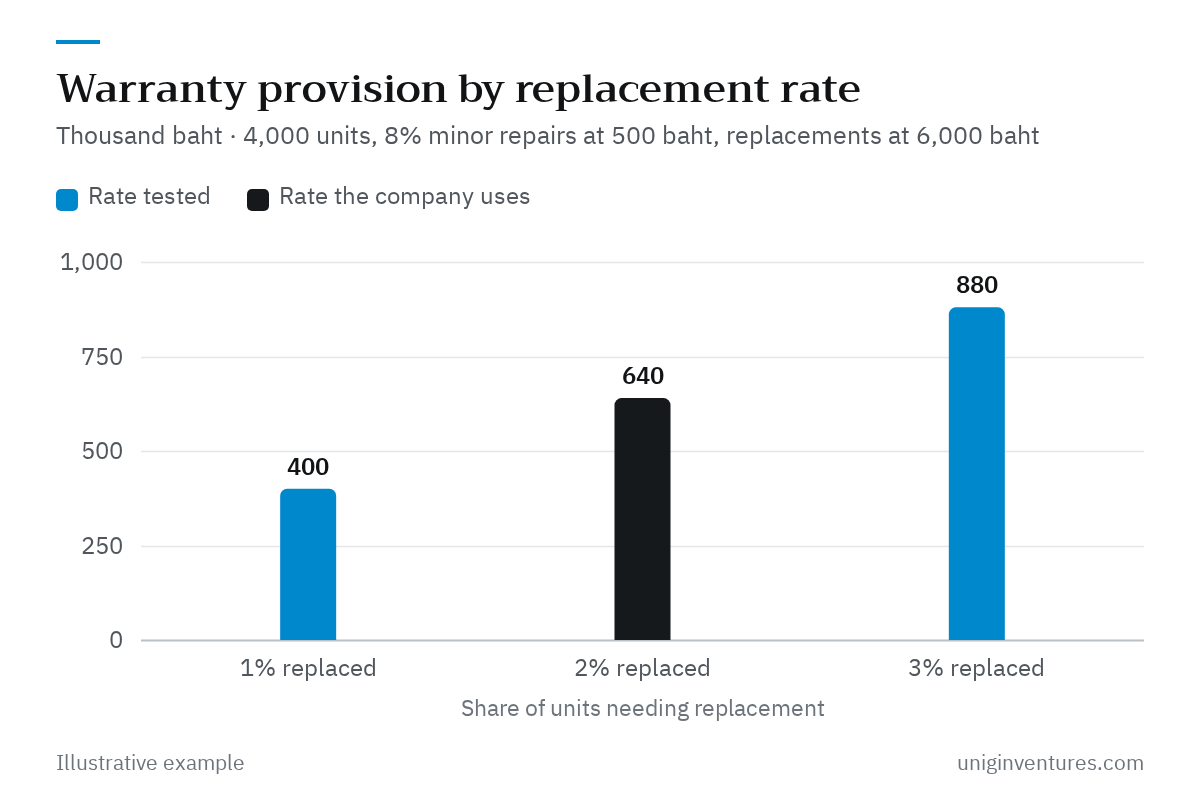
Illustrative example: a company sold 4,000 water filters this year with a one-year warranty. Its claims history over the past three years shows that 8% of units need a minor repair averaging 500 baht, and 2% need a replacement costing 6,000 baht. The rest have no claims. To keep the example simple, assume all claims arise next year.
Warranty cost per unit = (8% × 500) + (2% × 6,000) = 40 + 120 = 160 baht
Warranty provision = 4,000 × 160 = 640,000 baht
At year end, record: debit warranty expense 640,000, credit warranty provision 640,000.
The most sensitive input is the replacement rate, because each replacement is expensive. A move of just one percentage point changes the provision by 240,000 baht.
The following year: use the provision, then review it
Next year the company spends 520,000 baht on actual repairs and replacements: debit warranty provision 520,000, credit cash 520,000. This does not touch profit, because the expense was recognized when the provision was set up. Once the warranty period for this batch expires, the remaining 120,000 baht no longer supports any obligation and is reversed to profit or loss.
Review provisions at every close and use each one only for the purpose it was set up for. In this example, the actual cost averaged 130 baht per unit, not 160. The next estimate should reflect the latest data instead of repeating the old rate.
Lawsuits and disputes
A lawsuit is a single obligation, not a large population like warranties. The estimate is usually the most likely outcome, with other possible outcomes considered alongside it.
Illustrative example: a customer sues for 2,000,000 baht, claiming the company's installation work halted its factory. At year end, the company's lawyer gives an assessment. Three possible answers lead to three treatments:
- The lawyer thinks losing is more likely than winning, and the most likely payment is 800,000 baht. Record a provision of 800,000 baht, not the 2,000,000 baht claimed.
- The lawyer thinks the company could lose, but winning is more likely. Do not record anything. Disclose a contingent liability in the notes, describing the case and, where practicable, its estimated financial effect.
- The lawyer thinks the claim has almost no merit. Neither record nor disclose.
Get the lawyer's view in writing as of the period end, because it is the evidence your auditor will use to test this number. In the reverse case, where the company is the plaintiff and may receive money, do not book the income in advance. Disclose it in the notes once an inflow is probable.
Tax: provisions are not deductible until you pay
Section 65 ter (1) of the Revenue Code disallows reserves as expenses, with exceptions only for certain businesses such as insurers and some financial institutions. In ruling No. Kor Kor 0702/1978 dated April 8, 2025, on estimated retirement severance pay, the Revenue Department said that an expense based on an estimate of future costs is in the nature of a reserve and is not deductible until the severance is actually paid. Warranty provisions and provisions for lawsuit damages follow the same principle.
| Item | Year 1 | Year 2 | Total |
|---|---|---|---|
| Expense in profit or loss | 640,000 | −120,000 | 520,000 |
| Deductible for tax | 0 | 520,000 | 520,000 |
On the Year 1 PND 50, add back 640,000 baht. In Year 2, deduct the 520,000 baht of claims actually paid, and remove the 120,000 baht reversal from taxable profit, because it was never deducted. The two-year totals match; only the timing differs. Keep a schedule that tracks each provision so your accounting firm can use it every year.
Where to start
- List every uncertain obligation: product warranties, rework after delivery, lawsuits against the company, disputes with customers or suppliers, and contractual penalties.
- Track claims by product: units sold, number of claims and cost per claim, for at least two to three years.
- Get a written lawyer's assessment every year end for each open case, stating the chance of losing and the likely amount.
- Review balances at every close, compare estimates with actual payments, and adjust the rates.
- Give your accounting firm the add-back and deduction schedule before filing the PND 50.
Provisions keep the cost of this year's sales in this year's financial statements. Disclosing contingent liabilities lets banks and investors see a risk before it turns into a number. Both start from a list of obligations the company keeps itself.
Sources
- TFRS for NPAEs (revised 2022), Federation of Accounting Professions (in Thai)
- Exposure draft of TFRS for NPAEs: provisions, contingent liabilities and contingent assets, Forvis Mazars Thailand
- Thai Financial Reporting Standard for NPAEs (Revised 2022), RSM Thailand
- IAS 37 Provisions, Contingent Liabilities and Contingent Assets, IFRS Foundation
- IAS 37 technical article, ACCA
- Ruling Kor Kor 0702/1978 on estimated retirement severance expenses, Revenue Department (in Thai)
- Revenue Code, Section 65 ter (1), Revenue Department (in Thai)