An Imprest Petty Cash System: Size It, Replenish It, Audit Every Baht
How an imprest petty cash fund works, how to size it, the documents every payment needs, a worked replenishment with the journal entry, and the controls that make the fund easy to check.
In this article
Petty cash is the smallest pot of money in a company and one of the hardest to check. Courier fees, expressway tolls, drinking water and stationery get paid several times a day. Receipts go missing, the cash comes up short, and at month end nobody can say what the missing money was spent on. Many of those payments also cannot be booked as expenses because there is no proof.
This article explains the imprest petty cash system: how to size the fund, the documents every payment needs, a worked replenishment with the journal entry, and the controls that make the fund easy for owners and auditors to check.
What an imprest system is
The OpenStax textbook Principles of Financial Accounting describes a petty cash fund as a predetermined amount of cash held on hand to make payments for small day-to-day purchases that are impractical to pay by check. It is an imprest account: it holds a fixed amount of cash that is replaced as it is spent, so the balance stays the same.
The whole system rests on one equation that must hold at all times.
Cash counted + vouchers and receipts already paid = the petty cash fund amount
If the fund is 10,000 baht and the cash count is 3,180 baht, there must be 6,820 baht of receipts. If not, you know the shortage immediately. A float with no fixed amount, topped up whenever it runs low, gives you nothing to check against.
The petty cash account in the general ledger moves only when the fund is set up or its size changes. Individual expenses are recorded when the fund is replenished.
How big should the fund be
The fund should last until the next replenishment without leaving more cash in the drawer than you need.
Fund ≈ monthly petty cash spending ÷ replenishments per month + a small buffer
Illustrative example: an office reviews the last three months and finds it spends an average of 18,000 baht a month from petty cash. It plans to replenish twice a month, so the fund is 18,000 ÷ 2 + 1,000 = 10,000 baht.
OpenStax notes that management adjusts the fund to actual use: increase it if it needs replenishing too often, and reduce it if it turns out larger than needed. Set a per-payment cap as well, for example no more than 2,000 baht per item, and pay anything larger by bank transfer through the normal process. That figure is an example; set yours to fit your operations.
Documents for every payment
Every petty cash payment should have two documents.
- A petty cash voucher. Sequentially numbered, with the date, amount, purpose, the recipient's signature and the approver's signature. OpenStax notes that this receipt tracks the use of the cash and requires a manager's signature.
- Evidence from the seller. A receipt or tax invoice, attached to every voucher.
Two tax points matter for whoever holds the fund.
- Ask for a full tax invoice when buying from a VAT-registered shop. Revenue Department VAT Notification No. 42 makes input tax on abbreviated tax invoices non-creditable, while Royal Decree No. 243 lets companies treat that group of input tax as an expense. See Non-Creditable Input VAT.
- Withholding tax. Revenue Department Order Tor.Por.4/2528 requires withholding when the income paid under one contract totals 1,000 baht or more, even if each installment is under 1,000 baht. If petty cash pays the same service provider several times under one contract, look at the contract total, not each payment. See Withholding Tax Rates SMEs Use Most.
Once paid, stamp each receipt "PAID" with the voucher number so the same receipt cannot be claimed twice.
A worked replenishment
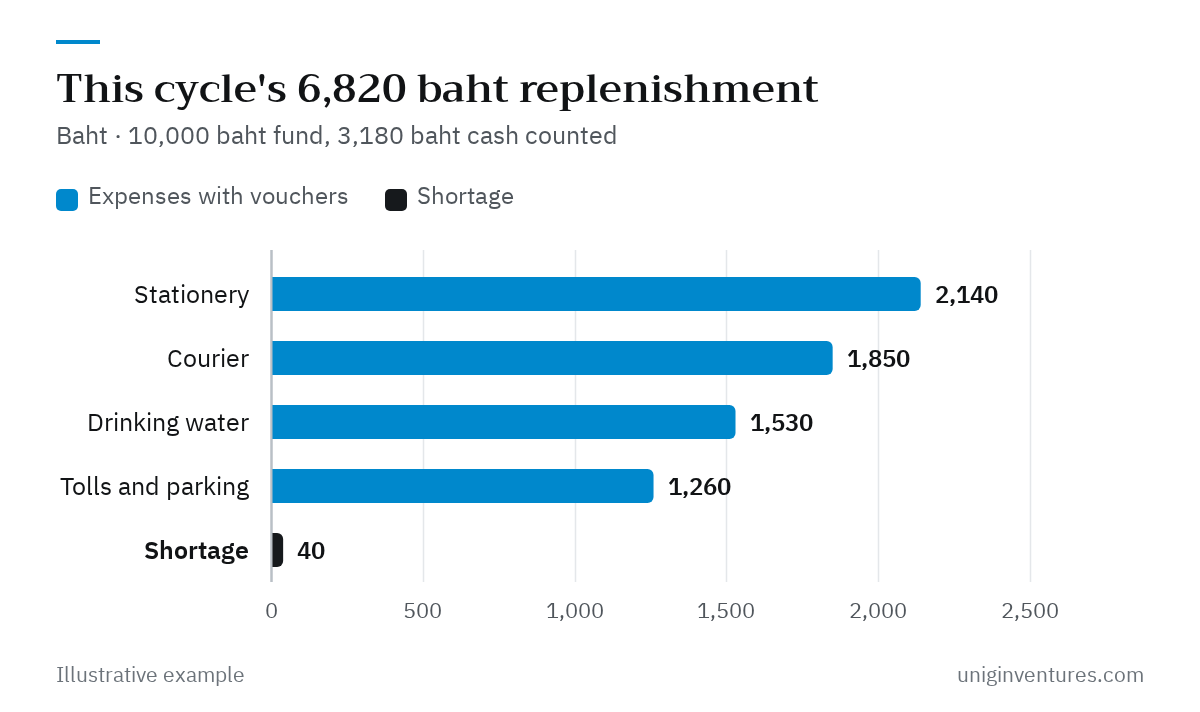
Illustrative example: the fund is 10,000 baht. At replenishment time, the custodian counts 3,180 baht in cash and has these vouchers with evidence.
| Item | Evidence | Amount |
|---|---|---|
| Stationery | Full tax invoice (2,000 + 7% VAT of 140) | 2,140 |
| Courier and parcels | Receipt | 1,850 |
| Office drinking water | Abbreviated tax invoice | 1,530 |
| Tolls and parking | Receipt | 1,260 |
| Total vouchers | 6,780 | |
| Cash counted | 3,180 | |
| Cash plus vouchers | 9,960 | |
| Shortage | 40 |
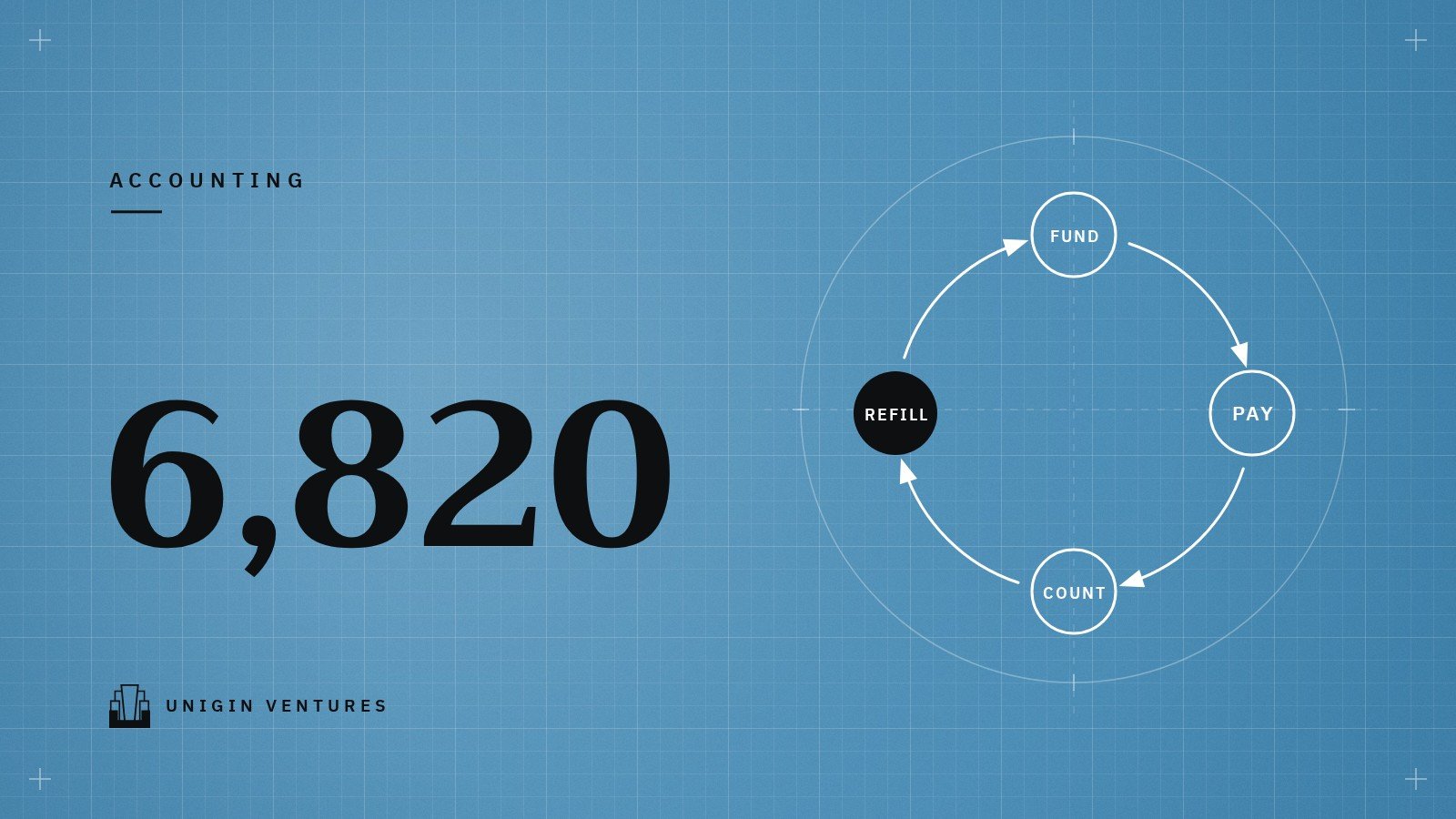
The replenishment is 10,000 − 3,180 = 6,820 baht, which equals 6,780 baht of vouchers plus the 40 baht shortage. Once the transfer arrives, the cash is back to exactly 10,000 baht.
The journal entry for this cycle:
| Account | Debit | Credit |
|---|---|---|
| Office supplies | 2,000 | |
| Input VAT | 140 | |
| Freight and courier | 1,850 | |
| Office expenses (drinking water) | 1,530 | |
| Travel | 1,260 | |
| Cash over and short | 40 | |
| Bank | 6,820 | |
| Total | 6,820 | 6,820 |
Notice that petty cash itself does not appear, because the fund size has not changed. Each expense goes to its own account at replenishment. The VAT on the full tax invoice goes to input VAT, while the water bought on an abbreviated invoice is expensed in full. OpenStax explains that a shortage is recorded as a debit, which has the same effect as an expense; an overage is a credit. The original setup entry is a 10,000 baht debit to petty cash and a credit to the bank.
Controls that make it auditable
- One custodian. If several people use the same drawer, nobody can tell whose hands the shortage happened in.
- The approver is not the custodian. Whoever approves vouchers and replenishments must not hold the cash. For splitting duties in a small team, see Internal Controls for Small Teams.
- Surprise counts. Someone other than the custodian counts the cash and vouchers against the fund amount, and both sign.
- Replenish before every month-end close. Otherwise, expenses already paid will be missing from that month's accounts.
- No personal loans. No IOUs or personal checks in place of cash. Staff advances go through their own process.
- Watch over and short as a trend. OpenStax notes that consistent shortages suggest inadequate controls that warrant review.
Where to start
- Add up three months of petty cash spending, then set the fund amount, the replenishment cycle and a per-payment cap.
- Appoint one custodian and an approver who is not the custodian.
- Create numbered petty cash vouchers and teach the custodian to ask for full tax invoices.
- Replenish on schedule and before every month-end close, booking each expense to its own account and over and short separately.
- Run a surprise count at least once a month and review the fund size every quarter.
The figures, fund size and cap in this article are illustrative examples to explain the reasoning. For tax evidence questions with special conditions, ask your bookkeeper or auditor.
Sources
- 8.4 Define the Purpose and Use of a Petty Cash Fund, and Prepare Petty Cash Journal Entries — OpenStax, Principles of Financial Accounting
- Revenue Department Order Tor.Por.4/2528 on withholding tax (in Thai) — Revenue Department
- Revenue Code Sections 82/3 and 82/5 on input tax (in Thai) — Revenue Department
- VAT Notification No. 42: input tax not deductible under Section 82/5 (6) (in Thai) — Revenue Department
- Royal Decree No. 243 (1991) on input tax treated as a deductible expense (in Thai) — Revenue Department