Flexible Budget Variance Analysis: Separate Volume From Cost Control
Beating budget, or overspending on materials, means little when actual volume differs from plan. Flex the budget to actual volume and split volume effects from price and cost variances.

In this article
When the month-end numbers show profit above budget, most owners relax. When materials come in a hundred thousand baht over budget, they turn to purchasing. Both reactions can be wrong. The budget set at the start of the year assumes one level of sales, and when actual sales land somewhere else, variable costs are bound to come in above or below budget too. A straight comparison mixes the effect of volume with the effect of cost control.
The tool that separates the two is the flexible budget. This article shows how to restate the budget at the volume you actually sold, split the difference into a volume part and a price-and-cost part, and work through an example you can repeat every month with one spreadsheet.
Static budget vs. flexible budget
OpenStax's Principles of Accounting, Volume 2: Managerial Accounting defines a static budget as one prepared for a single level of output in a given period, and a flexible budget as one based on different volumes of sales. The same textbook notes that if sales differ from the budget, comparing actual costs with budgeted costs may not show clearly whether the company is meeting its targets. Budgeted costs should be recalculated from actual sales activity each period so the comparison is like for like.
ACCA's article "All about budgeting" draws one more distinction. A flexible budget is prepared at the start of the period and forecasts revenue, costs and profit across a range of activity levels. At the end of the period, a flexed budget is created at the activity level actually achieved, and actual results are compared with it line by line for each revenue and cost.
The adjustment follows one rule: variable cost per unit times actual volume, with fixed costs left at their budgeted amount because they do not move with volume.
Example: profit beat budget, yet 76,000 baht went missing
Illustrative example. A shop selling boxed cookies budgets 10,000 boxes for October at 100 baht a box. Materials cost 40 baht a box, packaging and delivery 10 baht a box, and fixed costs (rent, permanent salaries) are 300,000 baht a month. The shop actually sells 12,000 boxes, but a promotion pulls the average price down to 97 baht.
| Item | Budget, 10,000 boxes | Actual, 12,000 boxes | Variance |
|---|---|---|---|
| Sales | 1,000,000 | 1,164,000 | 164,000 F |
| Materials | 400,000 | 516,000 | 116,000 U |
| Packaging and delivery | 100,000 | 114,000 | 14,000 U |
| Fixed costs | 300,000 | 310,000 | 10,000 U |
| Operating income | 200,000 | 224,000 | 24,000 F |
OpenStax calls a variance favorable (F) when revenue is higher or expenses are lower than budgeted, and unfavorable (U) in the opposite case. Reading this table, the owner sees two things: profit is 24,000 baht over budget, and materials are an alarming 116,000 baht over. Neither tells you much. The shop sold 2,000 boxes more than planned, so materials were always going to cost more.
Restate the budget at actual volume
Multiply the budgeted price and variable costs per box by 12,000 boxes and keep fixed costs at 300,000 baht. The result is the flexed budget, which answers one question: if we sold 12,000 boxes at the price and costs we planned, what profit should we have made?
| Item | Flexed budget, 12,000 boxes | Actual, 12,000 boxes | Variance |
|---|---|---|---|
| Sales | 1,200,000 | 1,164,000 | 36,000 U |
| Materials | 480,000 | 516,000 | 36,000 U |
| Packaging and delivery | 120,000 | 114,000 | 6,000 F |
| Fixed costs | 300,000 | 310,000 | 10,000 U |
| Operating income | 300,000 | 224,000 | 76,000 U |
The picture changes completely. At 12,000 boxes the shop should have earned 300,000 baht; it earned 224,000, a shortfall of 76,000 baht. The materials line that looked 116,000 baht over budget is really only 36,000 over. The other 80,000 baht is the material in the extra boxes sold.
Split the variance in two
Sales volume variance = Flexed budget profit − Static budget profit = (Actual volume − Budgeted volume) × Budgeted contribution margin per unit
Flexible budget variance = Actual profit − Flexed budget profit
In the example, budgeted contribution margin per box is 100 − 40 − 10 = 50 baht. The shop sold 2,000 boxes more than budget, so the sales volume variance is 2,000 × 50 = 100,000 baht favorable. The flexible budget variance is 224,000 − 300,000 = −76,000 baht, unfavorable. Lined up, they reconcile exactly to actual profit.
Budgeted profit 200,000 + volume 100,000 − selling price 36,000 − materials 36,000 + packaging and delivery 6,000 − fixed costs 10,000 = actual profit 224,000 baht
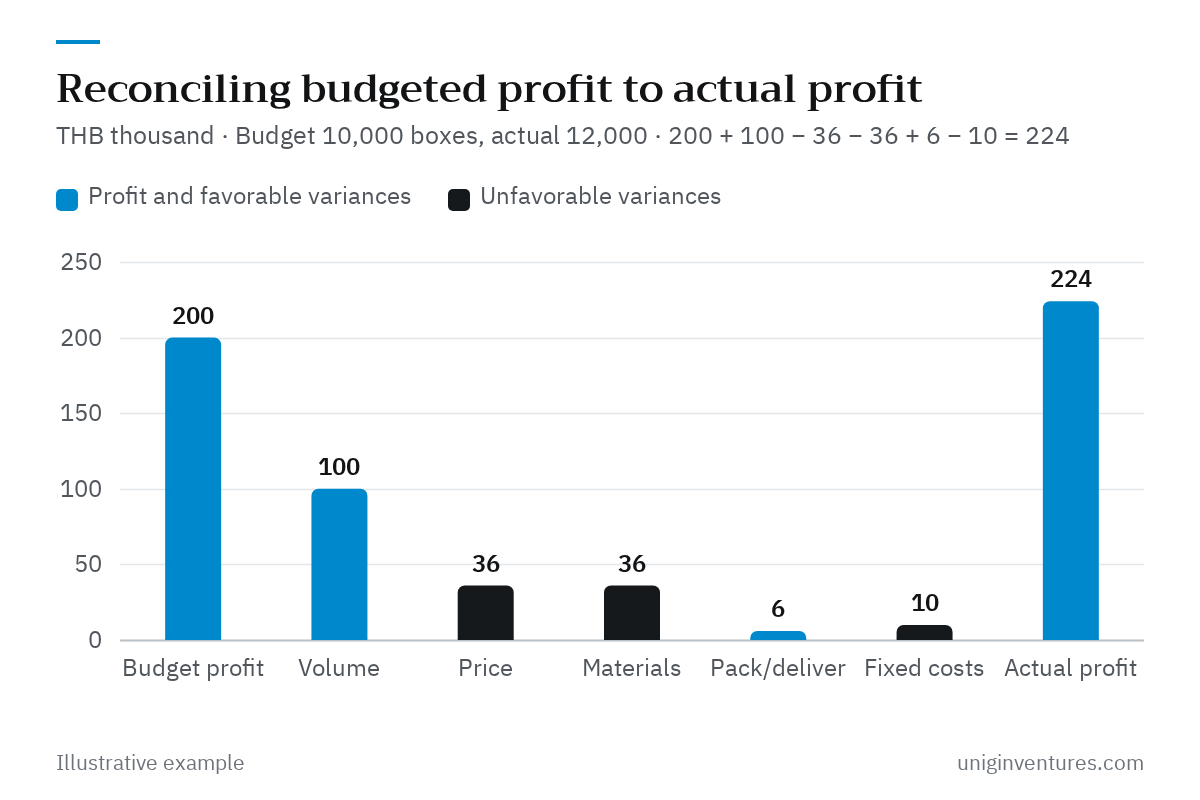
The volume variance belongs to sales and marketing. The flexible budget variance is about pricing and cost control. As OpenStax puts it, evaluating expenses against a flexible budget computed for the number of units sold indicates how well management controls expenses.
Reading each line
OpenStax cautions that variance analysis does not necessarily find a problem; it indicates where a problem may exist. Each number is the start of a question, not a verdict.
- Selling price, 36,000 baht. The average price was 3 baht below budget across 12,000 boxes. Did the promotion cause the extra 2,000 boxes? If so, giving up 36,000 baht to earn 100,000 baht of contribution was worth it. If sales rose because of the season, the discount was money given away for nothing.
- Materials, 36,000 baht. Actual cost was 43 baht a box instead of 40. Was it the price of ingredients, or more ingredients per box than the recipe (waste, spoilage)? The two are fixed in different places: price through purchasing, quantity in production.
- Packaging and delivery, 6,000 baht favorable. Favorable does not always mean good. A lower cost could come from a cheaper box that leads to customer complaints. Ask for the reason here too.
- Fixed costs, 10,000 baht. These do not depend on volume, so compare them with the original budget directly. If it was, say, temporary extra storage, ask whether it will recur next month.
The price shortfall is the same effect that a gross margin bridge breaks down in more detail. If you sell several products, you can go on from this table to split price, product mix and unit cost.
Follow up only the variances that matter
A business with dozens of expense lines does not need to chase every one. Set a threshold in advance and explain only variances above a percentage or an amount, for example more than 5% of the flexed budget or more than 20,000 baht. Those figures are only an example; choose a threshold that fits the size of your business and keep it the same every month so months stay comparable.
Costs that are partly fixed and partly variable
A flexed budget is only as good as the split between fixed and variable costs. Some expense lines contain both, such as kitchen electricity, with a steady base load for air conditioning plus oven use that rises with output. The ACCA article uses the high-low method to split costs like these: take the months with the highest and lowest activity and divide the difference in cost by the difference in volume.
Illustrative example. In a month when the shop bakes 12,000 boxes, electricity is 46,000 baht; in a month of 8,000 boxes it is 38,000 baht. The variable part is (46,000 − 38,000) ÷ (12,000 − 8,000) = 2 baht a box. The fixed part is 46,000 − (12,000 × 2) = 22,000 baht a month. The flexed electricity budget for a 10,000-box month is therefore 22,000 + 20,000 = 42,000 baht. The method uses only two months, so check it against the others, and if the highest or lowest month was unusual (an oven broke down for several days, say), use the next one instead.
Where to start
- Open this year's budget and split each expense line into a variable cost per unit and a fixed cost per month, using the high-low method for mixed lines. The unit can be pieces, labor hours or orders, depending on what drives the cost (see contribution margin by product).
- Build a three-column spreadsheet: static budget, flexed budget, actual. Make the flexed column calculate from a single cell holding actual volume.
- After each monthly close, enter actual volume and actual figures, then reconcile from budgeted profit to actual profit as in the example. If it does not reconcile, a formula is wrong.
- Write a one-sentence explanation for every variance above your threshold, with the name of the person responsible and what will happen next month.
- If actual unit costs stay away from budget for several months in a row, change the assumption in next quarter's budget instead of explaining the same variance every month (see annual budget vs. rolling forecast).
The table works best when the monthly close is quick and expenses land in the right month. If October's materials are booked in November, both months show the wrong variance (see accruals and cut-off).
The business and figures in this article are illustrative examples. This article is general information, not accounting or financial advice for any particular business.