Fixed Asset Register and Annual Count: Make the Books Match What You Own
Discarded machines still being depreciated, laptops gone with former staff. How to keep an asset register, run the annual count, reconcile it with the ledger and write off what is gone.
In this article
The balance sheets of many small companies list machines, computers and air conditioners that no longer exist. Some broke down and were thrown out years ago, others left with employees who resigned, yet they are still depreciated every month. Meanwhile, equipment used every day is missing from the list. The asset figures no longer match reality, and the first person to ask about it is usually the auditor, the bank or an investor doing due diligence, not the owner.
This article explains how to keep a fixed asset register that actually works, how to run the annual count, how to reconcile the register with the general ledger, and what to do with the differences you find, with a worked example of how much writing off missing assets hits profit.
Why the general ledger alone is not enough
The general ledger only shows totals: the computer account holds 450,000 baht at cost, but it does not say which machines, who has them or when they were bought. The fixed asset register is the item-by-item list whose totals must equal the ledger.
You need item-level data for both accounting and tax. OpenStax's Principles of Accounting defines book value as an asset's original cost less accumulated depreciation, so you need the cost and depreciation of each item to know what it is still worth. On the tax side, Section 4 of Royal Decree No. 145 (B.E. 2527, 1984) requires depreciation to be calculated according to the time each asset has been held in each accounting period, so you need each item's acquisition date. Section 3 says that once a company chooses an accounting method and rate it must keep using them unless the Director-General of the Revenue Department approves a change, so the method and rate for each class belong in the register. (For the maximum tax rates and how they differ from book depreciation, see depreciation of fixed assets.)
The fields a countable register needs
| Field | What it is for |
|---|---|
| Asset code | Matches the tag on the item, used to pair items during the count |
| Name, model and serial number | Tells identical items apart, such as several laptops of the same model |
| Class and ledger account | Totals for reconciling with the ledger |
| Acquisition date and ready-for-use date | Starts depreciation and drives the time-based tax calculation |
| Cost and purchase document number | Traces back to the tax invoice or contract; cost includes shipping, non-recoverable taxes and installation |
| Location and person responsible | Where to count it, and whom to ask when it cannot be found |
| Method, useful life and rate | Keeps depreciation consistent every year |
| Accumulated depreciation and book value | Shows the loss if the item has to be written off |
| Status and last count date | In use, idle, damaged, awaiting disposal or written off |
On cost, OpenStax explains that the total cost of acquiring an asset goes into its cost, not only the purchase price: shipping, taxes, assembly and legal fees. Ordinary maintenance that does not extend the useful life, increase capacity or improve performance is expensed at once, while improvements that extend the asset's life are capitalized and depreciated.
Set a clear threshold
If every mouse or plastic chair that lasts a few years goes into the register, the list grows too long for anyone to maintain. Most businesses agree a policy with their accountant on the minimum price at which an item is recorded as an asset. Put the threshold in writing, apply it the same way every year, and tell everyone who places orders.
The annual count, step by step
- Set the date and scope. Count close to the end of the financial year so the results can still adjust that year's accounts. Print the register by location: office, plant, warehouse and branches.
- Have people who do not hold the items do the counting. OpenStax describes the internal control principle that the person who controls an asset should not also keep its accounting records. Each counting team should include at least one person who does not use or look after the items at that location (see segregation of duties in a small team).
- Count in both directions. Walk from the register to the floor to find what is missing, then from the floor to the register to find what was never recorded. Each direction catches a different kind of problem.
- Tag items and note their condition. Tag anything without a label as you go, note whether it is in use, idle or damaged, and photograph damaged items as evidence.
- Items away from the office, such as laptops staff take home or vehicles used upcountry: have the person responsible send a photo showing the tag or serial number and sign a confirmation.
- Summarize and get approval. The counting team signs the list of differences, and a director or manager approves it before any accounting adjustment.
Example: reconciliation and the differences found
Illustrative example. A food manufacturer counts its assets for the first time in several years. The first step, before anyone goes out to count, is to compare the register totals with the general ledger.
| Class | General ledger | Register | Difference |
|---|---|---|---|
| Machinery and plant equipment | 2,400,000 | 2,400,000 | 0 |
| Furniture and office equipment | 680,000 | 680,000 | 0 |
| Computers | 450,000 | 410,000 | 40,000 |
| Vehicles | 1,200,000 | 1,200,000 | 0 |
| Total | 4,730,000 | 4,690,000 | 40,000 |
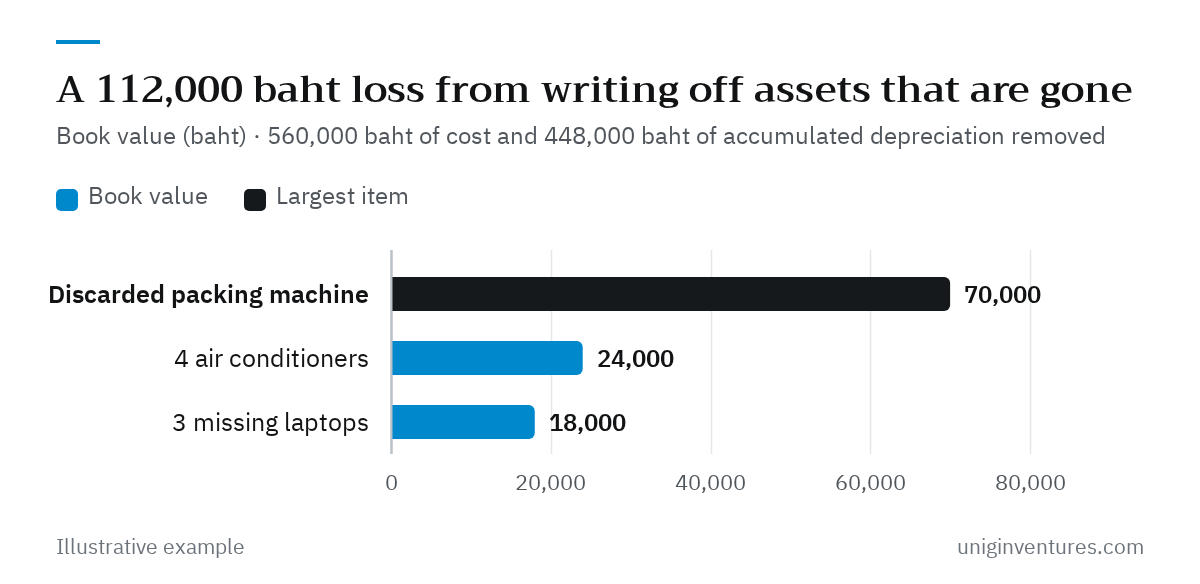
The 40,000 baht difference in computers is a server bought this year. The accountant had booked it in the ledger but not yet added it to the register. The team found the machine in the server room, added it and tagged it. The physical count turned up three more problems. Each item was bought about four years earlier and depreciated at 20% of cost a year.
| Item | Cost | Accumulated depreciation | Book value |
|---|---|---|---|
| Sachet packing machine, broken and discarded | 350,000 | 280,000 | 70,000 |
| 4 air conditioners removed when the office moved | 120,000 | 96,000 | 24,000 |
| 3 laptops that cannot be found | 90,000 | 72,000 | 18,000 |
| Total | 560,000 | 448,000 | 112,000 |
What to do with the differences
Items discarded, sold or lost
OpenStax shows that on disposal both the asset's cost and its accumulated depreciation are removed from the books, and the proceeds are compared with book value: more than book value is a gain, less is a loss. An item thrown away for nothing is therefore a loss equal to its entire book value. In the example, the company removes 560,000 baht of cost and 448,000 baht of accumulated depreciation and recognizes a loss of 112,000 baht.
That loss is not new damage. It recognizes something that has already happened. Without the write-off, the company would keep depreciating assets it no longer has until the same 112,000 baht had gone through the following years anyway. Writing them off makes the balance sheet match reality and keeps next year's depreciation from being overstated.
For the missing laptops, search before writing them off: check the equipment return forms of employees who left and ask the people previously responsible, then keep a record of the search. For the tax effect of writing off lost or damaged assets, consult your accountant or auditor, and keep the count report, photos and approval documents. If an asset is sold, VAT and the gain on sale are covered in selling company assets.
Items that exist but are not in the register
Check whether they were booked. If an item was capitalized but left out of the register, like the server in the example, add it. If it was expensed and its price is above your threshold, ask your accountant whether an adjustment is needed, and note the cause so it does not happen again.
Items still there but idle or damaged
Update the status in the register, then decide whether to repair, sell or scrap. Idle equipment still takes up space and depreciation, and if what you could recover from it is far below its book value, ask your accountant about an impairment write-down.
Where to start
- Get the latest register from your accountant and compare each class total with the general ledger before you count anything.
- Add the missing fields from the table above, especially the code, serial number, location and person responsible.
- Write down the capitalization threshold and the rule for repairs versus improvements, and tell the people who place orders.
- Schedule the count before year-end, with teams that include someone who does not hold the items. Count in both directions and tag everything.
- Summarize the differences with their book values, get approval, and have your accountant post the adjustments before closing (see year-end close and audit preparation).
- Make it a rule that every purchase, move, disposal or sale of an asset is reported to the accountant within the month, and collect an equipment return form whenever an employee leaves.
The company and figures in this article are illustrative examples. This article is general information, not accounting or tax advice for any specific case. Legal information as of November 2026.
Sources
- 11.2 Analyze and Classify Capitalized Costs versus Expenses, Principles of Accounting Volume 1 — OpenStax (Rice University)
- 11.3 Explain and Apply Depreciation Methods to Allocate Capitalized Costs, Principles of Accounting Volume 1 — OpenStax (Rice University)
- 11.5 Describe Some Special Issues in Accounting for Long-Term Assets, Principles of Accounting Volume 1 — OpenStax (Rice University)
- 8.3 Describe Internal Controls within an Organization, Principles of Accounting Volume 1 — OpenStax (Rice University)
- Royal Decree No. 145 (B.E. 2527) on depreciation of assets (in Thai) — Revenue Department