Unit Product Cost for Small Factories: What to Include Before You Price
Build unit product cost from direct materials, direct labor and overhead, with a two-size sauce factory example, why fixed overhead belongs on normal capacity, and how to use it for pricing.
In this article
Many small factory owners price from the cost of raw materials plus the margin they want, then find at year-end that profit is lower than expected. The usual cause is that the cost behind the price leaves out the production line's labor and the factory's running costs, or includes them but spreads them across products in a way that does not match how each product uses the factory.
This article shows how to calculate unit product cost from three parts: direct materials, direct labor and manufacturing overhead. It works through a sauce factory that makes two bottle sizes, explains why fixed overhead should be divided by normal capacity rather than actual output, and shows how to use the result for pricing and for accepting orders.
Unit product cost has three parts
Managerial accounting textbooks split product cost into three parts and keep it apart from selling and administrative expenses, which are period costs.
| Part | What it is | Example in a food factory |
|---|---|---|
| Direct materials | Materials you can trace to a specific unit | Recipe ingredients, bottles, caps, labels |
| Direct labor | Pay for the people who make the product | Workers on the filling line |
| Manufacturing overhead | Production costs that are not worth measuring unit by unit | Factory rent, production supervisor and QC salaries, machine depreciation, factory power and gas |
Delivery to customers, sales salaries, marketing and office costs are not part of product cost, but your margin still has to cover them. Keeping the line clear tells you each product's gross profit before the costs that come with the passing of time.
Example: the cost of a 300 ml bottle of chili sauce
Illustrative example: a small factory has one production line that runs 8 hours a day, 250 days a year, with 6 workers. It fills 300 bottles of 300 ml chili sauce an hour, or 2,400 a day. Labor, including the employer's social security contribution, averages 60 baht per worker-hour (a hypothetical rate).
| Item | How it is calculated | Per bottle |
|---|---|---|
| Recipe ingredients | Includes normal production waste | 9.00 |
| Bottle, cap and label | 4.50 + 0.50 | 5.00 |
| Direct labor | 6 workers × 60 baht ÷ 300 bottles an hour | 1.20 |
| Variable overhead (power, gas, water used in production) | 240 baht per line-hour ÷ 300 bottles | 0.80 |
| Fixed overhead | 600 baht per line-hour ÷ 300 bottles (see next section) | 2.00 |
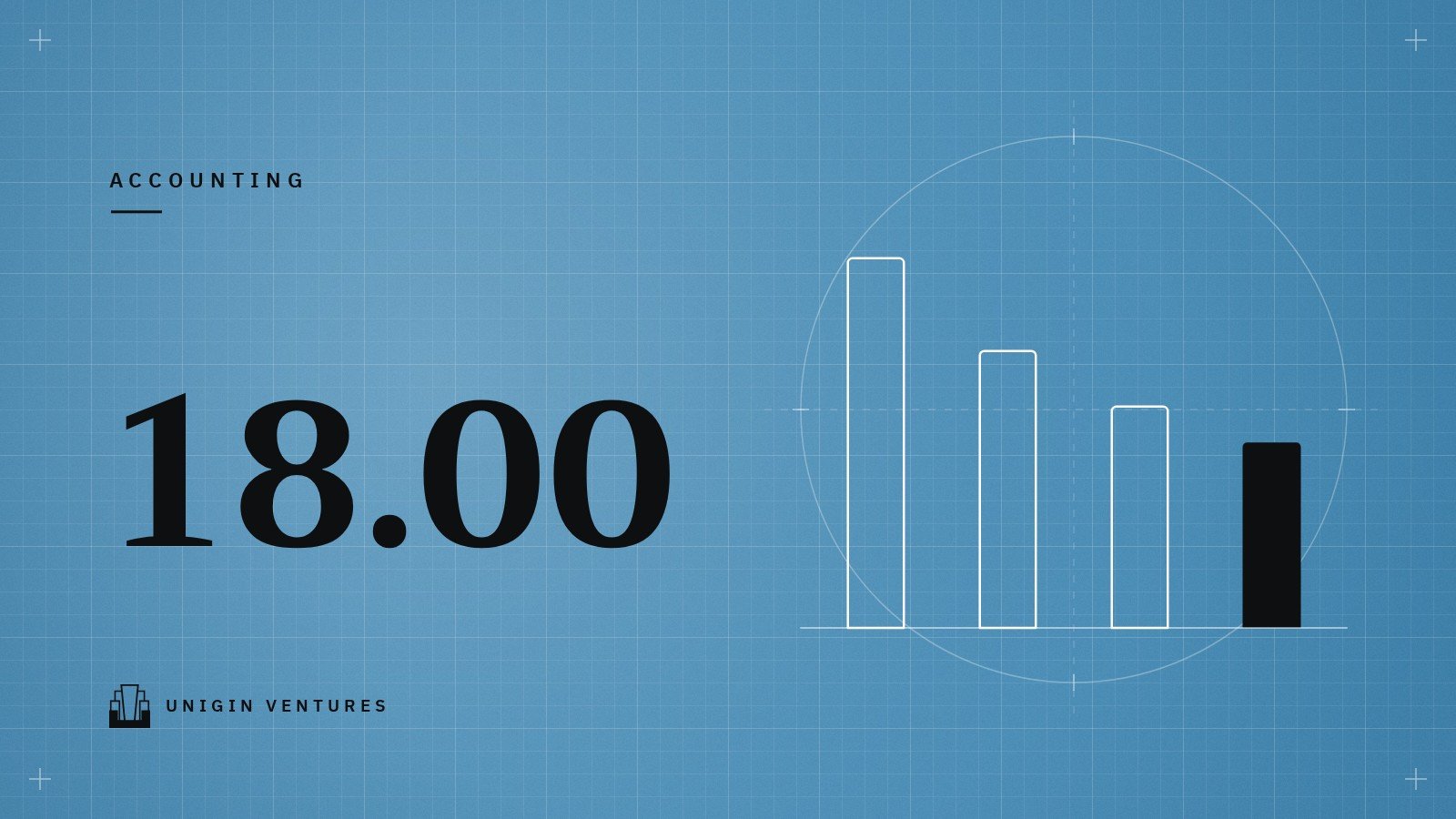
| Product cost per bottle | 18.00 |
Price from the 14.00 baht of ingredients, bottle and label alone, and the other 4.00 baht per bottle, about 22% of the full product cost, drops out of the price.
A note on labor: most small factories pay line workers by the day or the month, whether output that day is high or low. In the short term labor does not fall with output. The 1.20 baht is the cost per bottle when the line runs full time, not money you save at once when you make less.
Fixed overhead: divide by normal capacity, not actual output
The example factory's fixed overhead for the year is factory rent of 360,000 baht, production supervisor and QC salaries of 480,000 baht, machine depreciation of 240,000 baht, and maintenance and factory insurance of 120,000 baht, a total of 1,200,000 baht.
Overhead does not arrive evenly through the year, and the actual figures come too late to set prices. So you set a predetermined overhead rate at the start of the year.
Fixed overhead rate = annual fixed overhead ÷ line-hours at normal capacity
= 1,200,000 ÷ (8 hours × 250 days) = 1,200,000 ÷ 2,000 = 600 baht per line-hour
The denominator is where the numbers diverge most. If sales are weak this year and the factory makes only 400,000 bottles, dividing fixed overhead by actual output gives 3.00 baht a bottle and a unit cost of 19.00 baht. At 300,000 bottles, fixed overhead becomes 4.00 baht a bottle.
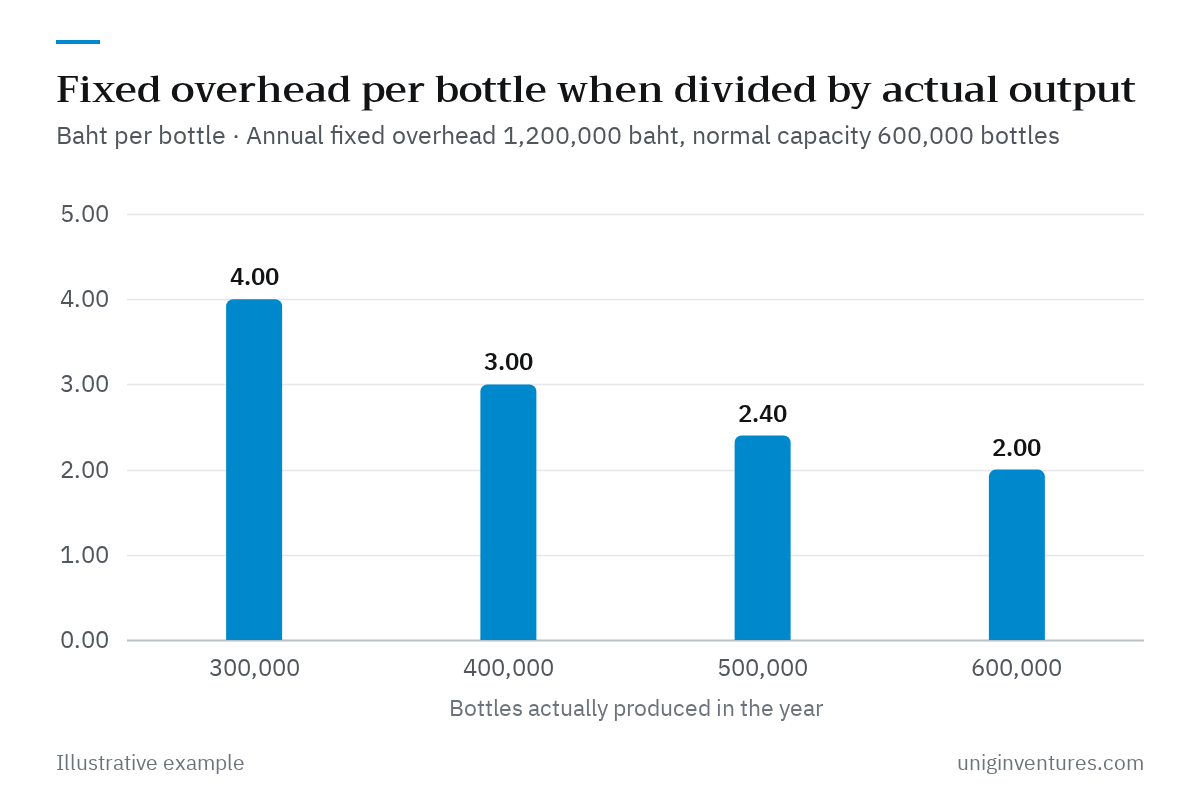
The trouble with dividing by actual output is that unit cost rises in the years when sales fall. Raise the price on that basis and sales may fall further, which pushes unit cost up again. Using normal capacity as the denominator holds fixed overhead at 2.00 baht a bottle and shows the unused part separately.
In a year with actual output of 400,000 bottles, fixed overhead applied to products is 400,000 × 2.00 = 800,000 baht. The remaining 400,000 baht is underapplied overhead. In the management report, show it on its own line as the cost of unused capacity. That number points to the real problem, spare capacity, which you fix by finding sales or cutting fixed costs, not by raising prices.
Several products: allocate by line time
Say the same factory also makes a 1 liter bottle, which the line fills at 120 bottles an hour. The annual plan is 450,000 small bottles (1,500 hours) and 60,000 large bottles (500 hours), a total of 2,000 hours, equal to normal capacity.
Spread fixed overhead evenly per bottle and you get 1,200,000 ÷ 510,000 bottles = 2.35 baht a bottle. But a large bottle takes 2.5 times as long on the line as a small one, so allocating by line-hours reflects resource use better.
| Item | 300 ml bottle | 1 liter bottle |
|---|---|---|
| Ingredients, bottle, cap and label | 14.00 | 35.00 |
| Direct labor (360 baht per line-hour) | 1.20 | 3.00 |
| Variable overhead (240 baht per line-hour) | 0.80 | 2.00 |
| Fixed overhead (600 baht per line-hour) | 2.00 | 5.00 |
| Product cost per bottle | 18.00 | 45.00 |
| Fixed overhead if spread evenly per bottle | 2.35 | 2.35 |
Spreading evenly makes each small bottle look 0.35 baht too expensive and each large bottle 2.65 baht too cheap. An owner who sees those numbers might cut the large bottle's price or push its sales, even though it uses more line time. Check the allocation: 450,000 × 2.00 + 60,000 × 5.00 = 1,200,000 baht, the full year's fixed overhead.
Common allocation bases are direct labor hours, direct labor cost, machine hours and units produced. Choose the base that rises and falls with the use of shared resources. Where the line is the bottleneck, line-hours are usually the right base; see how to find the bottleneck in Capacity and bottlenecks. Businesses that work job by job should use the method in Job costing.
How to use unit cost
Normal pricing
Your normal selling price must be above the full product cost of 18.00 baht and leave enough to cover selling and administrative costs and profit. A price below full product cost can work for a while, but over time the factory will not have the cash for rent, salaries and replacing machines.
Special orders when the line has spare time
If a customer wants extra volume at a lower price and the line has spare time, the cost that actually increases is materials and variable overhead of 14.80 baht a bottle, plus labor if you have to pay overtime or hire. Fixed overhead does not rise, so an order priced above incremental cost adds profit. If the line is full, the order takes time away from products sold at the normal price, and you must count the profit you give up. The reasoning is in Contribution margin.
Valuing inventory in the financial statements
According to the IFRS Foundation's summary of IAS 2, the cost of inventories includes costs of purchase, costs of conversion (direct labor and production overhead) and other costs of bringing the inventories to their present location and condition. Unsold finished goods therefore carry more than their material cost. Most Thai SMEs use the financial reporting standard for non-publicly accountable entities (TFRS for NPAEs). Have your bookkeeper or auditor confirm how overhead goes into inventory and how underapplied overhead is recorded under the standard your company uses. For an overview of that standard, see TFRS for NPAEs.
Where to start
- Write a bill of materials for each main product, with current purchase prices and normal waste.
- Time the production line on several days to get units per hour for each product.
- Separate factory costs from selling and office costs, then split overhead into fixed and variable.
- Set normal capacity in hours per year and calculate the overhead rate per hour.
- Calculate unit cost for every product, compare it with the selling price, and review the rates at the start of each year or when fixed costs change.
- Every month-end, compare actual overhead with overhead applied to products. Persistent underapplied overhead is a sign of spare capacity.
The numbers in the example are illustrative and do not come from a real business. This article is general management accounting information. For inventory valuation in your financial statements, check with your bookkeeper or auditor under the standard your company uses.
Sources
- Principles of Accounting, Volume 2: Managerial Accounting, Chapter 2 Key Terms (product costs, period costs, manufacturing overhead) — OpenStax, Rice University
- 4.4 Compute a Predetermined Overhead Rate and Apply Overhead to Production — OpenStax, Rice University
- 4.6 Determine and Dispose of Underapplied or Overapplied Overhead — OpenStax, Rice University
- IAS 2 Inventories — IFRS Foundation